
Monday 03 March 2025
The quest for better data analysis has led researchers down a rabbit hole of complexity, with techniques becoming increasingly sophisticated and nuanced. Among these is spline quantile regression (SQR), a method that seeks to reconcile the smoothness of traditional regression models with the power of quantile-based analysis.
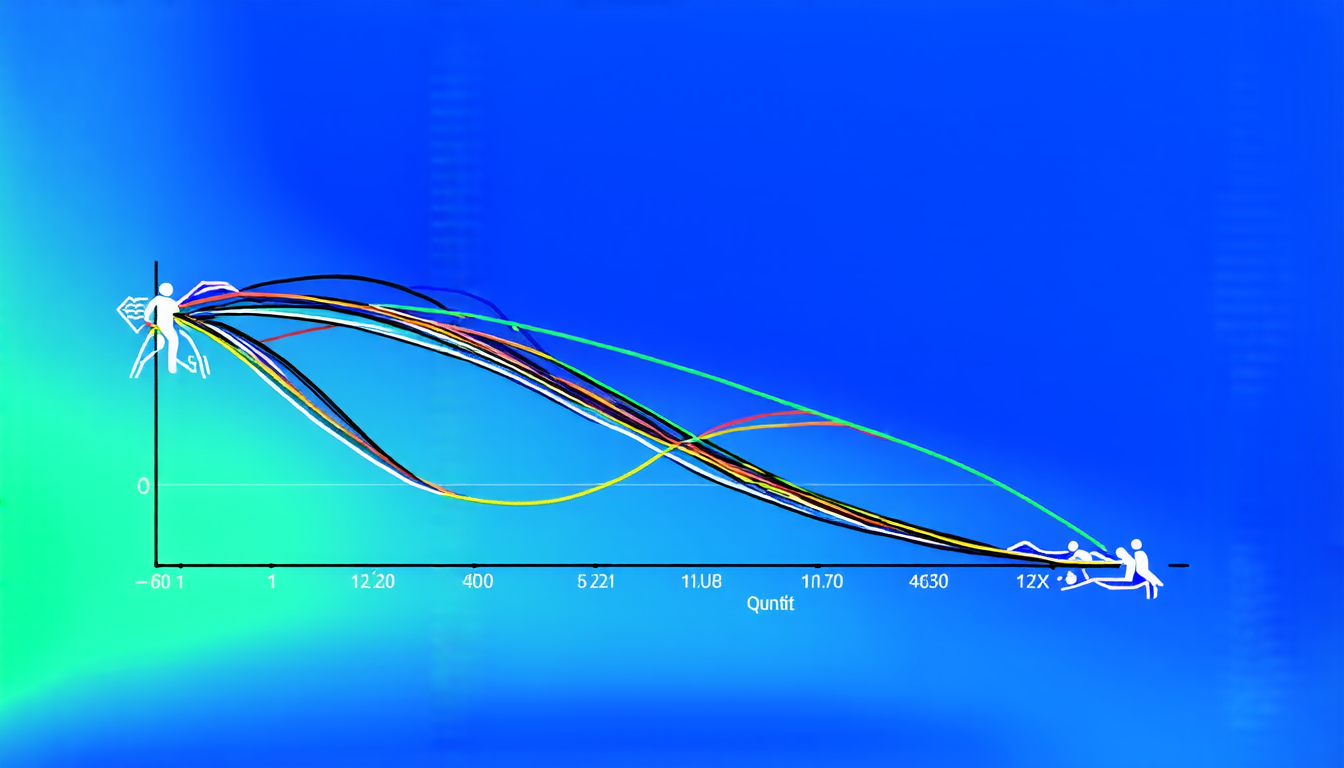
In essence, SQR aims to find a balance between the two extremes of linear regression, which assumes a mean relationship between variables, and quantile regression, which explores the distributional properties of data. By employing spline functions to model the underlying relationships, SQR can capture subtle patterns and non-linearities in the data that might be lost with simpler methods.
The researchers behind this work have developed an algorithm that reformulates the SQR problem as a linear program (LP), which can then be solved using an interior-point method. This approach offers several advantages over traditional optimization techniques, including improved computational efficiency and increased flexibility in handling complex constraints.
One of the key challenges faced by SQR is the need to balance smoothness across different quantile levels. To address this issue, the researchers have developed a novel penalty term that encourages spline functions to vary smoothly over time while still respecting the underlying distributional properties of the data.
The efficacy of SQR was tested using a range of datasets, including synthetic and real-world examples. In each case, the results showed significant improvements in accuracy and robustness compared to traditional regression methods. The authors also explored the use of gradient-based optimization algorithms, such as BFGS, ADAM, and GRAD, which can be used to approximate the SQR solution with less computational overhead.
The implications of this work extend far beyond the realm of academia. As data analysis becomes increasingly critical in fields such as finance, medicine, and environmental science, the need for sophisticated techniques like SQR will only continue to grow. By providing a powerful tool for modeling complex relationships between variables, SQR offers a promising pathway towards more accurate and reliable decision-making.
In practical terms, this means that researchers and practitioners can now leverage the strengths of both linear regression and quantile-based analysis to gain deeper insights into their data. This could lead to breakthroughs in fields such as predictive maintenance, where subtle patterns in sensor data might be used to anticipate equipment failures; or financial forecasting, where SQR could help identify hidden relationships between economic indicators.
As the field of data science continues to evolve, it’s clear that techniques like SQR will play an increasingly important role.
Cite this article: “Spline Quantile Regression: A Promising Technique for Complex Data Analysis”, The Science Archive, 2025.
Data Analysis, Spline Quantile Regression, Linear Programming, Interior-Point Method, Optimization Techniques, Computational Efficiency, Penalty Term, Smoothness, Quantile Regression, Gradient-Based Optimization Algorithms
Reference: Ta-Hsin Li, Nimrod Megiddo, “Spline Quantile Regression” (2025).