

Monday 03 March 2025
Scientists have been studying massive stars, those behemoths of the cosmos that shine bright and burn out quickly, for decades. These stars are fascinating because they can give us clues about how the universe came to be the way it is today. Recently, a team of researchers has made some significant discoveries about how these stars interact with their surroundings.
The study focused on what happens when a massive star runs out of fuel and begins to collapse under its own gravity. This event triggers a massive explosion known as a supernova, which can briefly outshine an entire galaxy. But before the explosion occurs, the star goes through a phase where it sheds its outer layers into space.
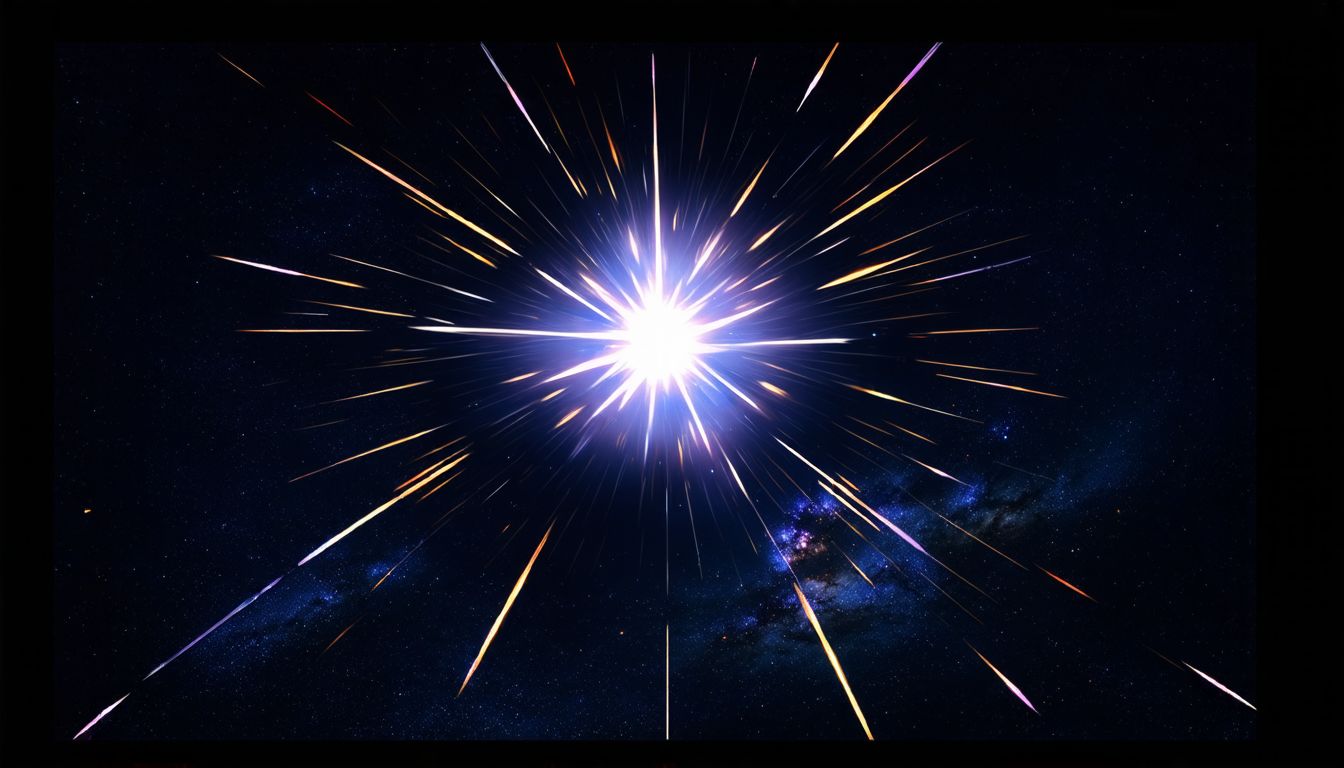
The researchers used computer simulations to model this process, and they found that the star’s outer layers are not just random material being flung off into space. Instead, they form a disk-like structure around the star, which is surrounded by powerful jets of energy shooting out in opposite directions.
These jets are thought to be created by the star’s strong magnetic field, which heats up and accelerates particles as it interacts with the surrounding gas. The jets can travel thousands of light-years, shaping the surrounding environment and potentially influencing the formation of new stars and planets.
The study also suggests that these massive stars may play a more significant role in the formation of black holes than previously thought. Black holes are regions of space where gravity is so strong that not even light can escape once it gets too close. They’re formed when a massive star collapses under its own gravity, but this process usually doesn’t happen if the star has a strong magnetic field.
The researchers believe that the jets created by these stars may be able to strip away the outer layers of the star, allowing the inner core to collapse and form a black hole. This would mean that massive stars are more likely to produce black holes than previously thought, which could have significant implications for our understanding of the universe.
These findings not only shed new light on the lives of massive stars but also offer insights into how the universe evolved over billions of years. The researchers hope to continue studying these stars and their interactions with the environment, which will help us better understand the complex processes that shape the cosmos.
Cite this article: “Massive Stars Final Moments Reveal Secrets of Black Hole Formation”, The Science Archive, 2025.
Massive Stars, Supernovae, Stellar Collapse, Magnetic Fields, Jets Of Energy, Black Holes, Star Formation, Planetary Formation, Galaxy Evolution, Cosmic Environment





