

Monday 03 March 2025
Scientists have made a significant breakthrough in understanding how autonomous robots can adapt and learn in complex environments. Researchers have developed a new theoretical framework that allows them to study decentralized learning processes, where individual agents interact with each other and their environment to optimize their behavior.
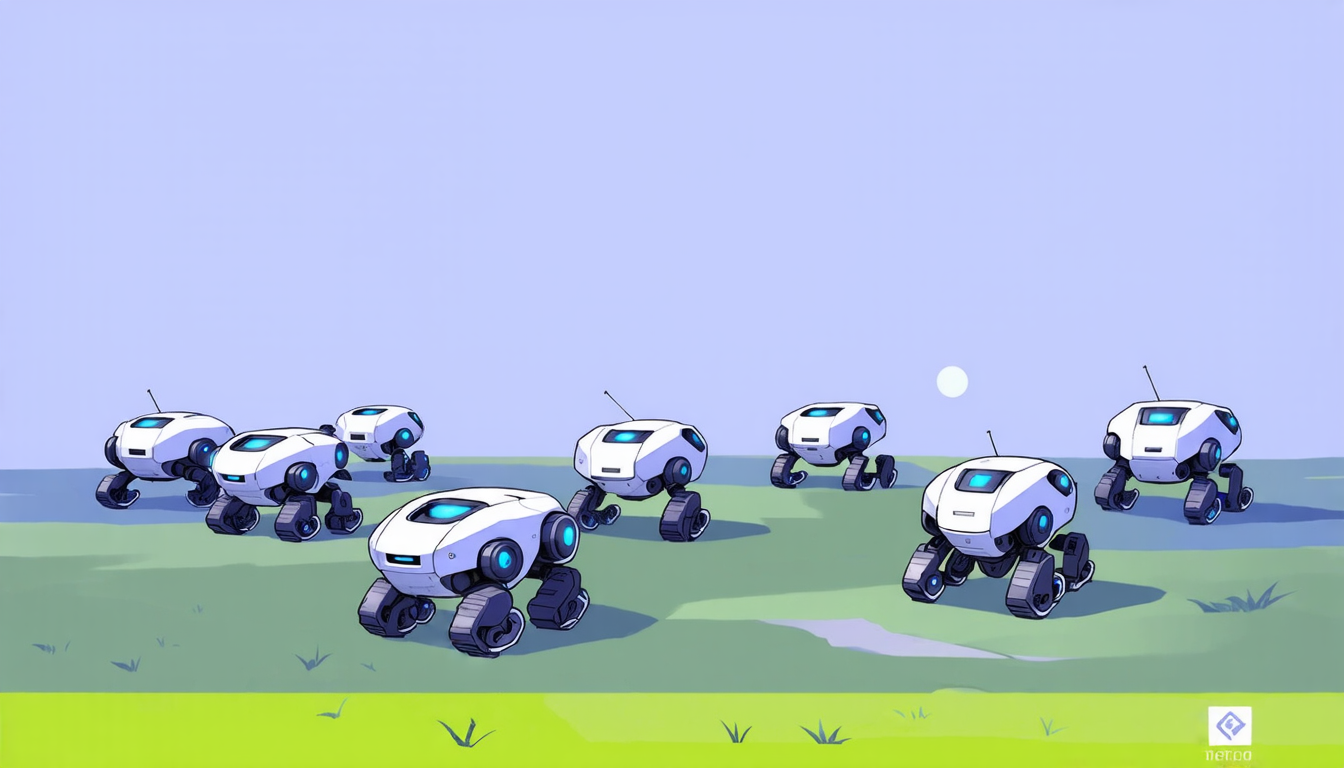
The team used this framework to model two different scenarios: one where robots move around a landscape with varying light intensities, and another where they adjust their speed based on the intensity of an external light source. In both cases, the robots learned to adapt their behavior over time by interacting with each other and their environment.
One of the key findings is that the learning process can be described using hydrodynamic equations, which are typically used to model the behavior of fluids. This allows scientists to understand how the robots’ collective behavior emerges from individual actions, much like how a fluid’s properties arise from the movement of its constituent particles.
The researchers also found that the diversity of the robots’ initial conditions plays a crucial role in shaping their learning process. When the initial conditions are diverse, the robots can explore different parts of the environment and learn more effectively. This is similar to how humans can benefit from interacting with people from different backgrounds, as it exposes them to new ideas and perspectives.
The study’s findings have implications for fields such as robotics, artificial intelligence, and even biology. For example, understanding how decentralized learning processes occur in nature could help scientists develop new theories about animal behavior and social interactions.
The researchers used agent-based simulations to test their theoretical framework, which allowed them to study the robots’ behavior at a large scale while still capturing individual-level details. They also developed a multi-dimensional kinetic theory that can be applied to more complex systems with multiple interacting agents.
Overall, this research has shed new light on how autonomous robots can adapt and learn in complex environments. By understanding these processes, scientists can develop more sophisticated artificial intelligence systems that are capable of learning and adapting in real-world scenarios.
Cite this article: “Decentralized Learning in Autonomous Robots: A Breakthrough in Complex Environments”, The Science Archive, 2025.
Autonomous Robots, Decentralized Learning, Artificial Intelligence, Robotics, Agent-Based Simulations, Kinetic Theory, Complex Environments, Adaptability, Collective Behavior, Machine Learning





