

Monday 03 March 2025
Scientists have long sought to capture the intricate dance of neurons in real-time, but it’s a daunting task. Traditional methods like MRI and EEG can only provide a fuzzy snapshot of brain activity, while more advanced techniques like optogenetics require invasive procedures and limited spatial resolution.
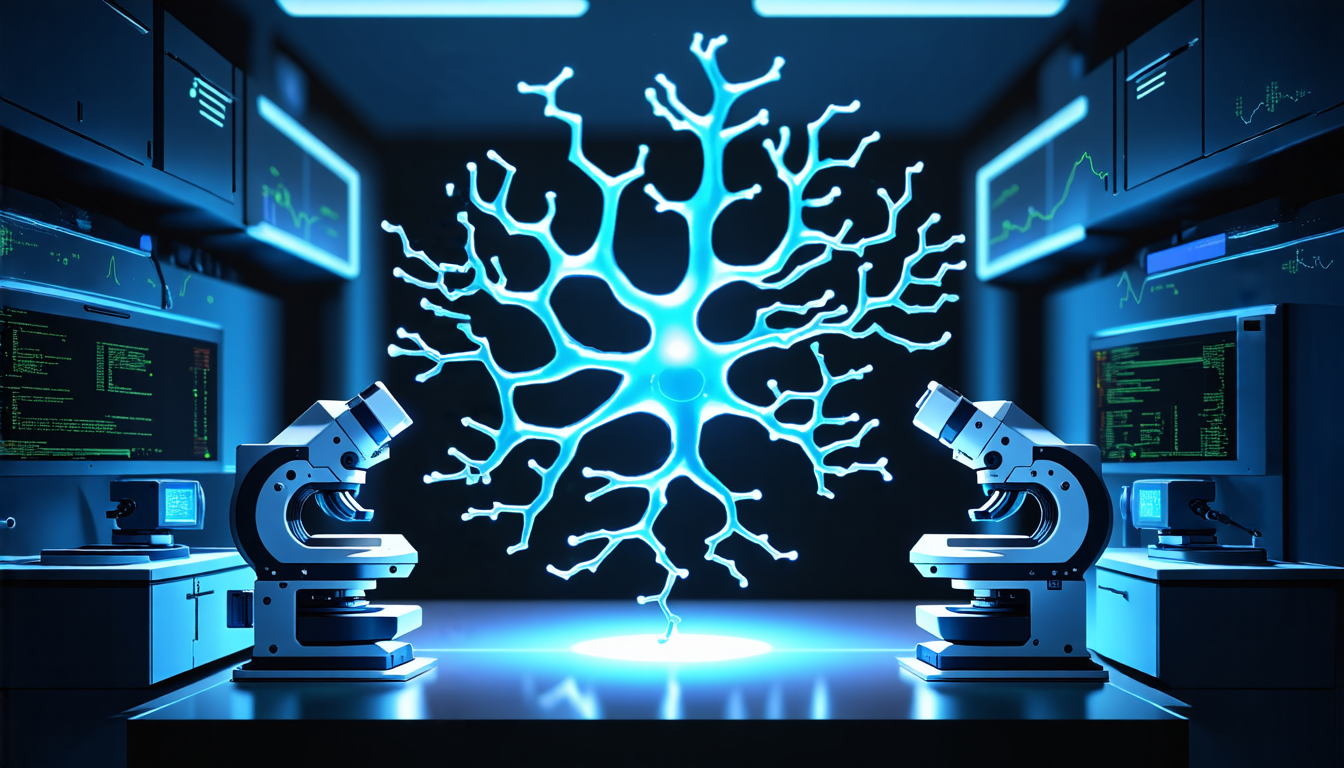
Recently, researchers have been working on developing a new microscopy technique that could revolutionize our understanding of the human brain. This innovative approach uses thermally adaptive surface microscopes to record neural activity with unprecedented speed and precision.
The key innovation is an array of microlenses that can be precisely tuned to focus on specific depths within the brain. By adjusting the temperature of these lenses, scientists can optimize their performance for different wavelengths of light, allowing them to capture high-resolution images of neurons in real-time.
But what does this mean for our understanding of the brain? With this technology, researchers can now observe complex neural networks with unprecedented clarity. They can watch as individual neurons fire off signals, and see how these signals are transmitted across vast distances.
One potential application is in the study of neurological disorders. By monitoring neural activity in real-time, scientists may be able to better understand the underlying causes of conditions like Alzheimer’s and Parkinson’s. This could lead to more targeted treatments that address the specific problems causing these diseases.
Another area where this technology has the potential to make a significant impact is in the field of brain-computer interfaces (BCIs). BCIs are systems that allow people to control devices with their thoughts, but current methods are often slow and unreliable. With the ability to capture high-resolution neural activity in real-time, scientists may be able to develop more sophisticated BCIs that can accurately interpret a person’s intentions.
The development of this technology is also expected to have significant implications for our understanding of consciousness itself. By observing the intricate dance of neurons in real-time, researchers may be able to better understand how our brains generate subjective experience – and what it means to be conscious.
While there are still many challenges to overcome before this technology becomes widely available, the potential benefits are substantial. With its ability to capture high-resolution neural activity in real-time, this innovative microscopy technique has the potential to revolutionize our understanding of the human brain – and open up new avenues for treatment and research.
Cite this article: “Unlocking the Brains Secrets: A New Microscopy Technique Revolutionizes Understanding of Neural Activity”, The Science Archive, 2025.
Brain, Neuroscience, Microscopy, Neurons, Neural Activity, Consciousness, Brain-Computer Interfaces, Alzheimer’S, Parkinson’S, Optogenetics





