

Monday 03 March 2025
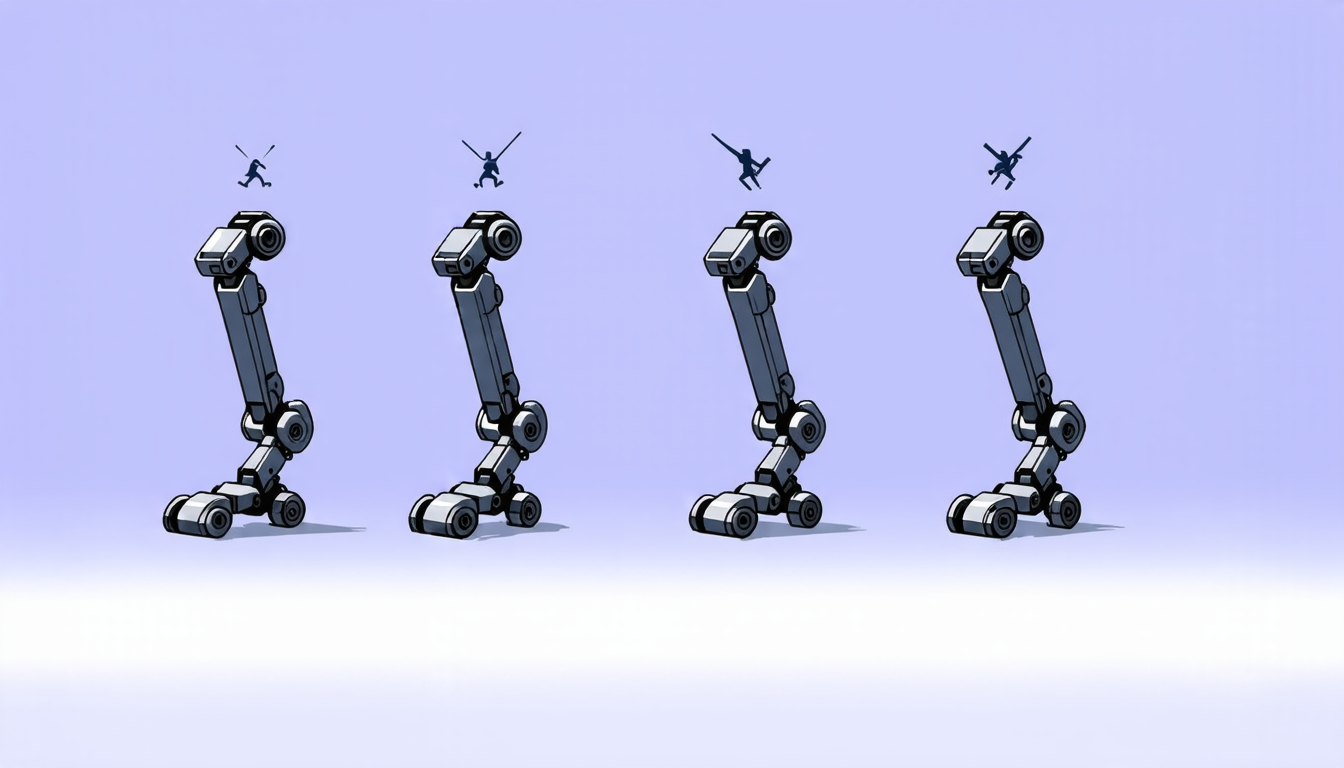
A team of researchers has made a significant breakthrough in understanding the relationship between leg stiffness and speed in legged robots. By analyzing the movement patterns of these machines, they have discovered that adapting leg stiffness to different speeds can lead to more energy-efficient locomotion.
Legged robots are designed to mimic the way humans and animals move, using their legs to propel themselves forward. However, unlike humans, legged robots often struggle with efficiency, consuming a lot of energy to achieve the same speed. This is because they typically use a fixed stiffness in their legs, which can lead to inefficient movement patterns.
To overcome this issue, researchers have been exploring ways to adapt leg stiffness to different speeds. By doing so, the robot can adjust its movement pattern to minimize energy consumption and optimize efficiency. However, designing such systems has proven challenging, as it requires a deep understanding of the complex relationships between leg stiffness, speed, and movement patterns.
The new study aimed to shed light on this issue by analyzing the movement patterns of legged robots at different speeds. The researchers used advanced computer simulations to model the behavior of these machines, allowing them to explore a wide range of scenarios and identify key trends.
Their findings suggest that adapting leg stiffness is crucial for achieving efficient locomotion in legged robots. By adjusting stiffness levels to match different speeds, the robot can optimize its movement pattern and minimize energy consumption. This is particularly important at higher speeds, where inefficient movement patterns can lead to significant energy waste.
The researchers also found that there are optimal stiffness levels for each speed range, beyond which further adjustments do not result in improved efficiency. This knowledge can be used to design more efficient legged robots, potentially leading to significant improvements in their overall performance and endurance.
While the study focused on legged robots, its findings have implications for a broader range of applications. For instance, the principles discovered could be applied to human locomotion, helping us better understand how our bodies adapt to different speeds and environments. The research also has potential applications in fields such as biomechanics, where understanding movement patterns is crucial for designing more efficient prosthetics or orthotics.
Overall, this study represents a significant step forward in understanding the complex relationships between leg stiffness, speed, and movement patterns in legged robots. By shedding light on these interactions, researchers can develop more efficient and effective machines, with potential benefits extending far beyond the world of robotics.
Cite this article: “Adapting Leg Stiffness for Efficient Locomotion in Legged Robots”, The Science Archive, 2025.
Legged Robots, Energy Efficiency, Locomotion, Leg Stiffness, Speed, Movement Patterns, Computer Simulations, Robotics, Biomechanics, Prosthetics





