

Monday 03 March 2025
The quest for a solution to one of mathematics’ most enduring mysteries has taken a significant step forward with the development of an innovative algorithm that calculates the stopping time of numbers in the Collatz sequence.
For those unfamiliar, the Collatz conjecture is a simple yet intriguing problem that poses a seemingly straightforward question: take any positive integer, and if it’s even, divide it by 2; if it’s odd, multiply it by 3 and add 1. Repeat this process indefinitely, and eventually, you’ll reach the number 1. The conjecture states that no matter what starting value you choose, you will always end up at 1.
However, despite its simplicity, the Collatz sequence has been a source of fascination and frustration for mathematicians for over eight decades. While it’s easy to verify the conjecture for small numbers, as the values get larger, the calculations become increasingly complex and time-consuming.
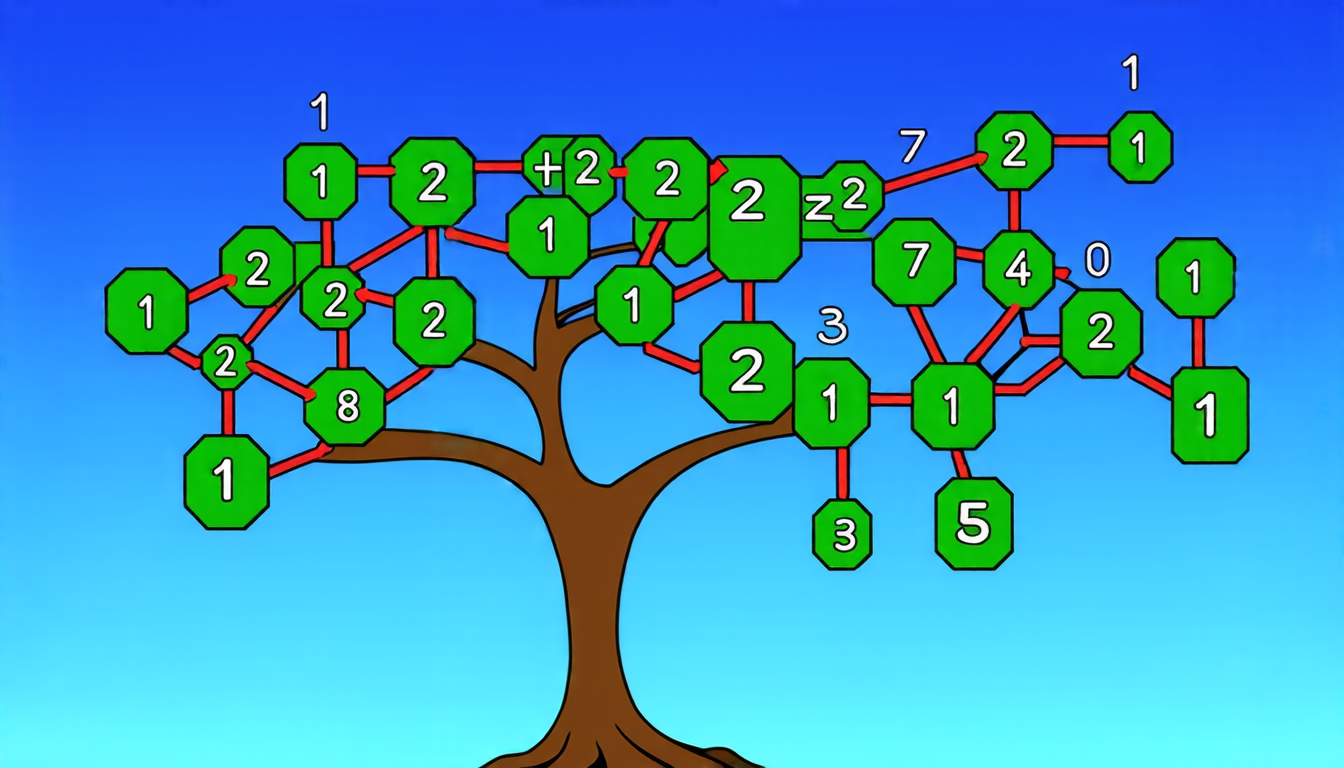
Enter the new algorithm, which utilizes a combination of logical operations and bitwise manipulations to significantly reduce the computational overhead associated with calculating the stopping times. By exploiting patterns in the Collatz tree – a graphical representation of the sequence’s branching structure – the algorithm is able to minimize redundant operations and optimize its processing.
The results are striking: the new algorithm achieves an average improvement of around 28% compared to existing methods, making it significantly faster for large input sizes. This isn’t just a theoretical advantage; the implications are significant, as it opens up the possibility of verifying the conjecture for much larger numbers than previously thought possible.
But what does this mean in practical terms? For one, it could help mathematicians further their understanding of the underlying patterns and structures that govern the Collatz sequence. It may also have applications in other areas of mathematics, such as number theory and cryptography.
Furthermore, the algorithm’s efficiency is not limited to mathematical computations alone. Its ability to process large data sets quickly makes it a potential tool for various scientific and engineering applications, from modeling complex systems to encrypting sensitive information.
As researchers continue to refine and explore the possibilities of this new algorithm, one thing is clear: the quest to solve the Collatz conjecture has taken a significant step forward. And with its potential implications stretching far beyond the realm of pure mathematics, it’s an exciting development that could have far-reaching consequences for many fields of study.
Cite this article: “Breakthrough Algorithm Advances Collatz Conjecture Research”, The Science Archive, 2025.
Mathematics, Collatz Conjecture, Algorithm, Numbers, Sequence, Stopping Time, Bitwise Manipulation, Logical Operations, Cryptography, Number Theory





