

Monday 03 March 2025
The quest for a better way to reconstruct images from sparse data has been a long-standing challenge in medical imaging. Cone-beam computed tomography (CBCT) is a crucial tool for diagnosing and treating cancer, but its ability to capture detailed images of moving tissues is limited by the short duration of each scan.
Researchers have been working on developing more efficient algorithms that can reconstruct high-quality images from these sparse data sets. One approach has been to use machine learning techniques to learn patterns in the data and improve image reconstruction. However, these methods often require large amounts of training data and can be computationally intensive.
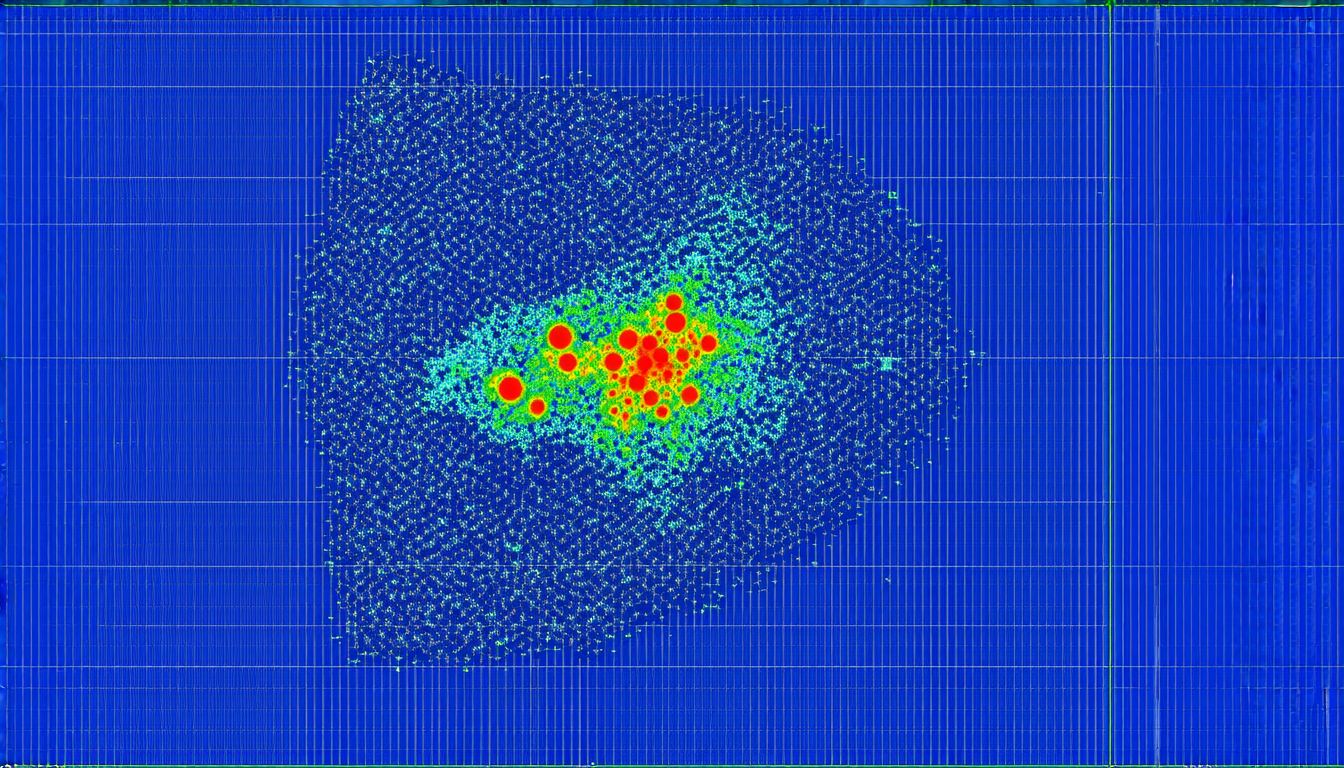
A new study published in a leading medical physics journal presents an innovative solution to this problem. The researchers have developed a novel framework that uses Gaussian point clouds to represent volumetric data. This approach allows for more efficient reconstruction of images from sparse data sets, while also preserving the fine details of the underlying anatomy.
The team’s method begins by representing each voxel (a 3D pixel) as a Gaussian point cloud. These clouds are characterized by their position, covariance, rotation, and density. The researchers then use a deformation network to warp these clouds into a more realistic representation of the patient’s anatomy.
One of the key advantages of this approach is that it allows for more efficient reconstruction of images from sparse data sets. Traditional methods often require solving large systems of linear equations, which can be computationally intensive and may not always produce accurate results. In contrast, the team’s method uses a series of Gaussian point clouds to represent the volumetric data, allowing for faster and more efficient reconstruction.
The researchers tested their method on a range of clinical cases, including patients with lung cancer and breast cancer. The results show that their approach can produce high-quality images from sparse data sets, while also preserving the fine details of the underlying anatomy.
This study has significant implications for the field of medical imaging. It provides a new framework for reconstructing images from sparse data sets, which could be used to improve diagnostic accuracy and reduce radiation exposure for patients. Additionally, this approach could be used to develop more efficient algorithms for other applications in medical imaging, such as MRI and PET scans.
Overall, this study demonstrates the potential of Gaussian point clouds to revolutionize the field of medical imaging. By providing a new framework for reconstructing images from sparse data sets, this approach has the potential to improve diagnostic accuracy and reduce radiation exposure for patients.
Cite this article: “Revolutionizing Medical Imaging with Gaussian Point Clouds”, The Science Archive, 2025.
Medical Imaging, Cone-Beam Computed Tomography, Image Reconstruction, Sparse Data, Machine Learning, Gaussian Point Clouds, Volumetric Data, Deformation Network, Lung Cancer, Breast Cancer





