

Monday 03 March 2025
Scientists have made a significant breakthrough in developing a new type of interferometer that can measure tiny changes in phase, making it an essential tool for various applications including navigation, field sensing, and gravitational wave detection.
The traditional method of measuring phase uses a technique called homodyne detection, where a coherent light beam is split into two beams and then recombined to detect any changes in the phase. However, this method has its limitations as it relies on the intensity of the light beam, which can be affected by various noise sources.
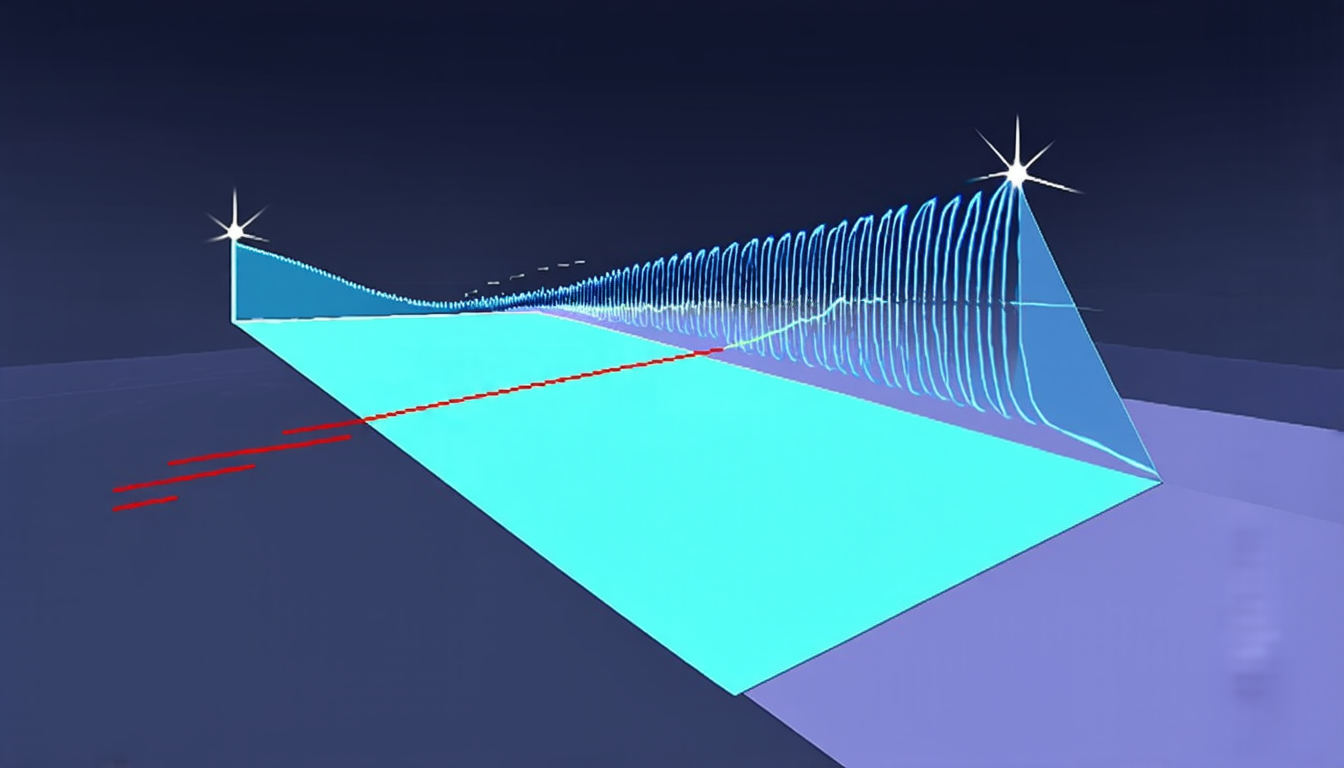
The new interferometer, known as Quantum Twin Interferometer (QTI), uses entangled photons instead of coherent light beams. This allows for more precise measurement of phase changes and reduces the impact of noise sources. The QTI consists of two pairs of entangled twin beams arranged in a parallel configuration, allowing for fully exploitation of the quantum resource.
The key to the QTI’s success lies in its ability to detect tiny changes in phase using the entangled photons. When the phase is changed, the entangled photons become correlated with each other, making it possible to measure the change precisely. The QTI achieves a 3 dB quantum noise reduction in phase-sensing power at the level of milliwatts, which is an improvement of three orders of magnitude over traditional photon-correlated interferometers.
The QTI’s performance was tested experimentally, and the results show that it can accurately detect tiny changes in phase. The device’s sensitivity was found to be 1/3 times better than previously achieved with traditional methods. This demonstrates the potential of the QTI for various applications where precise measurement of phase is crucial.
One of the significant advantages of the QTI is its ability to operate at low power levels, making it suitable for use in a wide range of scenarios. The device’s performance was tested with different power levels, and it was found that the sensitivity remained consistent even when the power level was reduced.
The development of the QTI has far-reaching implications for various fields including navigation, field sensing, and gravitational wave detection. For example, in navigation, the QTI can be used to improve the accuracy of GPS signals by detecting tiny changes in phase. In field sensing, the device can be used to detect subtle changes in magnetic or electric fields.
In addition to its practical applications, the QTI also has the potential to advance our understanding of quantum mechanics and its role in nature.
Cite this article: “Quantum Twin Interferometer Breakthrough: Enhancing Precision in Phase Measurement”, The Science Archive, 2025.
Quantum Twin Interferometer, Entangled Photons, Homodyne Detection, Phase Measurement, Noise Reduction, Quantum Noise, Interferometry, Gravitational Wave Detection, Navigation, Field Sensing.





