

Monday 03 March 2025
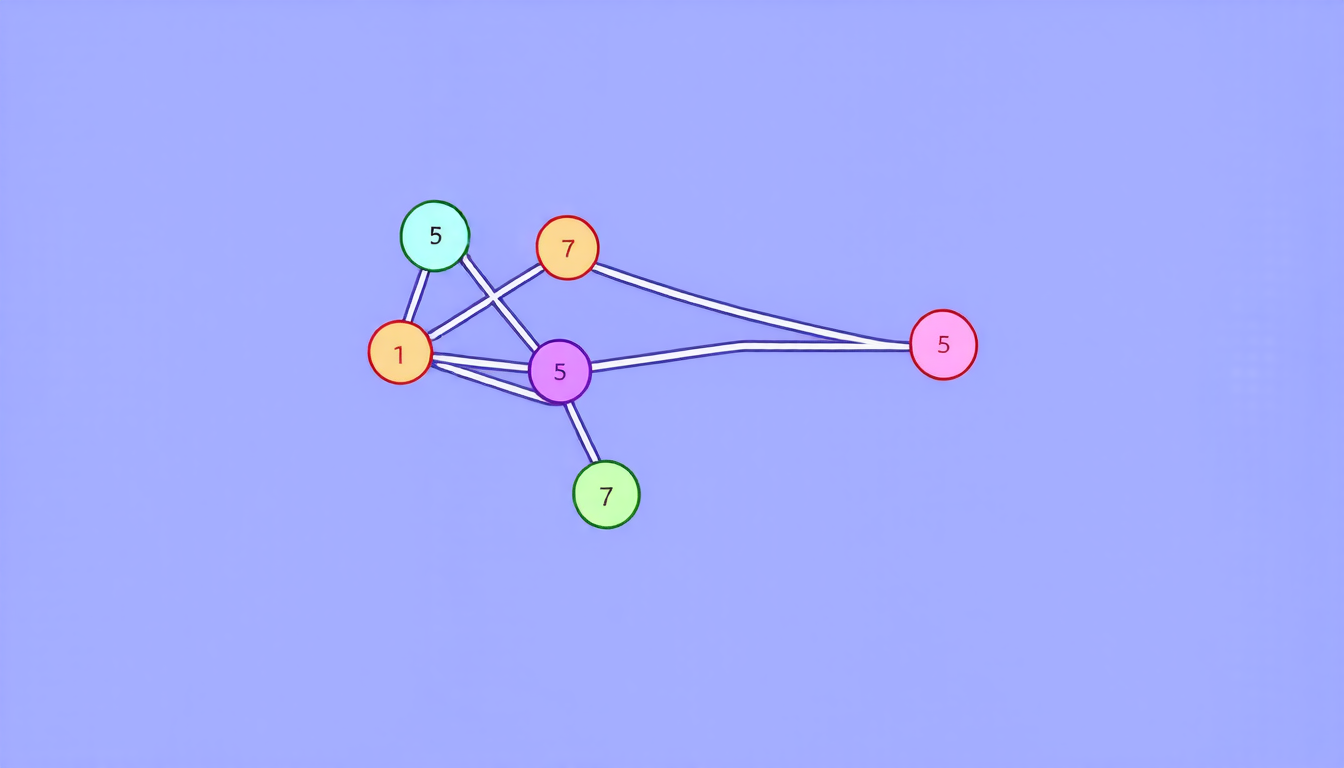
A team of mathematicians has made a significant breakthrough in understanding the properties of graphs, which are visual representations of relationships between objects. Graph theory is a fundamental area of mathematics that has numerous applications in computer science, biology, and other fields.
The researchers have discovered new families of graphs that can achieve only two distinct eigenvalues, a phenomenon previously thought to be rare or even impossible. An eigenvalue is a number that describes the behavior of a matrix, which is a mathematical object used to represent relationships between variables.
In graph theory, eigenvalues are crucial in understanding the structure and properties of a graph. For instance, knowing the eigenvalues of a graph can help identify its connectedness, symmetry, or even its distance from other graphs. However, not all graphs have distinct eigenvalues, which has made it challenging to study their properties.
The mathematicians used a combination of mathematical techniques, including tensor products and strong graph products, to construct new families of graphs that exhibit this unique property. These constructions allowed them to partition the edge set of the graph into smaller pieces, each with its own distinct eigenvalue pattern.
One of the key findings is that certain types of regular graphs, which have a fixed degree at every vertex, can achieve two distinct eigenvalues when combined with specific clique structures. Cliques are subgraphs where every pair of vertices is connected by an edge.
The researchers also explored the relationship between graph theory and other areas of mathematics, such as linear algebra and combinatorics. They showed that their constructions can be used to create new matrices with specific properties, which has implications for various fields, including computer science and biology.
This breakthrough has significant potential applications in various fields where graph theory is used. For instance, it could help improve the design of complex networks, such as transportation systems or social media platforms, by allowing researchers to better understand their structural properties.
The discovery also sheds new light on the fundamental nature of graphs and their eigenvalues, which can have far-reaching implications for our understanding of mathematical structures. As researchers continue to explore this area, they may uncover even more surprising properties and applications of graph theory.
Cite this article: “Graph Theory Breakthrough: New Families of Graphs with Unique Eigenvalue Properties”, The Science Archive, 2025.
Graph Theory, Eigenvalues, Matrix, Computer Science, Biology, Linear Algebra, Combinatorics, Tensor Products, Strong Graph Products, Clique Structures
Reference: Eric Culver, Mark Kempton, “Two Distinct Eigenvalues from a New Graph Product” (2025).





