

Tuesday 04 March 2025
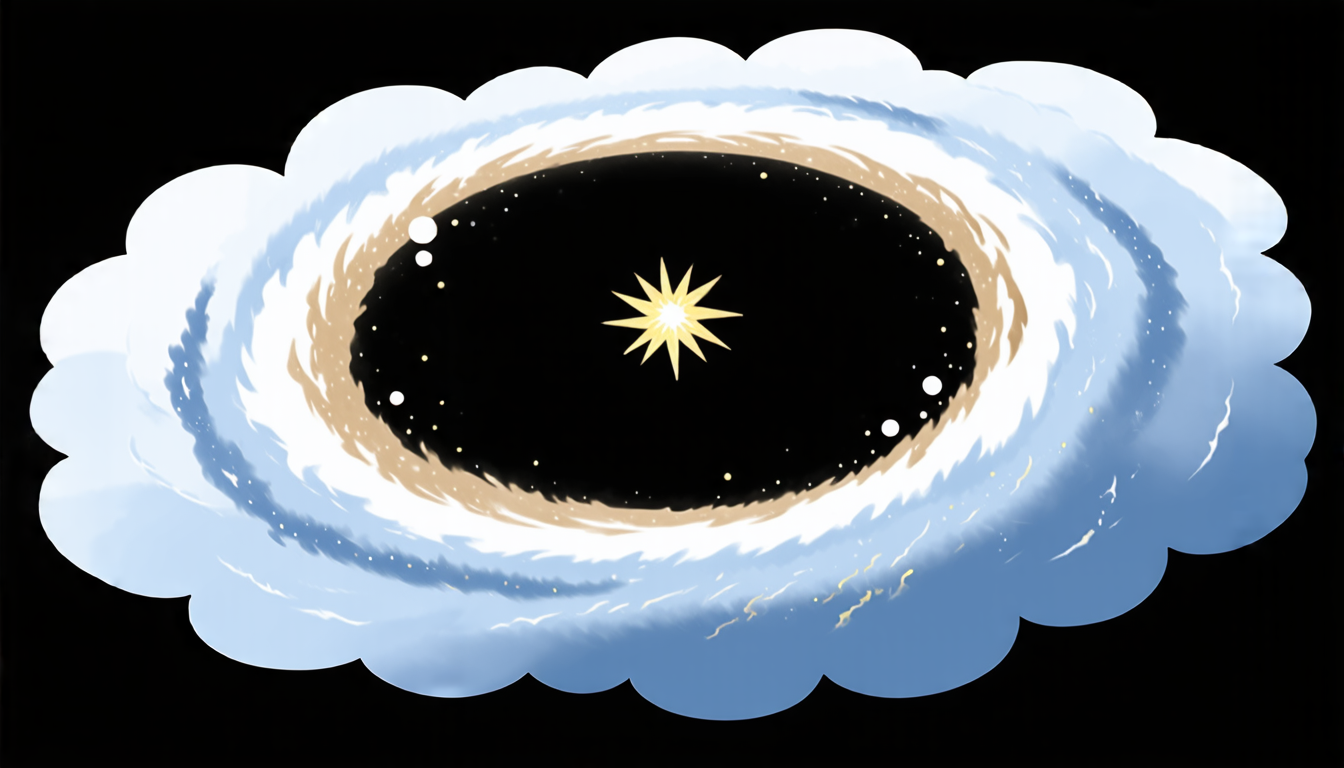
A team of astronomers has been studying the evolution of protoplanetary discs, which are swirling clouds of gas and dust that surround newly formed stars. These discs are thought to be the building blocks of planets, and understanding how they form and change over time is crucial for unlocking the secrets of planetary formation.
The researchers used a combination of observations and computer simulations to study the evolution of these discs. They found that the discs undergo significant changes as they grow and mature, with gas and dust being swept up into the center of the disc and forming a dense, hot core.
One of the key findings of the study is that the rate at which gas and dust are accreted onto the central star can have a significant impact on the final mass of the planet. The researchers found that if too much gas and dust are accreted, the planet can become too massive and may not be able to support its own weight.
The team also found that the rate at which gas and dust are lost from the disc through processes such as photoevaporation and viscous evolution can have a significant impact on the final mass of the planet. They found that if too much gas and dust are lost, the planet may not be able to form at all.
The study provides new insights into the complex process of planetary formation, and highlights the importance of considering both the rate of accretion and the rate of loss when trying to understand how planets form.
In the early stages of a star’s life, it is surrounded by a swirling cloud of gas and dust known as a protoplanetary disc. This disc is thought to be the building block of planets, with gas and dust gradually accumulating in the center of the disc and forming a dense, hot core.
Over time, the disc undergoes significant changes as it grows and matures. Gas and dust are swept up into the center of the disc, where they form a dense, hot core that eventually becomes the star itself. At the same time, gas and dust are lost from the disc through processes such as photoevaporation and viscous evolution.
The rate at which gas and dust are accreted onto the central star can have a significant impact on the final mass of the planet. If too much gas and dust are accreted, the planet can become too massive and may not be able to support its own weight.
Cite this article: “The Evolution of Protoplanetary Discs: Key Factors in Planetary Formation”, The Science Archive, 2025.
Protoplanetary Discs, Planetary Formation, Star Formation, Gas And Dust, Accretion, Planet Mass, Photoevaporation, Viscous Evolution, Planetary Growth, Planetary Development





