

Tuesday 04 March 2025
The quest for more effective human-robot collaboration has led researchers to develop a novel feedback mechanism that aligns human teaching methods with robot learning behaviors. The Mental Model Mismatch (MMM) Score, introduced in a recent study, significantly improves teaching performance and reduces misunderstandings between humans and robots.
In traditional teaching scenarios, humans often project their own experiences and perceptions onto the system, resulting in mental models that may not accurately reflect how the system functions. This mismatch can lead to ineffective teaching methods and hinder the learning process. The MMM Score addresses this issue by providing a quantitative measure of the discrepancy between human intentions and robot learning outcomes.
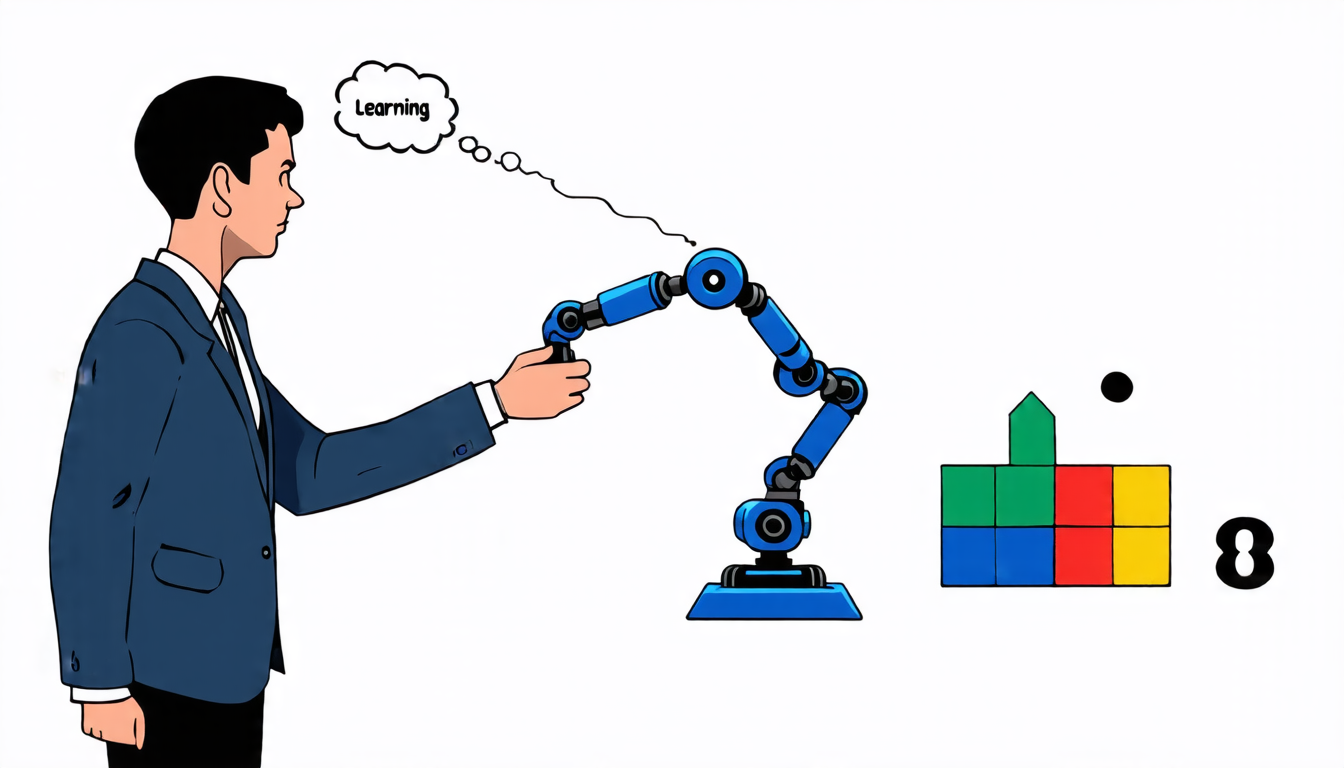
The study employed a virtual robot arm to test the effectiveness of the MMM Score. Participants were asked to teach the robot to solve a puzzle game, with some receiving traditional performance-based feedback and others receiving intention-based feedback through the MMM Score. The results showed that participants who received intention-based feedback outperformed those in the control group by a significant margin.
The MMM Score’s ability to reduce mental model mismatch is attributed to its capacity to provide adaptive feedback that aligns human teaching behavior with robot learning behavior. By highlighting the gap between intended and actual outcomes, the score encourages humans to adjust their teaching strategies and better understand how the robot learns.
This advancement has significant implications for various domains where human-robot collaboration is crucial, such as healthcare, education, and industrial production. By improving teaching efficiency and reducing misunderstandings, the MMM Score can lead to more accurate and effective learning outcomes.
The study’s findings also underscore the importance of transparency in human-robot interaction. Participants who received intention-based feedback reported a better understanding of the robot’s learning process, highlighting the need for clear and concise communication between humans and robots.
While the MMM Score shows promise in improving human-robot collaboration, its long-term impact on teaching strategies and user satisfaction remains to be seen. Future research should investigate the scalability and adaptability of this mechanism in diverse real-world scenarios.
The development of the MMM Score represents a significant step towards more effective human-robot interaction. By addressing mental model mismatch and providing adaptive feedback, researchers have created a foundation for improving the accuracy and efficiency of robot learning. As AI systems become increasingly integrated into our daily lives, the need for seamless human-machine collaboration will only continue to grow, making innovations like the MMM Score crucial for shaping the future of work and technology.
Cite this article: “Aligning Human Teaching with Robot Learning through Mental Model Mismatch Scores”, The Science Archive, 2025.
Human-Robot Collaboration, Feedback Mechanism, Mental Model Mismatch, Intention-Based Feedback, Robot Learning, Teaching Performance, Misunderstandings, Human-Machine Interaction, Ai Systems, Transparency.





