

Tuesday 04 March 2025
Physicists have made a significant breakthrough in their quest to understand the properties of subatomic particles, specifically the decay of D+ mesons into electrons and neutrinos. The discovery is a major milestone in the field, shedding new light on the fundamental forces that govern the universe.
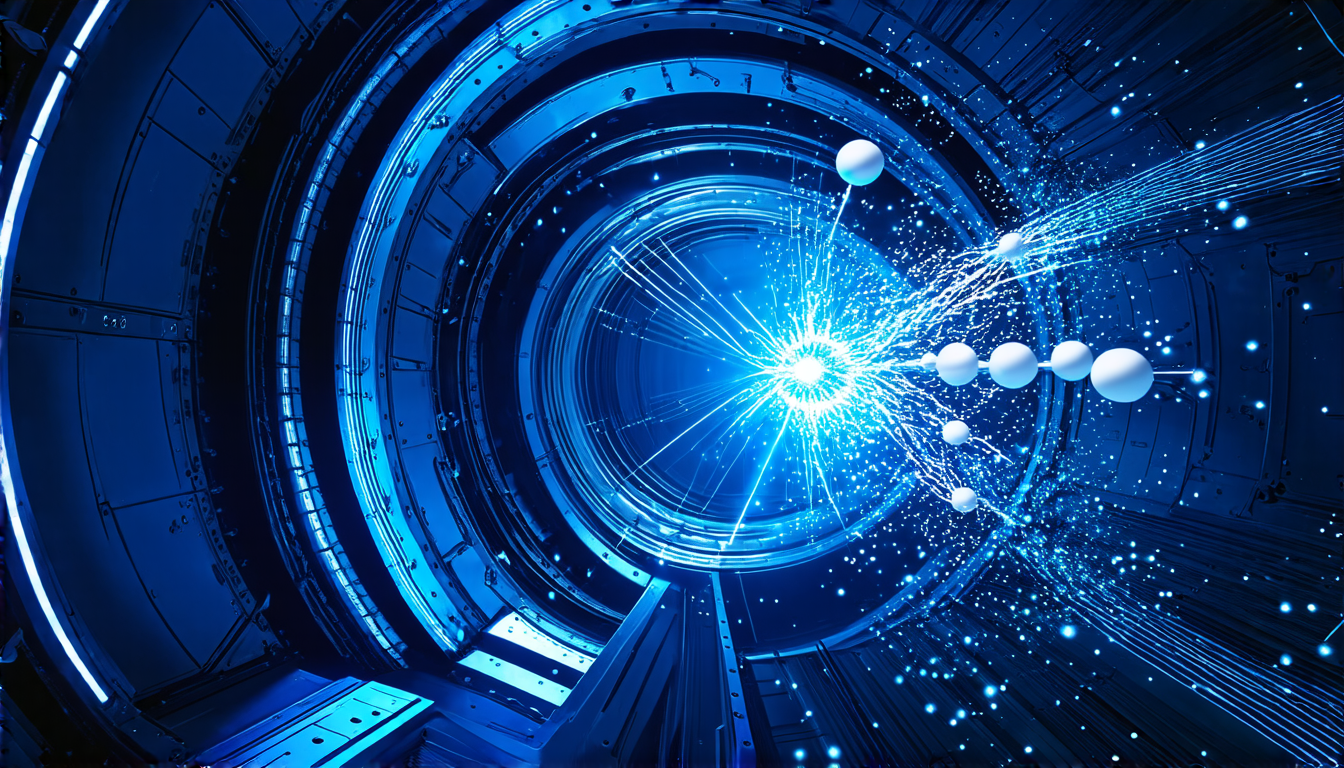
The research was conducted by scientists at the Beijing Electron Positron Collider (BESIII), who used powerful particle accelerators to create high-energy collisions between positrons and electrons. By analyzing the decay patterns of D+ mesons produced in these collisions, researchers were able to gather valuable insights into the properties of these particles.
The D+ meson is a type of subatomic particle that consists of one charm quark and one up antiquark. It’s a fleeting entity that exists for only a fraction of a second before decaying into other particles. In this case, the researchers were specifically interested in the decay mode where the D+ meson breaks down into an electron, a neutrino, and a photon.
By studying this decay process, physicists can gain valuable information about the forces that govern particle interactions. The research team used sophisticated algorithms to analyze the data, which revealed intriguing patterns and correlations between the particles involved.
One of the key findings is the measurement of the branching fraction – or probability – of the D+ meson decaying into an electron and a neutrino. This value is crucial for understanding the fundamental forces that govern particle interactions and has important implications for our understanding of the universe.
The results are significant not only because they provide new insights into the properties of subatomic particles but also because they pave the way for further research in this area. By continuing to study the decay patterns of D+ mesons, physicists can gain a deeper understanding of the fundamental forces that shape our universe.
The discovery is also a testament to the power of particle accelerators and the cutting-edge technology used by scientists at BESIII. The facility’s state-of-the-art detectors and sophisticated algorithms have enabled researchers to make precise measurements of particle decays with unprecedented accuracy.
As physicists continue to push the boundaries of human knowledge, discoveries like this one will remain essential for advancing our understanding of the universe and its many mysteries.
Cite this article: “Physicists Uncover New Insights into Fundamental Forces with D+ Meson Decay Breakthrough”, The Science Archive, 2025.
Particle Physics, Subatomic Particles, D+ Meson, Decay Patterns, Electron Neutrino Photon, Branching Fraction, Fundamental Forces, Particle Interactions, Beijing Electron Positron Collider, Besiii





