

Tuesday 04 March 2025
Scientists have made a significant breakthrough in detecting anomalies in industrial machinery, a crucial step towards preventing costly equipment failures and ensuring worker safety.
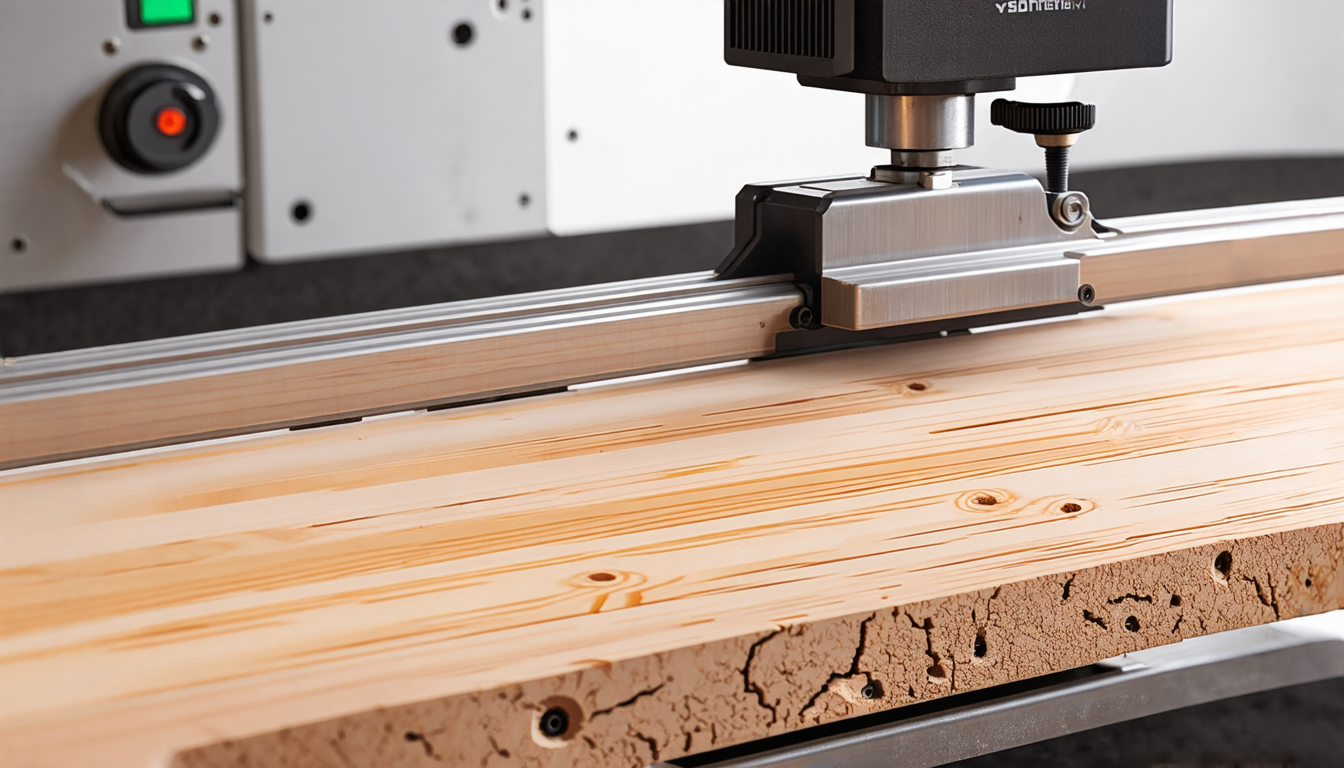
The team behind this development used machine learning algorithms to analyze audio signals from an industrial wood planer, identifying patterns that indicate when something is amiss. This approach allows for early detection of problems before they cause harm or downtime.
The researchers created two neural network models inspired by a convolutional autoencoder (CAE) introduced earlier. The first model, Skip-CAE, incorporates skip connections to improve its learning capabilities. The second model, Skip-CAE-Transformer, adds transformer encode and decode layers for better performance.
To test these models, the team built a new dataset of real-life audio recordings from an industrial wood planer, including 105 anomalies corresponding to stuck boards, broken boards, and uneven or thick boards. They compared their models with existing approaches such as one-class SVM, isolation forest, and a traditional autoencoder used in the DCASE challenge.
The results were impressive: the Skip-CAE-Transformer outperformed all other models, achieving an area under the receiver operating characteristic curve (AUC) of 0.875. This means that it accurately detected anomalies with minimal false positives.
Breaking down the results by anomaly type reveals that the Skip-CAE-Transformer excelled at detecting stuck boards and uneven or thick wood. This is significant because these types of anomalies can have a major impact on production and worker safety.
The success of this approach has implications for industries beyond wood processing, such as manufacturing and construction, where predictive maintenance and anomaly detection are crucial. By leveraging machine learning algorithms to analyze audio signals, manufacturers can reduce downtime, extend equipment lifespan, and ensure safer working conditions.
Furthermore, the development of these models demonstrates the potential for acoustic anomaly detection in noisy factory environments. This is a significant achievement, as many industrial machines operate in challenging acoustic conditions that make it difficult to detect anomalies using traditional methods.
The next step for this research will be to integrate these models into real-world production environments, where they can be used to monitor machinery and alert operators to potential problems before they occur. With the potential to prevent costly equipment failures and improve worker safety, this technology has significant practical applications that could benefit industries worldwide.
Cite this article: “Advanced Machine Learning Model Detects Anomalies in Industrial Machinery”, The Science Archive, 2025.
Industrial, Machine Learning, Anomaly Detection, Industrial Machinery, Acoustic Signals, Predictive Maintenance, Worker Safety, Equipment Failure, Convolutional Autoencoder, Transformer Encode/Decode Layers.





