

Tuesday 04 March 2025
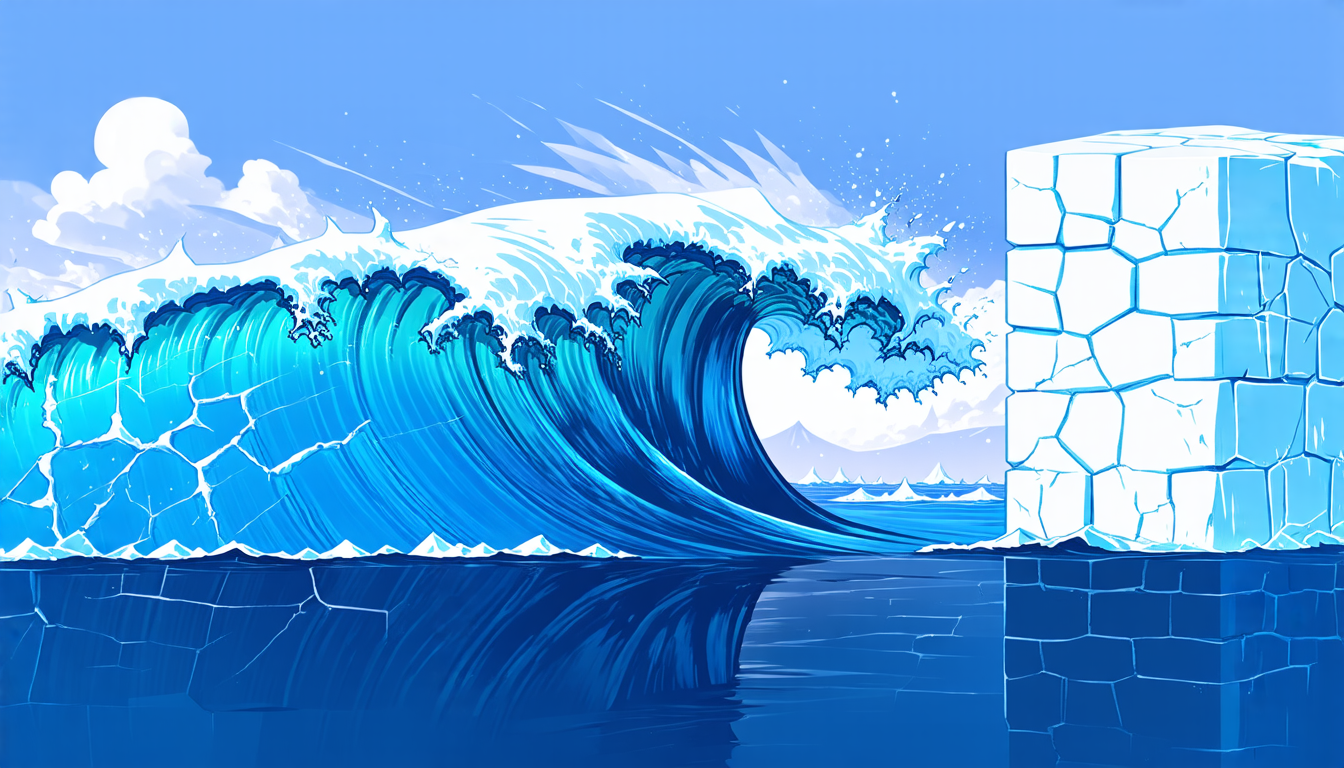
Scientists have made a significant breakthrough in understanding how brittle materials, like sea ice, fracture under stress. By mimicking the conditions of the ocean’s surface, researchers have discovered that the breaking point of these materials depends on the shape and size of the waves that hit them.
The study, published recently in a scientific journal, involved creating a thin layer of a brittle material – similar to varnish – floating on water. The team then used gravity waves to test its strength, measuring how it responded to different wave patterns and sizes.
One key finding was that the material fractured more easily when subjected to bending stresses, rather than tensile forces. This is important because sea ice, for example, is often broken by ocean swells, which create a bending motion as they roll over the surface.
The researchers also discovered that the breaking point of the material depended on the wavelength of the waves hitting it. In other words, shorter waves were more likely to cause the material to fracture than longer ones.
These findings have significant implications for our understanding of how sea ice breaks and behaves in response to ocean currents and weather patterns. Currently, many climate models assume that sea ice fractures when a certain stress threshold is reached, but this study suggests that the situation may be more complex.
The research team’s observations are consistent with an energy-based theory of fracture, which proposes that materials break when the energy released by cracking exceeds the energy required to create new surfaces. In other words, the material can absorb some amount of stress before it reaches a point where it becomes energetically more favorable for it to crack.
The study’s authors suggest that their findings could be used to improve climate models and better predict how sea ice will behave in response to changing environmental conditions. By understanding how brittle materials fracture under different wave patterns, scientists may be able to better forecast the impacts of climate change on polar regions.
The research is a testament to the power of laboratory experiments in shedding light on complex natural phenomena. By recreating the conditions found in the ocean and testing the strength of brittle materials, scientists can gain valuable insights into how these materials behave under stress.
In the future, this research could have practical applications for industries such as offshore engineering and environmental monitoring. For example, a better understanding of how sea ice breaks could help inform the design of oil rigs and other infrastructure in polar regions.
The study’s findings also highlight the importance of considering the complex interactions between ocean currents, weather patterns, and the behavior of brittle materials like sea ice.
Cite this article: “Breaking Point: Scientists Discover How Brittle Materials Fracture Under Stress”, The Science Archive, 2025.
Sea Ice, Fracture, Waves, Stress, Brittle Materials, Ocean Currents, Climate Models, Energy-Based Theory, Laboratory Experiments, Offshore Engineering





