

Tuesday 04 March 2025
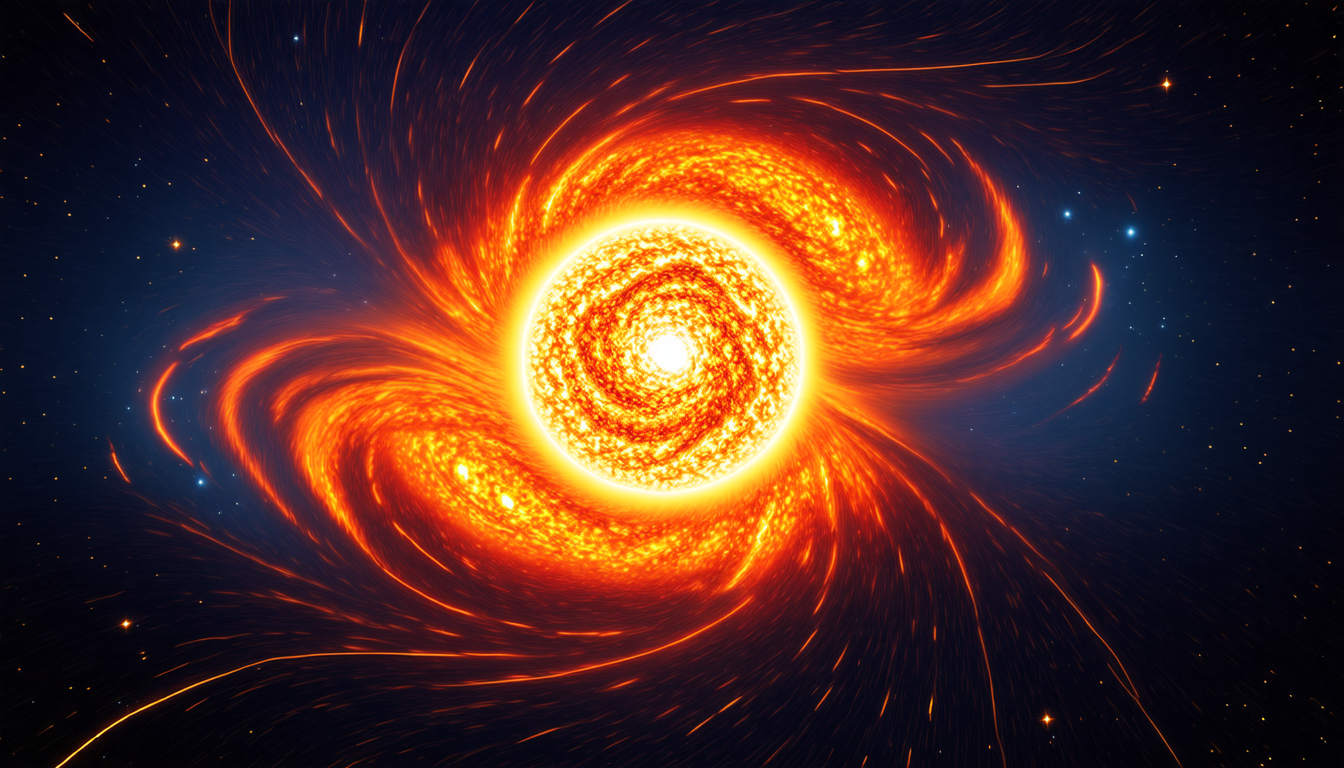
The sun’s magnetic field is a mysterious and complex phenomenon that has long fascinated scientists. For decades, researchers have sought to understand its intricacies, driven by the desire to better predict solar activity and its impact on our planet.
One of the most enduring enigmas surrounding the sun’s magnetic field is its ability to produce harmonics – specific patterns of energy that emerge from the turbulent convective zone beneath the surface. These harmonics are crucial for understanding the dynamics of the sun, as they influence everything from the formation of sunspots to the acceleration of solar winds.
Recently, researchers have made significant strides in unraveling the secrets of these harmonics. By analyzing data from NASA’s Solar Dynamics Observatory and the Wilcox Solar Observatory at Stanford University, scientists have identified a previously unknown type of harmonic that arises from the interaction between different modes of magnetic energy.
This new harmonic, known as tesseral, is characterized by a specific set of spatial and temporal patterns that are distinct from other types of solar activity. Tesseral harmonics are thought to play a key role in shaping the sun’s magnetic field, particularly during periods of low solar activity when the overall magnetic field is weaker.
One of the most striking features of tesseral harmonics is their ability to influence the formation of sunspots – dark regions on the sun’s surface where intense magnetic fields converge. By analyzing data from the Solar and Heliospheric Observatory (SOHO), researchers have found that tesseral harmonics can either enhance or suppress sunspot activity, depending on the specific conditions.
This finding has significant implications for our understanding of solar activity and its impact on Earth. Sunspots are a primary driver of space weather, which can disrupt satellite communications, damage electrical grids, and even pose a hazard to astronauts.
The discovery of tesseral harmonics also offers new insights into the dynamics of the sun’s convective zone – the region beneath the surface where energy is generated through the movement of hot, ionized gas. By studying these harmonics, scientists can gain a deeper understanding of how magnetic fields interact with convective flows to produce solar activity.
As researchers continue to unravel the mysteries of tesseral harmonics, they are uncovering new avenues for predicting and modeling solar activity. This knowledge has far-reaching implications for our ability to anticipate and prepare for space weather events, ultimately helping to protect both human populations and technological infrastructure from the sun’s fury.
Cite this article: “Unveiling the Secrets of the Suns Magnetic Field: The Discovery of Tesseral Harmonics”, The Science Archive, 2025.
Sun, Magnetic Field, Solar Activity, Harmonics, Nasa, Solar Dynamics Observatory, Wilcox Solar Observatory, Stanford University, Space Weather, Sunspots





