

Tuesday 04 March 2025
For autonomous vehicles to become a reality, they need to be able to navigate complex real-world environments and recognize objects in various settings. One major challenge is adapting to new domains, where the data used for training may differ significantly from what the vehicle encounters on the road.
Researchers have been working on developing synthetic datasets that can help bridge this gap. These datasets are designed to mimic real-world scenarios, but are generated using computer simulations or games. The idea is that by training a model on these simulated environments, it will be better equipped to handle novel situations and adapt more quickly when faced with new data.
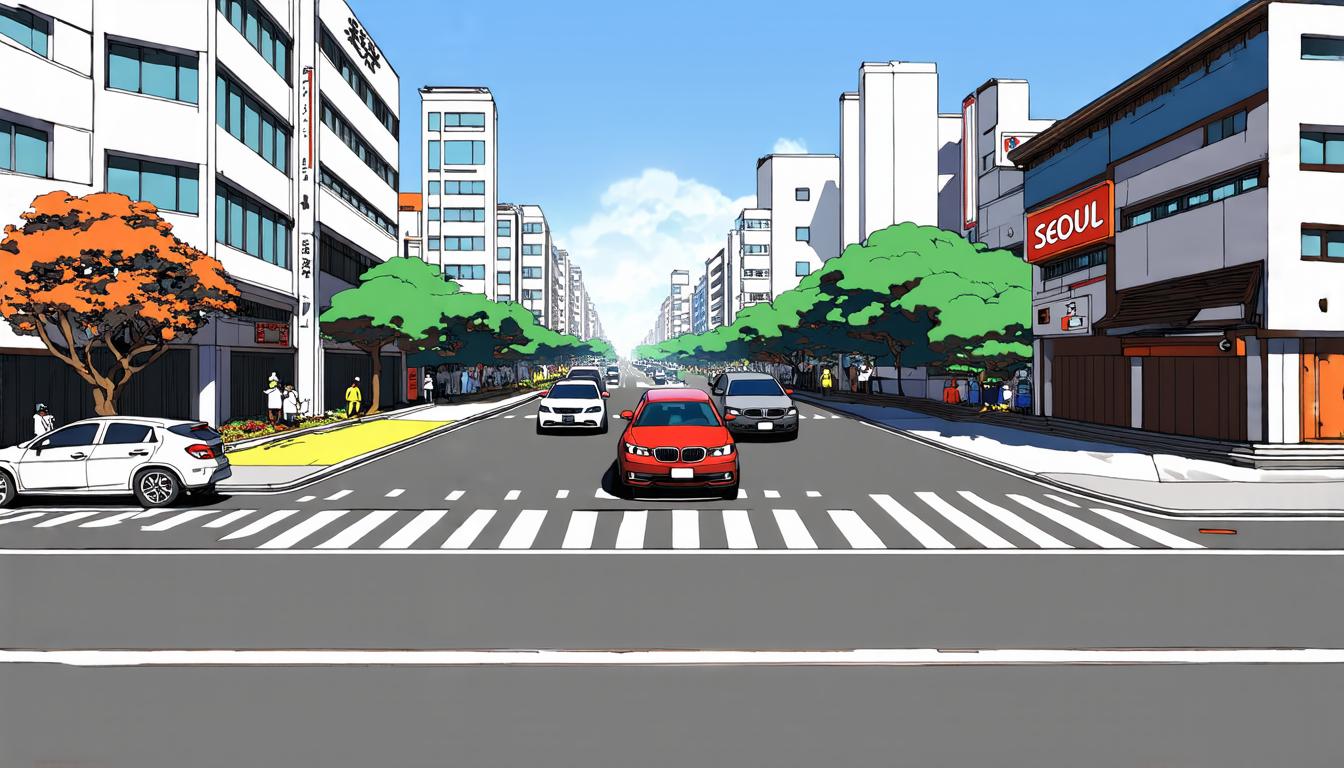
A recent paper proposes a new approach to synthetic dataset generation, one that focuses specifically on the problem of domain adaptation for object detection in autonomous vehicles. The authors introduce MORDA, a dataset designed to simulate real-world driving scenarios in South Korea, where digital twin maps are used to create a realistic virtual environment.
MORDA is generated by combining two sources: nuScenes, a widely-used dataset for autonomous vehicle perception, and AI-Hub, a dataset collected from real-world driving in South Korea. The authors use a combination of camera and lidar data to create a rich and diverse simulation, including images from multiple views, point clouds, and 3D bounding boxes.
The results are impressive: MORDA is able to significantly improve the performance of object detection models on unseen real-world data. In one experiment, a model trained on nuScenes alone achieved an mAP (mean average precision) of 27.3%, while the same model trained on nuScenes plus MORDA achieved an mAP of 27.8%. This may not seem like a huge difference, but it’s a significant improvement in domain adaptation.
The authors also tested MORDA against other synthetic datasets, including Virtual KITTI and SHIFT. While these datasets are also designed for object detection, they don’t quite match the level of realism and diversity achieved by MORDA.
One of the key advantages of MORDA is its ability to simulate real-world scenarios in a way that’s specific to South Korea. This means that autonomous vehicles trained on MORDA will be better equipped to handle the unique challenges of driving in Seoul or Busan, such as narrow streets and complex intersections.
The implications of this research are significant for the development of autonomous vehicles. By providing a more realistic and diverse synthetic dataset, researchers can train models that are better prepared to adapt to new environments and scenarios.
Cite this article: “Synthetic Dataset Generation for Autonomous Vehicle Domain Adaptation”, The Science Archive, 2025.
Autonomous Vehicles, Object Detection, Domain Adaptation, Synthetic Datasets, Computer Simulations, Games, South Korea, Digital Twin Maps, Nuscenes, Ai-Hub.





