

Tuesday 04 March 2025
As software developers struggle to keep up with the demands of modern technology, a new challenge has emerged: flaky job failures. These mysterious errors occur when automated testing and deployment processes fail unexpectedly, leaving developers scratching their heads and wondering what went wrong.
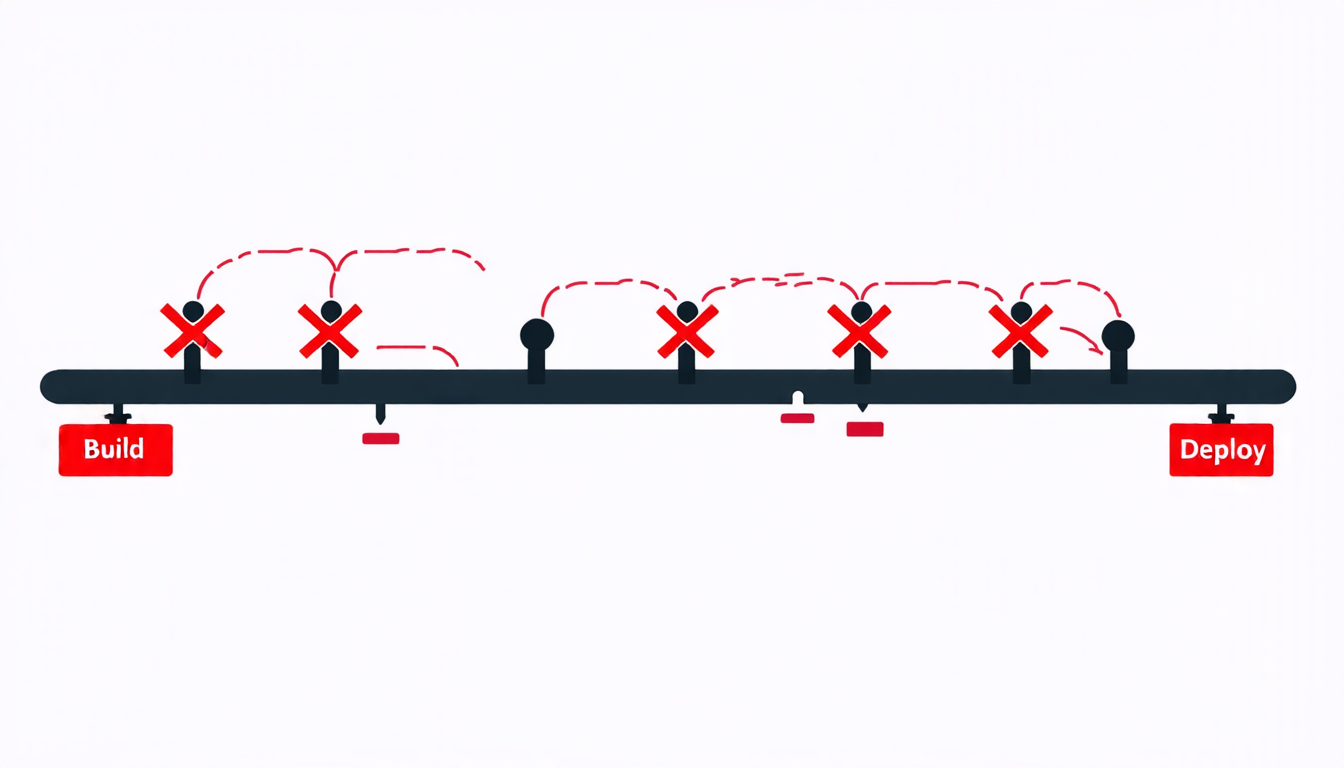
The problem is particularly prevalent in Continuous Integration/Continuous Deployment (CI/CD) pipelines, where code changes are automatically built, tested, and deployed to production environments. Flaky job failures can cause delays, wasted resources, and even affect the overall quality of software releases.
To tackle this issue, researchers have developed a novel approach to identify and prioritize flaky failure categories. By analyzing data from thousands of job logs at TELUS, a telecommunications company, they’ve uncovered 46 distinct categories of flaky failures, each with its own unique characteristics.
The study reveals that recency, frequency, and monetary cost are all important factors in determining the priority of flaky failures. For instance, failures that occur frequently may be more critical than those that happen infrequently, even if they’re less costly to fix. Similarly, failures that have a high monetary impact on the company’s bottom line should take precedence over those with lower costs.
To identify the most critical categories, the researchers employed an RFM (Recency, Frequency, Monetary) clustering model. This approach groups similar failure patterns together based on their R-F-M scores, allowing developers to focus on the most problematic areas first.
The results show that 14 priority categories require immediate attention, while another 14 warrant close monitoring for potential issues in the future. The remaining categories can be safely ignored or addressed at a later time.
This research has significant implications for software development and testing. By prioritizing flaky failures based on their recency, frequency, and monetary cost, developers can streamline their debugging process, reduce waste, and improve overall system reliability.
Moreover, this study highlights the importance of data-driven decision making in software engineering. By leveraging large datasets and advanced analytics techniques, developers can gain valuable insights into their systems, identify areas for improvement, and optimize their workflows more effectively.
As the software industry continues to evolve at breakneck speed, it’s clear that tackling flaky job failures will be a crucial challenge for developers and researchers alike. With this new approach, we’re one step closer to building more robust, reliable, and efficient systems – and keeping our technology running smoothly in the process.
Cite this article: “Prioritizing Flaky Job Failures: A Data-Driven Approach to Improving System Reliability”, The Science Archive, 2025.
Flaky Job Failures, Continuous Integration, Continuous Deployment, Automated Testing, Software Development, Data-Driven Decision Making, Rfm Clustering, Recency Frequency Monetary, Priority Categories, System Reliability





