

Tuesday 04 March 2025
Federated learning, a technology that enables multiple parties to collaborate on machine learning tasks while keeping their data private, has been facing a major challenge: ensuring the security of shared information. Researchers have proposed various solutions to address this issue, but none have been widely adopted due to concerns about scalability and efficiency.
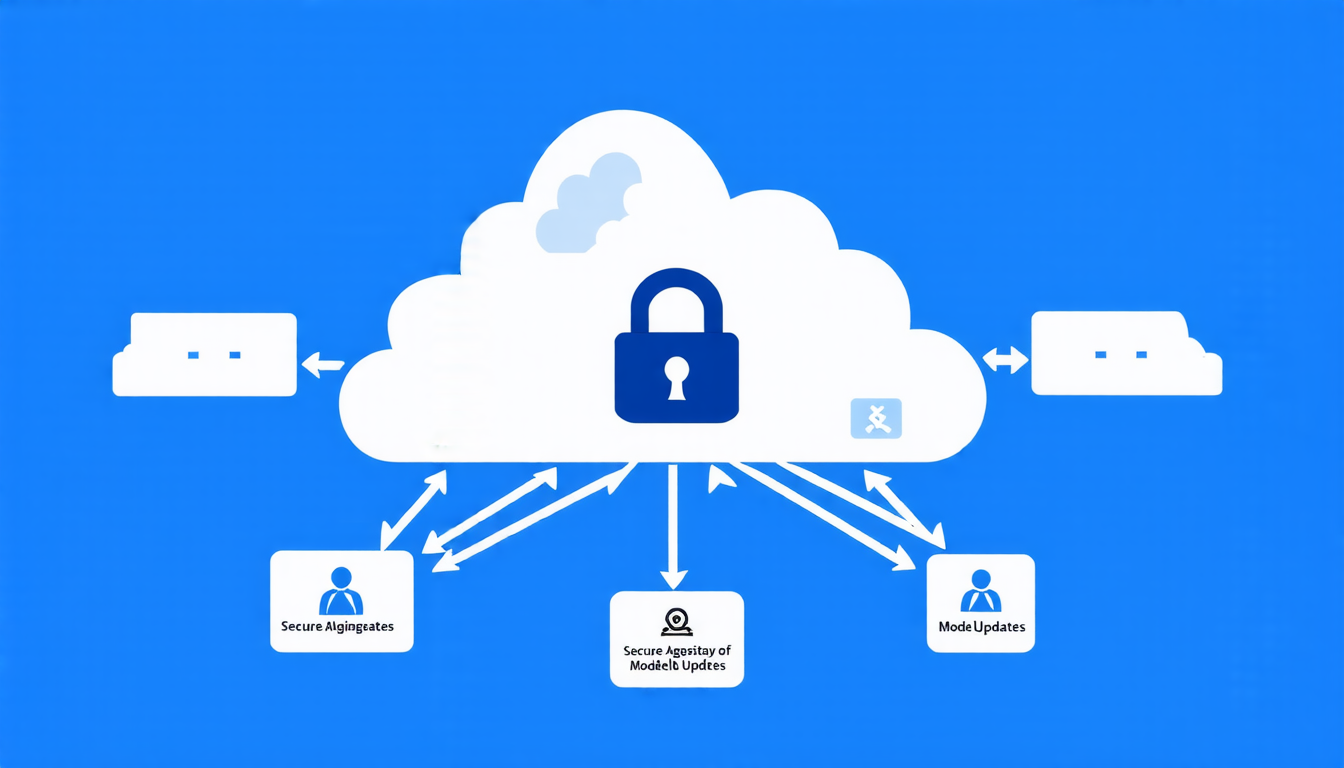
Recently, a team of scientists from China’s Beihang University proposed a novel approach that addresses these concerns. Their method, called TAPFed, uses a threshold functional encryption scheme to enable secure aggregation of model updates in federated learning. This approach allows multiple parties to contribute their data without compromising the security of the shared information.
In traditional federated learning systems, each party shares its local model update with an aggregator, who then combines these updates to train a global model. However, this process leaves room for malicious actors to manipulate or steal sensitive information. TAPFed solves this problem by encrypting the model updates before they are shared, ensuring that even if an attacker gains access to the encrypted data, it would be impossible to extract any meaningful information.
The key innovation behind TAPFed is its use of a threshold functional encryption scheme. This approach allows parties to share their encrypted model updates with each other, while still maintaining the security of the shared information. The scheme works by encrypting the model updates using a combination of public and private keys, which are generated randomly for each party.
When a party wants to contribute its model update to the global model, it first encrypts the update using its private key. It then shares this encrypted update with the aggregator, along with a proof that the update is correct. The aggregator can verify the correctness of the update by checking the proof, and if everything checks out, it adds the update to the global model.
The beauty of TAPFed lies in its ability to scale efficiently. Because each party only needs to share its encrypted model update with the aggregator, the amount of data that needs to be transmitted is significantly reduced compared to traditional federated learning systems. This makes TAPFed more suitable for large-scale applications where data transmission is a major concern.
In addition to its scalability and security benefits, TAPFed also offers improved performance over other secure aggregation methods. The team’s experiments showed that TAPFed can achieve equivalent model quality while reducing the transmission overhead by up to 45% compared to state-of-the-art approaches.
The implications of TAPFed are significant.
Cite this article: “Secure and Scalable Federated Learning with TAPFed”, The Science Archive, 2025.
Federated Learning, Machine Learning, Data Privacy, Encryption, Security, Scalability, Efficiency, Threshold Functional Encryption, Model Updates, Global Models





