

Tuesday 04 March 2025
The intricate dance of charge carriers in organic semiconductors has long fascinated scientists. These materials, found in everything from solar cells to smartphones, rely on the movement of electrically charged particles to function. But understanding how these particles – electrons and holes – interact with their surroundings is crucial for developing more efficient devices.
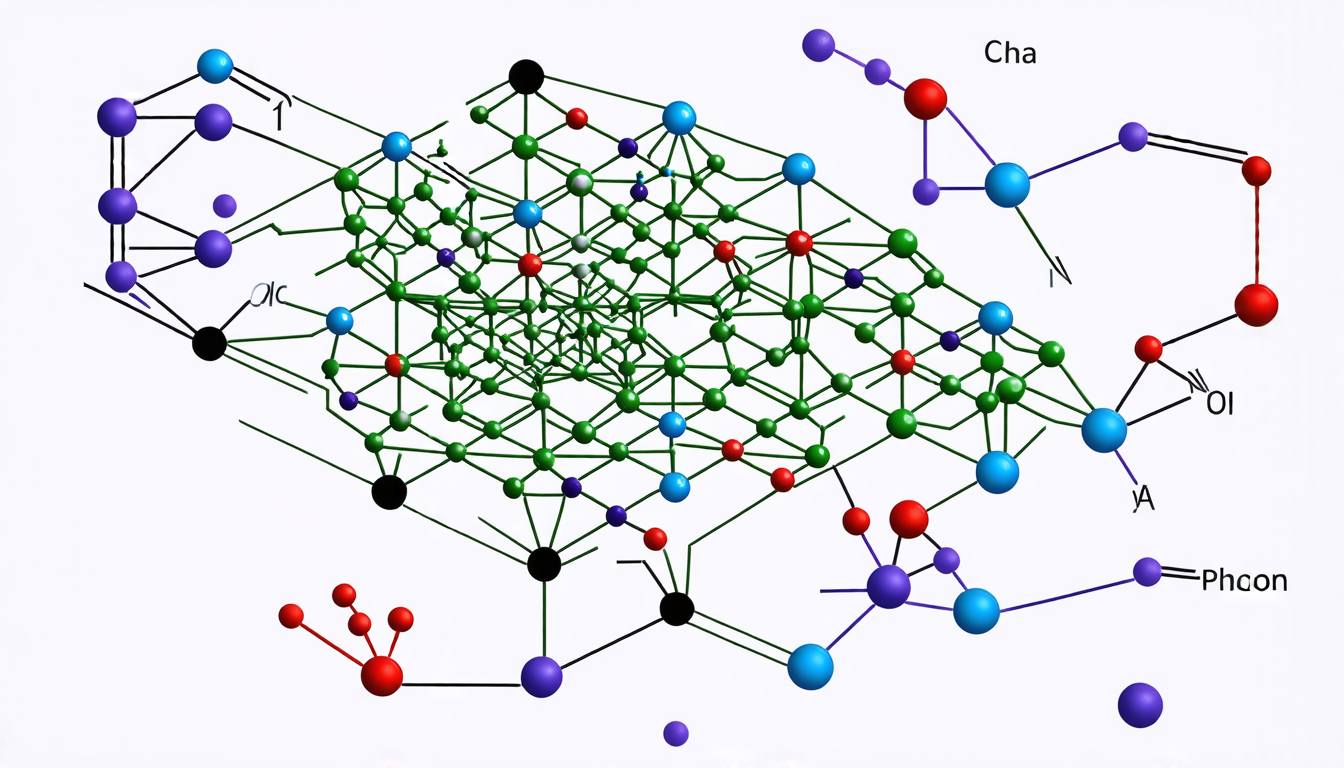
In a recent study, researchers used a sophisticated mathematical technique called hierarchical equations of motion (HEOM) to model the behavior of charge carriers in a one-dimensional Peierls model. The Peierls model is a simplified representation of organic semiconductors, allowing scientists to isolate and study specific aspects of their behavior.
The HEOM approach involves solving a complex system of equations that describe the interactions between charge carriers and the phonons – or vibrational modes – of the material’s lattice structure. By doing so, researchers can gain insights into how these interactions affect the movement of charge carriers.
One key finding is that the dynamics of charge carriers exhibit a crossover from superdiffusive to subdiffusive behavior as temperature increases. This means that at lower temperatures, charge carriers move in a more random and unpredictable manner, while at higher temperatures they become more organized and coherent.
Another important result is that the phonon-assisted transport regime, where phonons play a crucial role in facilitating charge carrier movement, occurs earlier than expected. This has significant implications for the development of more efficient organic semiconductor devices.
The study also compared the HEOM results with those obtained using the transient localization theory (TLS), a widely used approach that relies on simplifying assumptions to model charge carrier behavior. The comparison revealed that while TLS can provide qualitative insights, it is limited in its ability to capture the nuances of charge carrier dynamics.
The researchers’ findings have important implications for the development of more efficient organic semiconductor devices. By better understanding how charge carriers interact with their surroundings, scientists can design materials and devices that take advantage of these interactions to improve performance.
In addition to its practical applications, this study highlights the importance of rigorous mathematical modeling in understanding complex physical phenomena. The HEOM approach provides a powerful tool for researchers seeking to gain insights into the intricate dynamics of charge carriers in organic semiconductors.
The results of this study demonstrate the value of combining advanced mathematical techniques with experimental and theoretical research to deepen our understanding of these fascinating materials. As scientists continue to push the boundaries of what is possible with organic semiconductors, this work serves as a testament to the importance of rigorous scientific inquiry in driving innovation.
Cite this article: “Unraveling the Dynamics of Charge Carriers in Organic Semiconductors”, The Science Archive, 2025.
Charge Carriers, Organic Semiconductors, Hierarchical Equations Of Motion, Peierls Model, Phonons, Transport Regime, Transient Localization Theory, Mathematical Modeling, Charge Carrier Dynamics, Superdiffusive Behavior.





