

Wednesday 05 March 2025
As scientists continue to explore the mysteries of the universe, a new study has shed light on the potential for future discoveries in cosmological tests of gravity. Researchers have long been fascinated by the possibility of using gravitational waves to learn more about the fundamental forces that govern our cosmos.
Gravitational waves are ripples in the fabric of spacetime that were first detected directly in 2015 by the Laser Interferometer Gravitational-Wave Observatory (LIGO). These waves are produced when massive objects, such as black holes or neutron stars, collide and release an enormous amount of energy. Since then, scientists have been working to refine their understanding of these events and use them to learn more about the universe.
One way that researchers hope to do this is by using gravitational waves to test theories of gravity beyond Einstein’s general relativity. According to general relativity, gravity is a curvature of spacetime caused by massive objects. However, there are many alternative theories of gravity that have been proposed over the years, and scientists believe that these theories could potentially be tested using gravitational wave observations.
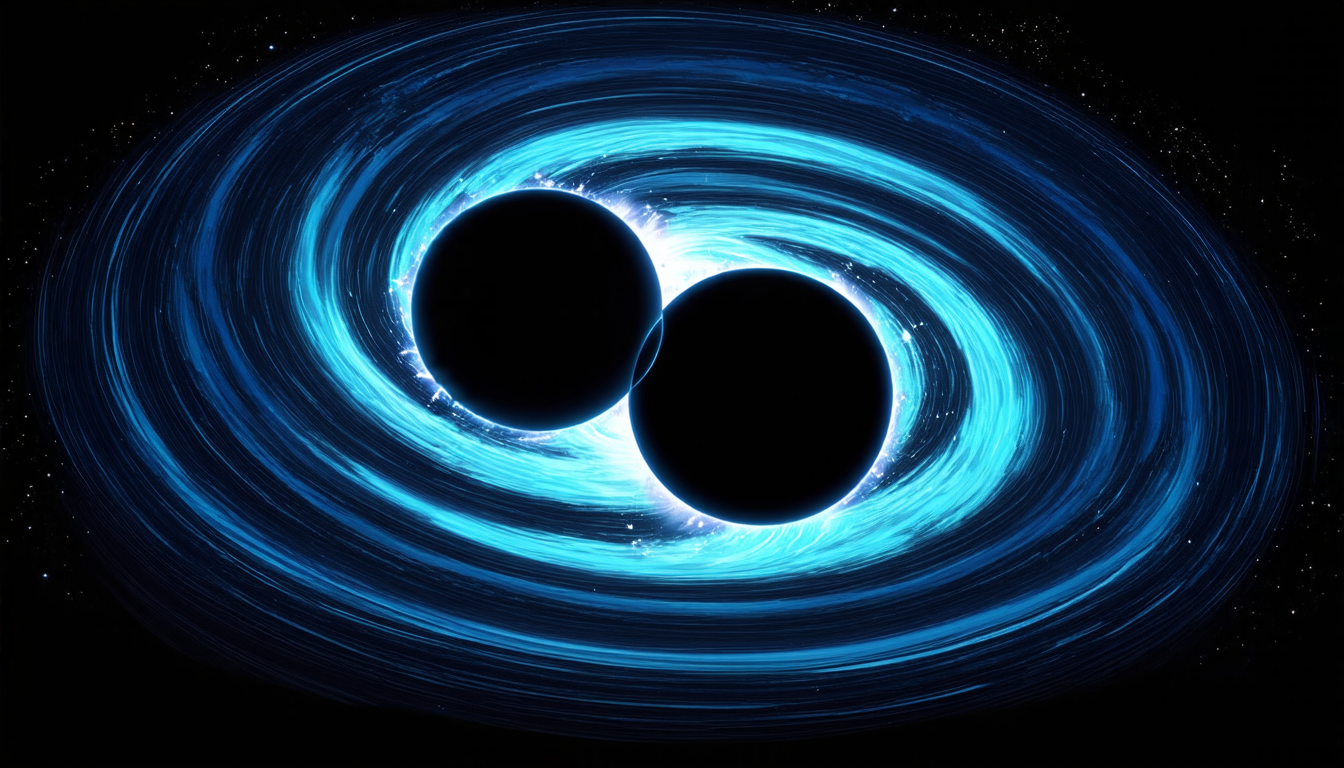
The new study focuses on the potential for future discoveries in this area. The researchers used advanced simulations to model the behavior of gravitational waves produced by binary black hole mergers. They found that even with current technology, it may be possible to use these events to test certain alternative theories of gravity.
The study also looked at the potential for future advancements in gravitational wave detection technology. The development of new detectors, such as the Einstein Telescope and the Cosmic Explorer, could potentially allow scientists to detect more frequent and distant gravitational wave events. This could open up new opportunities for testing theories of gravity and exploring the universe.
One of the most exciting aspects of this research is its potential implications for our understanding of dark matter and dark energy. These mysterious entities are thought to make up a large portion of the universe, but scientists know very little about them. By using gravitational waves to test theories of gravity, researchers may be able to gain new insights into these phenomena.
The study’s findings suggest that future discoveries in cosmological tests of gravity could be just around the corner. As scientists continue to develop new technologies and refine their understanding of gravitational waves, they may soon have the tools they need to explore the mysteries of the universe in ways previously unimaginable.
Cite this article: “Unlocking the Secrets of Gravity with Gravitational Waves”, The Science Archive, 2025.
Gravity, Gravitational Waves, Cosmology, General Relativity, Alternative Theories, Binary Black Hole Mergers, Dark Matter, Dark Energy, Einstein Telescope, Cosmic Explorer





