

Wednesday 05 March 2025
Light, one of the most fundamental forces in our universe, has long been a mystery to scientists and philosophers alike. For centuries, we’ve studied its properties, marveling at its ability to traverse vast distances without being affected by gravity or time. But despite its ubiquity, light remains a complex and often counterintuitive phenomenon.
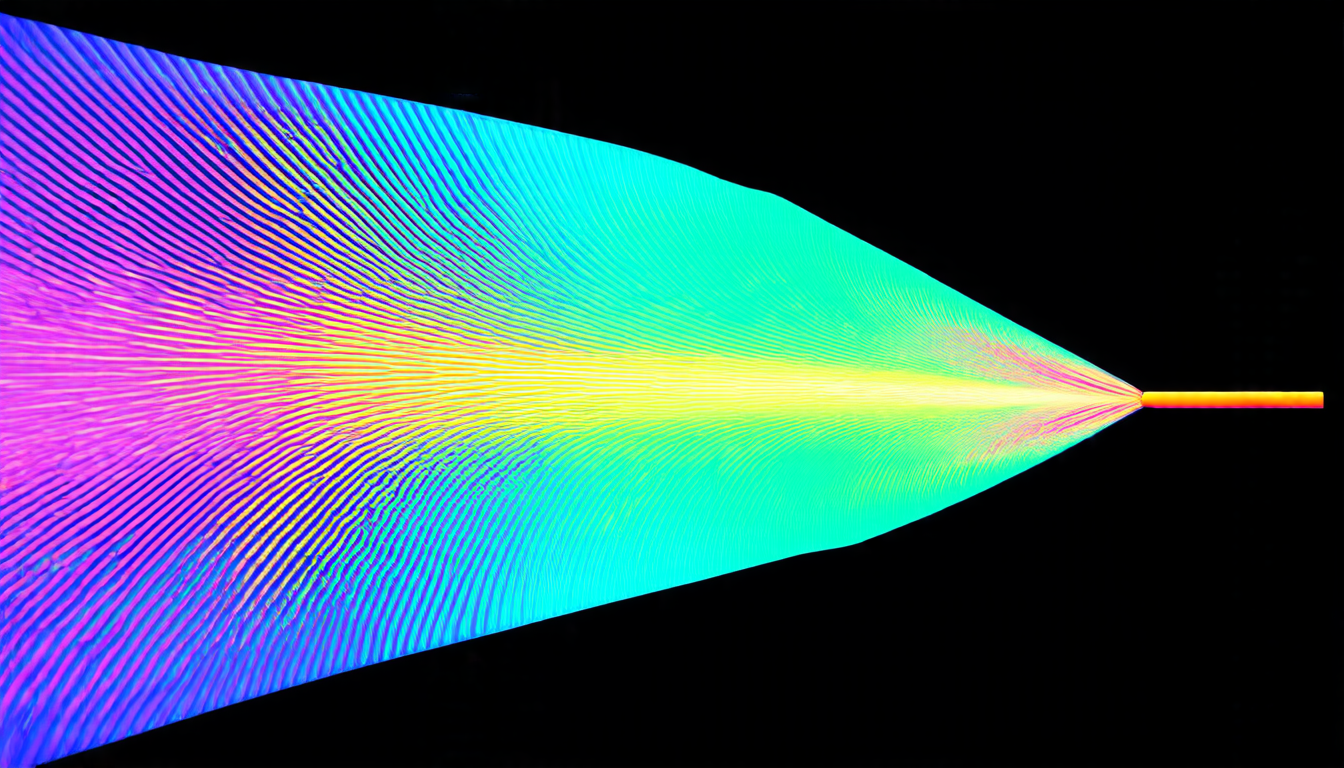
Recent research has shed new light on the intricacies of light’s behavior, particularly when it interacts with matter. A team of scientists has made a significant breakthrough in understanding the torque exerted by light on dielectric slabs, such as those found in optical fibers or waveplates.
To grasp this concept, let’s first consider how light behaves when it passes through a material. When light hits a surface, it can be refracted, or bent, depending on its frequency and the properties of the material. This bending causes the light to change direction, which can have significant effects on its trajectory.
Now, imagine a waveplate, a type of optical device that uses light’s polarization to manipulate its path. When light passes through a waveplate, it becomes polarized, meaning its electric field oscillates in a specific plane. This polarization is crucial for many applications, from filtering out unwanted light to creating complex optical patterns.
The researchers studied how light interacts with these waveplates, paying close attention to the torque exerted by the light on the material. Torque is a measure of rotational force, and in this case, it refers to the way the light’s electric field influences the movement of the waveplate’s molecules.
Using complex mathematical models and simulations, the team was able to accurately predict the torque exerted by light on these dielectric slabs. Their findings show that the torque is directly related to the polarization state of the light and the properties of the material it passes through.
This research has significant implications for a wide range of fields, from optics and photonics to materials science and even biomedicine. For instance, understanding how light interacts with biological tissues could lead to breakthroughs in medical imaging or cancer treatment.
In addition, this work paves the way for the development of more sophisticated optical devices, such as ultra-precise waveplates that can manipulate light’s polarization with unprecedented accuracy. These advancements will undoubtedly have far-reaching consequences across various disciplines and industries.
The study of light continues to be a vibrant field, driven by human curiosity and innovation.
Cite this article: “Unraveling the Torque of Light: Breakthroughs in Understanding Photonic Interactions”, The Science Archive, 2025.
Light, Torque, Waveplates, Dielectric Slabs, Optical Fibers, Polarization, Refracted, Materials Science, Biomedicine, Photonics
Reference: Xiaoyu Zheng, Peter Palffy-Muhoray, “Optical Torque and Plane Waves: An Identity” (2025).





