

Wednesday 05 March 2025
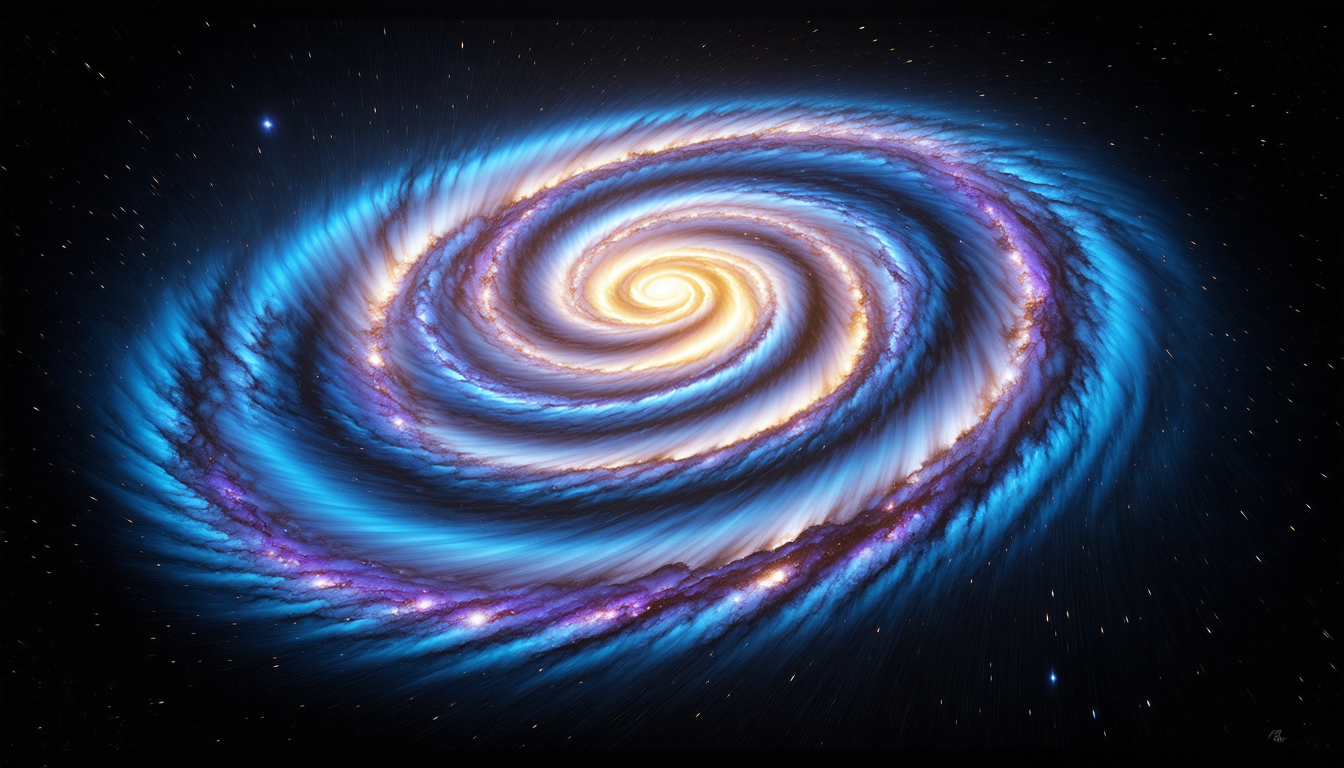
A team of astronomers has uncovered a remarkable phenomenon in a nearby galaxy, one that sheds new light on how supermassive black holes grow and shape their surroundings. The discovery revolves around a rapidly accreting active galactic nucleus (AGN) called RE J1034+396, which is believed to be at the heart of a spiral galaxy about 1 billion light-years away.
The AGN is remarkable because it’s surrounded by an outflow of hot gas moving at incredible speeds – up to 30% of the speed of light. This is much faster than previously observed outflows, and it’s thought to be driven by radiation from the accretion disk surrounding the black hole. The disk is a swirling ring of hot, dense gas that surrounds the black hole, and it’s the source of intense radiation.
The outflow is so powerful that it would be able to clear out massive amounts of material around the galaxy, effectively stifling star formation and limiting the fuel supply available for future episodes of rapid supermassive black hole growth. This has significant implications for our understanding of how galaxies evolve over time, as well as the role that supermassive black holes play in shaping their environments.
The researchers used data from the XMM-Newton space telescope to study the AGN and its outflow. They analyzed the light emitted by the gas around the galaxy, including X-rays and ultraviolet radiation, to infer the properties of the outflow. By modeling the behavior of the gas and the radiation it emits, they were able to constrain the parameters of the outflow, such as its velocity, density, and composition.
One of the key findings is that the outflow is remarkably consistent over time, with no significant changes observed over a period of years. This suggests that the outflow is sustained by a steady supply of radiation from the accretion disk, rather than being a transient event. The researchers also found that the outflow is much hotter and denser than previously thought, which helps to explain its incredible speed.
The implications of this discovery are far-reaching. It suggests that supermassive black holes may play a more significant role in shaping their host galaxies than previously thought, by clearing out material and limiting star formation. This could have important consequences for our understanding of galaxy evolution and the role that black holes play in it.
Further study is needed to confirm these findings and explore the implications in more detail.
Cite this article: “Supermassive Black Holes Powerful Outflow Reveals Galaxy Evolution Secrets”, The Science Archive, 2025.
Supermassive Black Holes, Active Galactic Nuclei, Agn, Outflows, Galaxy Evolution, Star Formation, Xmm-Newton, Space Telescope, Radiation, Accretion Disk





