

Wednesday 05 March 2025
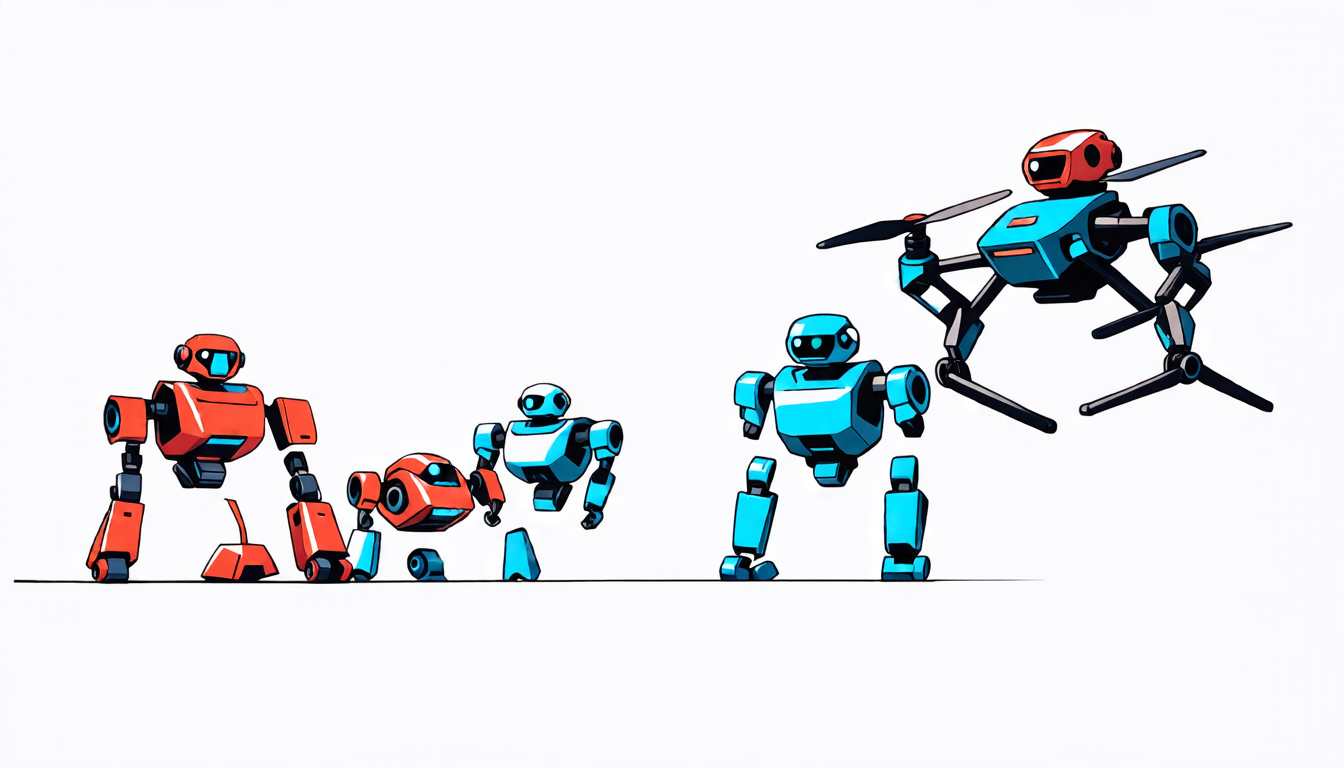
For decades, scientists have been working on developing a system that can control multiple robots or drones simultaneously, allowing them to work together seamlessly and efficiently in complex tasks such as search and rescue missions or environmental monitoring. This concept is often referred to as multi-agent systems.
Recently, researchers made a significant breakthrough in this field by developing an innovative method for controlling swarms of robots or drones using a combination of artificial intelligence and formal methods. The new approach, which they call GNN-ODE, uses a neural network to learn the behavior of individual agents and then combines them to create a coordinated action plan.
The key innovation is the use of a formal language called Signal Temporal Logic (STL) to specify complex tasks that require coordination among multiple agents. STL allows researchers to describe tasks in a precise and unambiguous way, making it easier for robots or drones to understand what needs to be done.
In traditional multi-agent systems, each agent has its own plan and decision-making process, which can lead to conflicts and inefficiencies when they try to work together. By using STL, the new approach ensures that all agents are working towards a common goal, reducing the risk of collisions or other errors.
The researchers tested their method on several challenging scenarios, including a loop task where multiple robots need to follow each other in a predetermined path without colliding with each other. They also developed a signal specification using STL, which requires robots to visit specific locations in a certain order before reaching a final goal.
The results were impressive: the GNN-ODE system was able to successfully complete all tasks while ensuring safety and avoiding collisions. The researchers believe that this breakthrough has significant implications for applications such as search and rescue missions, environmental monitoring, and autonomous vehicles.
One of the most exciting aspects of this research is its potential to be scaled up to larger numbers of agents. Currently, the system can control up to 32 robots or drones, but there is no reason why it couldn’t be applied to even larger swarms in the future.
The GNN-ODE method also has the potential to be used in other areas where complex tasks require coordination among multiple entities. For example, it could be used to control a fleet of autonomous vehicles or to coordinate the actions of multiple robots working together on a construction site.
Overall, this breakthrough is an important step forward in the development of multi-agent systems and has significant implications for a wide range of applications.
Cite this article: “Coordinated Control of Multi-Agent Systems: A Breakthrough in Swarm Robotics”, The Science Archive, 2025.
Artificial Intelligence, Multi-Agent Systems, Formal Methods, Robot Control, Drone Swarms, Signal Temporal Logic, Stl, Neural Networks, Autonomous Vehicles, Search And Rescue





