

Wednesday 05 March 2025
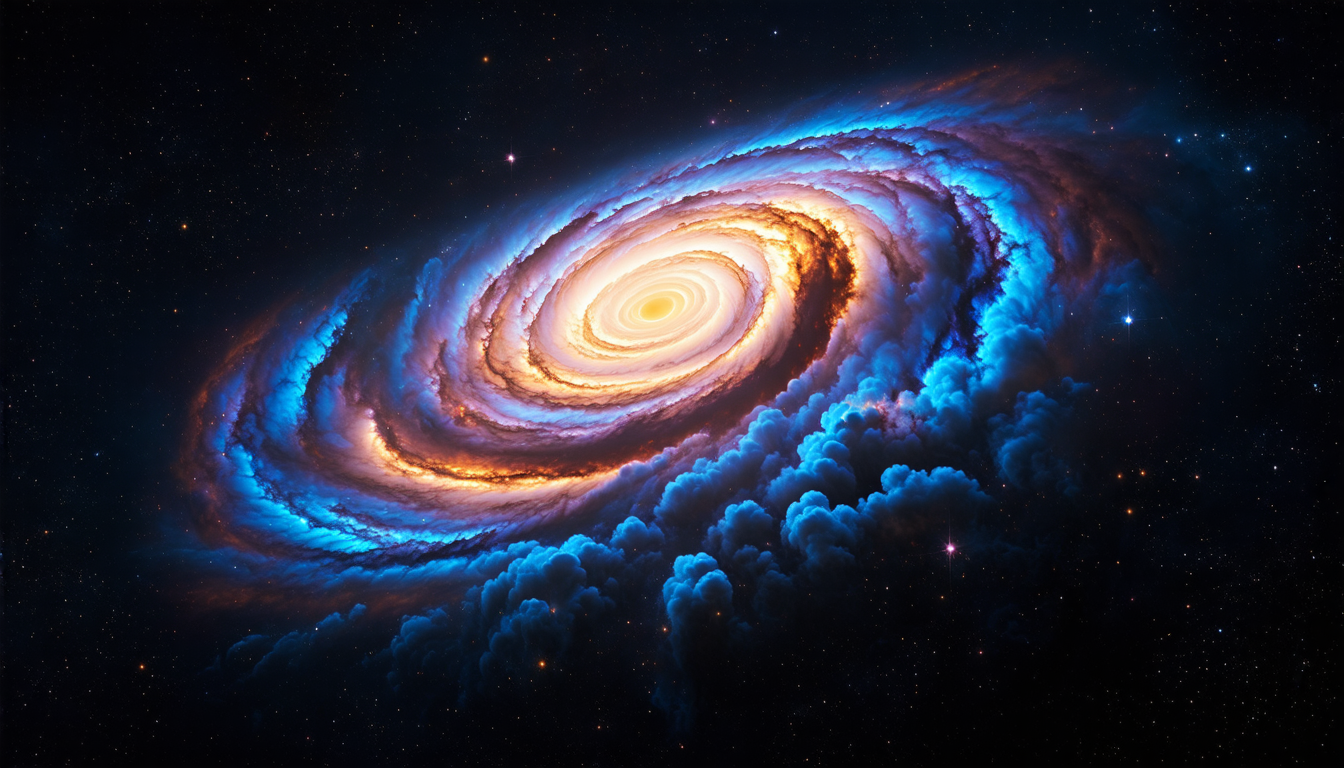
Deep within a nebula, a mysterious shell of gas and dust has been discovered, shrouding a supernova remnant called Kesteven 67. This remarkable finding offers new insights into the life cycle of stars and the impact they have on their surroundings.
Located about 14,000 light-years away in the constellation of Vela, Kesteven 67 is an expanding cloud of gas that was created by a massive star’s explosive demise. As it blew up, the star sent shockwaves through the surrounding interstellar medium, compressing and heating up the material. This process triggered the formation of new stars and planets.
The team behind this research used a combination of radio telescopes and X-ray observations to study Kesteven 67 in unprecedented detail. They discovered that the shell is made up of a variety of molecules, including carbon monoxide, hydrogen cyanide, and formic acid. These molecules are not only signs of the star’s violent death but also provide clues about the conditions within the nebula.
One of the most intriguing aspects of Kesteven 67 is its age. By studying the expansion velocity of the shell and the temperature of the hot gas inside it, scientists were able to determine that this supernova remnant is around 22,000 years old. This means that it has been expanding for roughly half the time since the last Ice Age.
This discovery sheds light on the complex dance between stars and their surroundings. Supernovae like Kesteven 67 not only create new elements but also shape the structure of galaxies by dispersing heavy elements throughout space. The team’s findings highlight the importance of understanding these events in order to better grasp the evolution of our universe.
The researchers are excited about the possibilities this discovery presents. By studying more supernovae remnants like Kesteven 67, scientists can gain a deeper understanding of how stars form and die, as well as the role they play in shaping the cosmos.
In addition, this research has implications for our own solar system. The team’s findings suggest that similar processes may have occurred in the past, influencing the formation of our own planet and potentially even the origins of life itself.
This remarkable discovery is a testament to humanity’s ongoing quest to explore and understand the mysteries of the universe. As scientists continue to unravel the secrets of Kesteven 67, they are uncovering new insights into the intricate web of relationships between stars, galaxies, and the cosmos as a whole.
Cite this article: “Unveiling the Secrets of Kesteven 67: A Supernova Remnants Journey Through Time”, The Science Archive, 2025.
Supernova, Nebula, Kesteven 67, Star, Galaxy, Universe, Molecules, Carbon Monoxide, Hydrogen Cyanide, Formic Acid





