

Wednesday 05 March 2025
Scientists have long been fascinated by the intricate patterns and structures that emerge in nature, from the swirling shapes of galaxies to the repeating patterns of crystals. Now, a new study has shed light on a fundamental aspect of these natural wonders: the way they pack together.
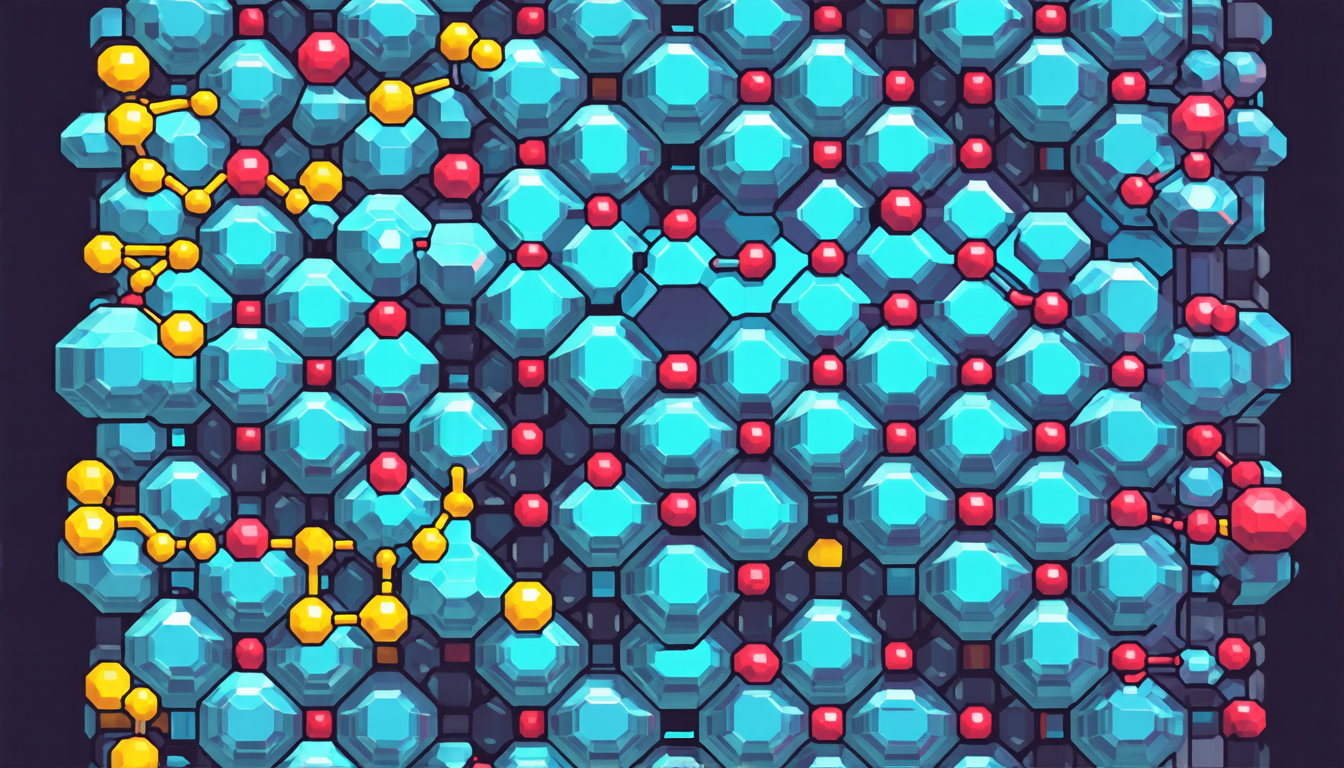
Researchers have discovered that a particular type of crystal lattice, known as the body-centered cubic (BCC) structure, is actually the most efficient way for particles to arrange themselves in three-dimensional space. This finding has significant implications not just for our understanding of crystals and materials science, but also for fields like chemistry, biology, and even astronomy.
To understand why this is important, let’s take a step back and look at how crystals form. Crystals are made up of repeating patterns of atoms or molecules that are arranged in a specific way to create a lattice structure. This lattice determines the properties of the crystal, such as its strength, conductivity, and optical properties.
But what drives these particles to arrange themselves in particular ways? Why do some crystals have repeating patterns of atoms, while others don’t?
The answer lies in the mathematics of packing. When particles are arranged in a lattice structure, they occupy a certain amount of space. The goal is to find the most efficient way for them to pack together, so that the lattice is as dense and stable as possible.
In the case of the BCC structure, scientists have discovered that it is the optimal solution for packing particles in three-dimensional space. This means that when atoms or molecules are arranged in a BCC lattice, they occupy the smallest amount of space possible while still maintaining their structural integrity.
This finding has far-reaching implications. For example, in materials science, understanding how particles pack together can help us design new materials with specific properties. In biology, it could provide insights into the structure and behavior of biological molecules like proteins and DNA. And in astronomy, it could even shed light on the formation of galaxies and other celestial bodies.
The study’s authors used a combination of mathematical techniques and computer simulations to arrive at their conclusion. They analyzed the properties of different crystal lattices, including the BCC structure, and found that it was the most efficient way for particles to pack together.
The discovery also has implications for our understanding of natural patterns in general. From the branching patterns of trees to the swirling shapes of galaxies, many natural phenomena can be understood as the result of particles or molecules packing together in a particular way.
Cite this article: “Crystals Secret: The Most Efficient Way to Pack Particles Together”, The Science Archive, 2025.
Crystals, Materials Science, Biology, Astronomy, Particle Arrangement, Lattice Structure, Packing Efficiency, Mathematics, Computer Simulations, Natural Patterns.
Reference: Shaun Cooper, Peter Schwerdtfeger, “A minimum property for cuboidal lattice sums” (2025).





