

Wednesday 05 March 2025
Scientists have made a significant breakthrough in understanding how waves propagate through complex media, such as the Earth’s crust or biological tissues. The discovery could lead to major advances in fields like seismology, medical imaging, and materials science.
Waves are all around us, from the ripples on a pond to the vibrations of music. But when these waves encounter obstacles or change direction, they can behave erratically. In some cases, this can be beneficial – think of how ultrasound technology uses sound waves to create detailed images of the body. However, in other situations, wave behavior can be unpredictable and even harmful.
One way scientists have tried to tame these waves is by using mathematical models to predict their behavior. But these models are only as good as the assumptions they’re based on, and real-world situations often defy simple predictions.
Enter the diffusive-viscous wave equation, a complex mathematical formula that describes how waves propagate through media with varying densities and viscosities. It’s like trying to solve a Rubik’s Cube – the variables are constantly shifting, making it challenging to find a solution that accurately predicts wave behavior.
Researchers have been working on developing numerical methods to solve this equation, but traditional approaches have limitations. They either sacrifice accuracy for computational speed or vice versa.
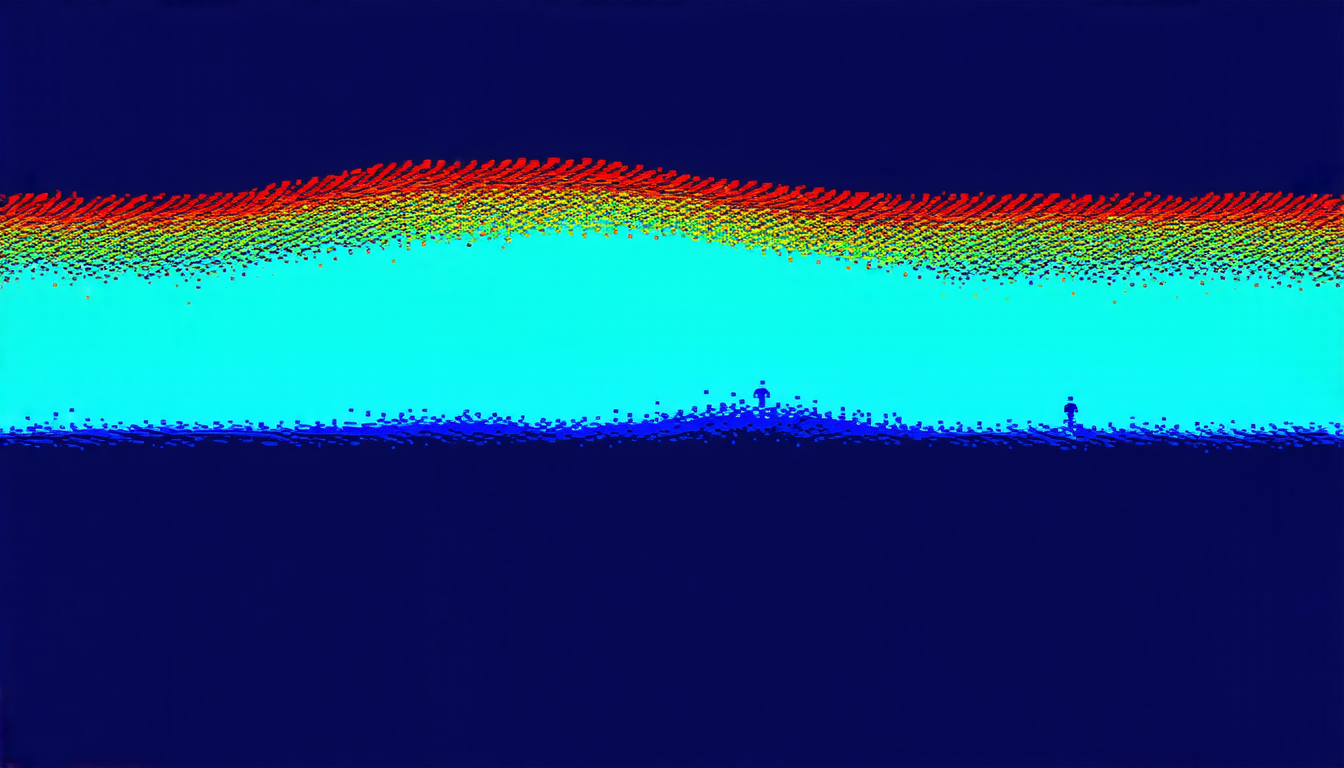
The breakthrough comes from a new finite difference method developed by scientists. By using a combination of mathematical techniques and clever programming, they’ve created an algorithm that can accurately simulate wave behavior in complex media with high spatial and temporal resolution.
This means researchers can now study the propagation of waves through heterogeneous materials like biological tissues or porous rocks. They can analyze how these waves interact with different structures and boundaries, providing valuable insights for applications ranging from medical imaging to oil exploration.
The implications are vast. For seismologists, this new method could help them better understand earthquake behavior and improve early warning systems. Medical professionals might use it to develop more effective treatments for diseases like cancer or Alzheimer’s. Materials scientists could design new materials with unique properties that exploit the complex behavior of waves.
While there’s still much work to be done, this breakthrough has opened up new avenues of research that could revolutionize our understanding of wave propagation. By harnessing the power of mathematics and computational power, scientists are one step closer to unlocking the secrets of these fascinating phenomena.
Cite this article: “Breaking Through Wavefronts: A New Method for Understanding Complex Media Propagation”, The Science Archive, 2025.
Waves, Propagation, Complex Media, Seismology, Medical Imaging, Materials Science, Diffusive-Viscous Wave Equation, Finite Difference Method, Numerical Methods, Computational Power





