

Wednesday 05 March 2025
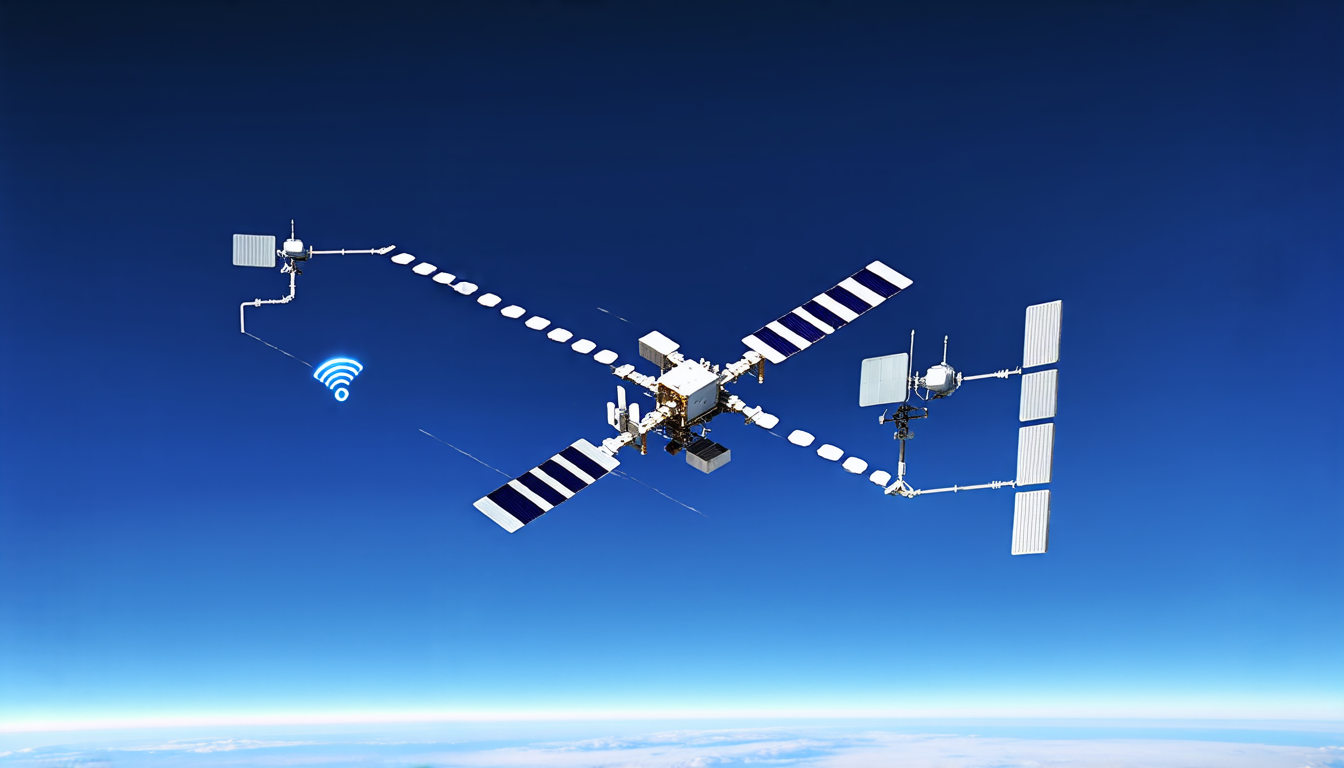
The rapidly evolving landscape of low-earth orbit (LEO) satellite networks has given rise to a new era of wireless communication possibilities. LEO satellites, which orbit the Earth at an altitude of around 100-1,200 kilometers, offer faster data rates and lower latency compared to traditional geostationary satellites.
However, as the number of LEO satellites increases, so do concerns about interference and signal strength. Non-orthogonal multiple access (NOMA) technology has emerged as a potential solution to mitigate these issues by allowing multiple devices to share the same frequency band simultaneously.
Researchers have been studying the application of NOMA in LEO satellite networks, exploring its potential benefits and limitations. A recent paper published in IEEE Transactions on Communications delves into the coverage and spectral efficiency of NOMA-enabled LEO satellite networks with ordering schemes.
The study examines two ordering schemes: mean signal power (MSP) based ordering and instantaneous-signal-to-interference-plus-noise ratio (ISINR) based ordering. The researchers demonstrate that both schemes can significantly improve coverage probability compared to traditional orthogonal multiple access (OMA).
Moreover, the paper highlights the importance of power allocation in NOMA systems. The authors show that optimizing power allocation can lead to substantial gains in spectral efficiency and user fairness. They also investigate the impact of SIC, main-lobe gain, and tradeoffs between the number of satellites and their altitudes on coverage probability.
The results suggest that NOMA can increase the sum spectral efficiency by up to 35% compared to OMA. Furthermore, the study finds that the optimal number of users is two, which maximizes the sum spectral efficiency. This has significant implications for network design and optimization in LEO satellite networks.
The authors’ work provides valuable insights into the performance of NOMA-enabled LEO satellite networks. As the demand for high-speed, low-latency wireless connectivity continues to grow, understanding the benefits and limitations of NOMA technology will be crucial for the development of future wireless communication systems.
In this context, the researchers’ findings offer a promising perspective on the potential of NOMA in LEO satellite networks. The study’s results highlight the need for further research into power allocation strategies, ordering schemes, and network optimization techniques to fully harness the benefits of NOMA technology.
The increasing deployment of LEO satellites and the growing demand for high-speed wireless connectivity make this area of research increasingly relevant.
Cite this article: “Exploring the Potential of Non-Orthogonal Multiple Access in Low-Earth Orbit Satellite Networks”, The Science Archive, 2025.
Leo Satellite Networks, Noma, Multiple Access, Signal Strength, Interference, Coverage Probability, Spectral Efficiency, Power Allocation, Sic, Main-Lobe Gain.





