

Wednesday 05 March 2025
Scientists have made a significant discovery that could change our understanding of how cells move and interact with each other. For years, researchers have been studying the behavior of cells in living organisms, trying to understand the intricate dance they perform as they grow, divide, and migrate.
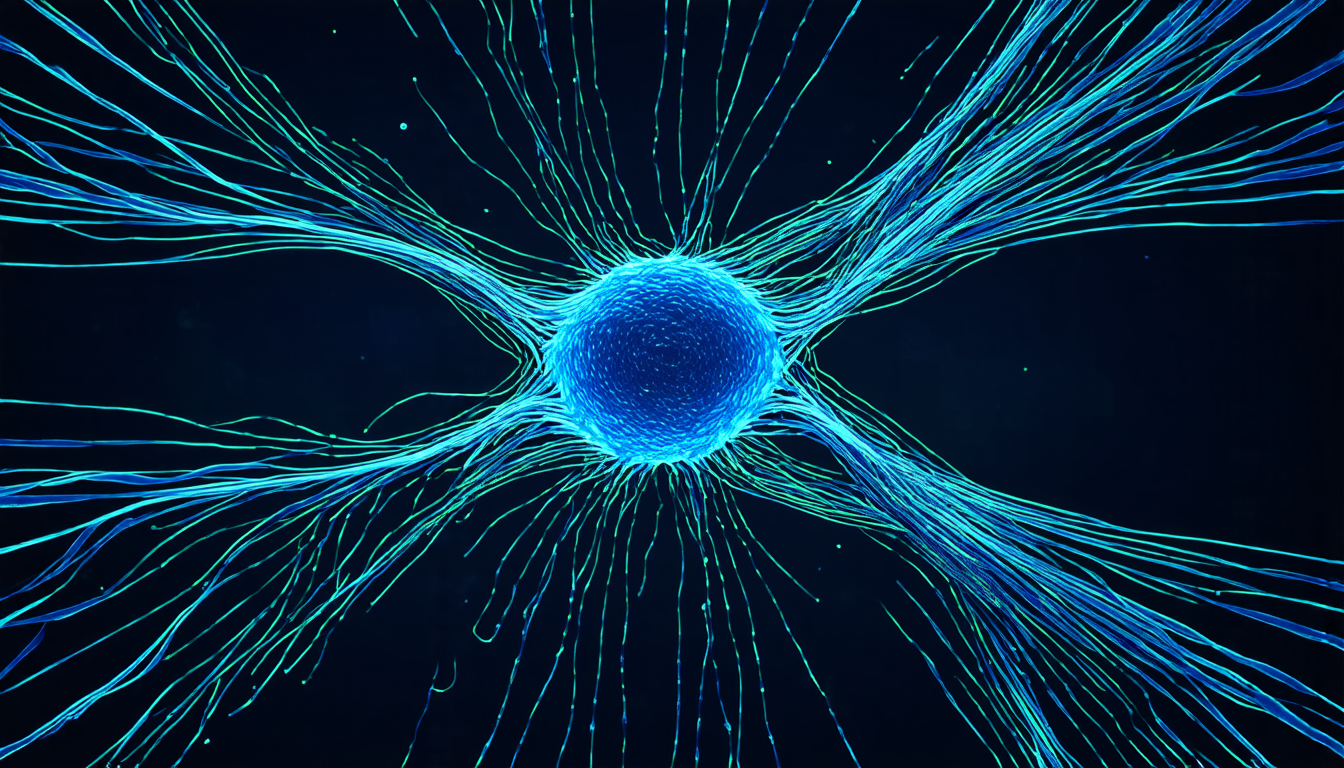
One key aspect of this research has focused on the role of active filaments – long, thin structures made up of protein molecules that play a crucial part in cell movement. These filaments are found in many different types of cells, from those lining our digestive tract to those forming the walls of our blood vessels.
Recently, a team of scientists developed a new theory that aims to explain how these active filaments interact with each other and with their surroundings. The researchers used computer simulations to model the behavior of these filaments under different conditions, and they made some surprising discoveries.
One key finding was that the filaments can create complex patterns as they move and interact with each other. These patterns are similar to those found in liquid crystals, which are materials that exhibit both liquid-like and crystal-like properties.
The researchers also discovered that the filaments can create topological defects – areas where the pattern is disrupted or distorted. These defects play a crucial role in the behavior of the filaments and can even affect the movement of neighboring cells.
But what’s most fascinating about this research is how it could be used to understand diseases such as cancer. Cancer cells often exhibit abnormal behavior, including changes in their ability to move and interact with each other.
By studying the behavior of active filaments in healthy cells, researchers may be able to gain insights into how cancer cells develop and spread. This knowledge could ultimately lead to the development of new treatments for this devastating disease.
In addition to its potential applications in medicine, this research has broader implications for our understanding of biological systems as a whole. It highlights the importance of considering the intricate interactions between individual components – in this case, active filaments – and how these interactions shape the behavior of the system as a whole.
The scientists’ findings also raise new questions about the nature of biological organization and how it arises from the interactions of individual parts. This research is a powerful reminder of the complexity and beauty of living systems, and it’s an exciting area of study that continues to captivate scientists and researchers around the world.
Cite this article: “Unraveling the Secrets of Cell Movement: New Insights into Cellular Behavior and Disease”, The Science Archive, 2025.
Cells, Movement, Filaments, Protein Molecules, Cell Interaction, Simulations, Patterns, Topological Defects, Cancer, Biology





