

Wednesday 05 March 2025
Tilings, a fundamental concept in mathematics, refer to the process of covering a surface or shape with smaller shapes, such as tiles, without overlapping or leaving gaps. In the realm of combinatorics, tilings have been extensively studied and applied to various fields, including computer science, physics, and biology. Recently, researchers have made significant progress in understanding colored tilings on graphs, which has far-reaching implications for many areas of study.
Colored tilings on graphs involve assigning colors to vertices or edges of a graph while satisfying certain conditions, such as ensuring that adjacent vertices have different colors. This concept is crucial in modeling real-world systems, where nodes and edges represent entities and relationships, respectively. By analyzing the properties of colored tilings, researchers can gain insights into the behavior and structure of these complex networks.
The paper under discussion focuses on enumerating colored partitions for specific families of graphs, including product graphs and star graphs. The authors employ a novel approach using generating functions to solve this problem, which has been long-standing in combinatorial mathematics. By leveraging the power of algebraic manipulations, they derived closed-form expressions for the expected number of blocks in these colored partitions.
One of the key findings is the connection between colored tilings and integer partition theory. The authors show that the number of last slices in a given graph can be expressed as a sum of integer partitions, which provides a deep understanding of the underlying structure of the tiling process. This discovery has significant implications for many areas, including computer science, where it can be used to optimize algorithms and data structures.
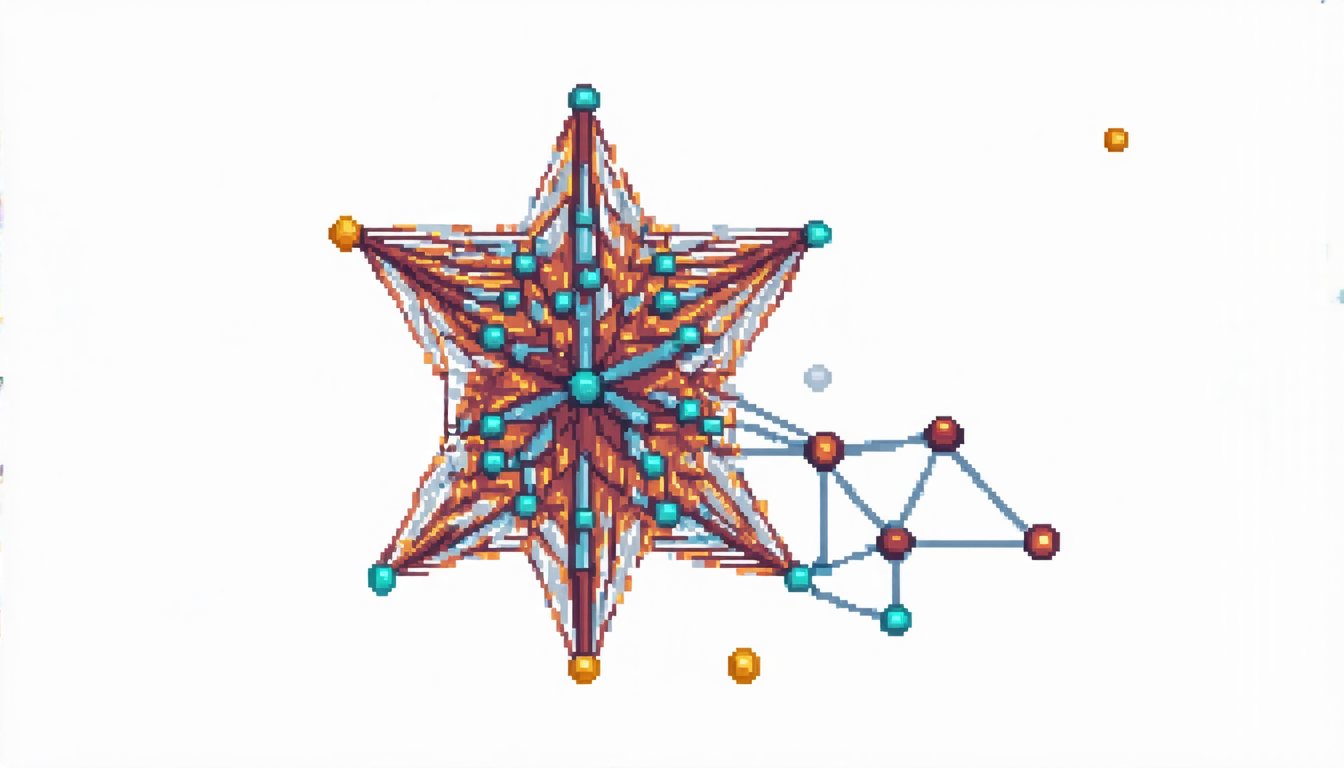
The study also highlights the importance of star graphs in modeling real-world networks. Star graphs are a class of graphs that exhibit unique properties, such as having a central node with a fixed number of edges. By analyzing colored tilings on these graphs, researchers can gain insights into the behavior of complex systems, including social networks and biological networks.
The authors’ approach has far-reaching implications for many areas of study, from computer science to biology. For instance, in computer science, it can be used to optimize algorithms and data structures, while in biology, it can provide insights into the structure and function of complex networks. The paper’s findings also open up new avenues for research in combinatorial mathematics, integer partition theory, and graph theory.
In summary, this paper presents a significant advancement in understanding colored tilings on graphs, with implications for many areas of study.
Cite this article: “Colored Tilings on Graphs: A Novel Approach and Its Implications”, The Science Archive, 2025.
Combinatorics, Colored Tilings, Graph Theory, Integer Partition Theory, Algebraic Manipulations, Generating Functions, Computer Science, Biology, Network Modeling, Optimization Algorithms





