

Thursday 06 March 2025
As scientists continue to push the boundaries of our understanding of the universe, a new study has shed light on the possibility of detecting gravitational anomalies in the solar system using a satellite constellation. The research, which leverages advanced numerical simulations and theoretical models, suggests that a network of satellites orbiting the Sun could potentially detect deviations from Newtonian gravity.
Gravitational forces are a fundamental aspect of our understanding of the universe, governing everything from the motion of planets to the behavior of galaxies. However, there is growing evidence to suggest that these forces may not be as straightforward as previously thought. The study of gravitational anomalies has become increasingly important in recent years, as scientists seek to understand the mysteries of dark matter and dark energy.
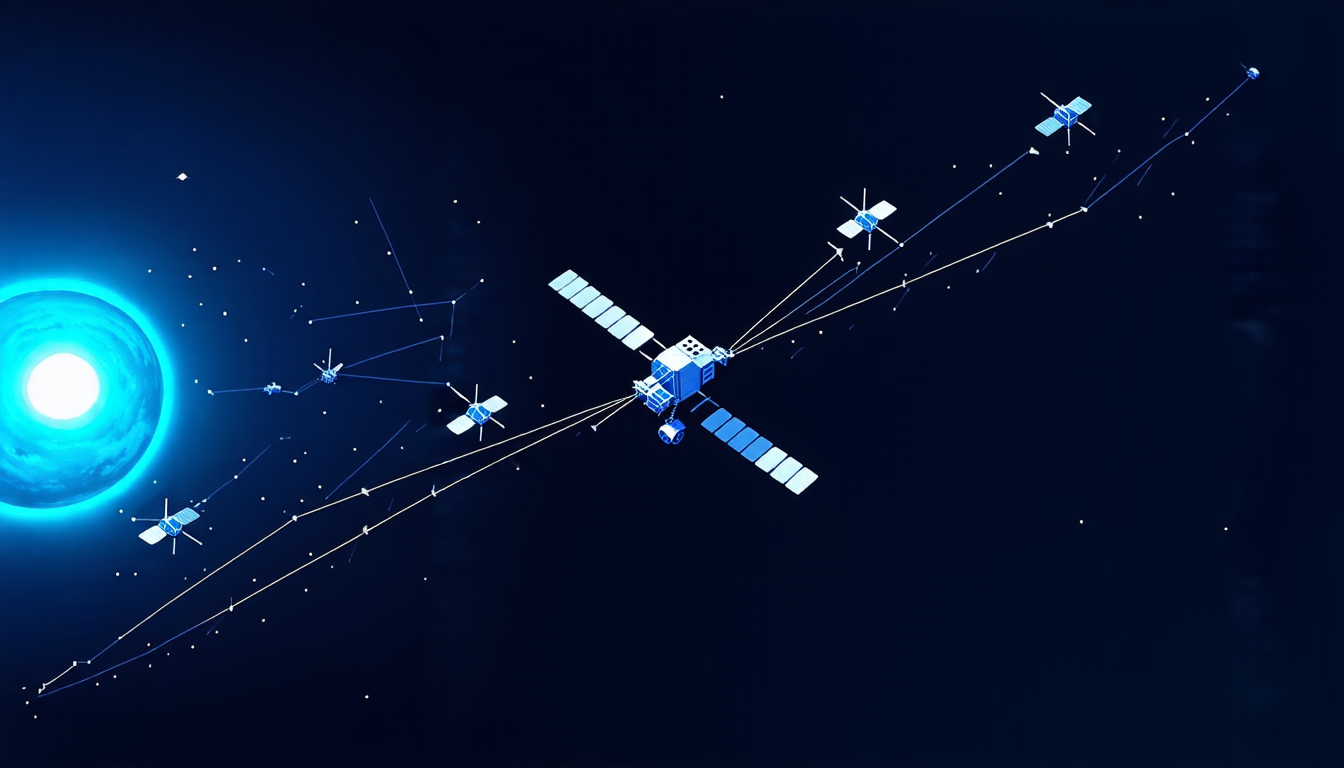
The proposed satellite constellation would consist of four satellites arranged in a tetrahedral configuration, orbiting the Sun at distances ranging from 1 to 30 astronomical units (AU). By measuring the subtle variations in gravitational forces between the satellites, researchers believe they could detect anomalies that may indicate the presence of new physical phenomena.
One of the key challenges facing this experiment is the need for extremely accurate measurements. The gravitational forces involved are incredibly weak, requiring precision levels of around one part per billion. To achieve this level of accuracy, scientists will need to develop advanced technologies capable of detecting minute changes in satellite positions and velocities.
The study also highlights the potential benefits of using multiple tetrahedral configurations, each with its own unique orbit and sensitivity to gravitational anomalies. By combining data from multiple constellations, researchers could potentially map the distribution of gravitational forces throughout the solar system, providing new insights into the nature of dark matter and dark energy.
While this research is still in its infancy, it represents an exciting step forward in our understanding of the universe. The potential for detecting gravitational anomalies using a satellite constellation has significant implications for our understanding of the fundamental laws of physics, and could potentially lead to breakthroughs in fields such as cosmology and particle physics.
As scientists continue to develop and refine their theories and models, it is clear that the search for gravitational anomalies will be an ongoing and complex challenge. However, with the advancement of technology and the development of new experimental techniques, the possibility of detecting these anomalies becomes increasingly plausible.
Cite this article: “Detecting Gravitational Anomalies in the Solar System Using Satellite Constellations”, The Science Archive, 2025.
Gravitational Forces, Satellite Constellation, Dark Matter, Dark Energy, Newtonian Gravity, Astronomical Units, Precision Measurements, Gravitational Anomalies, Tetrahedral Configuration, Cosmology.
Reference: Viktor T. Toth, “Pushing limits: Probing new gravity using a satellite constellation” (2025).





