

Thursday 06 March 2025
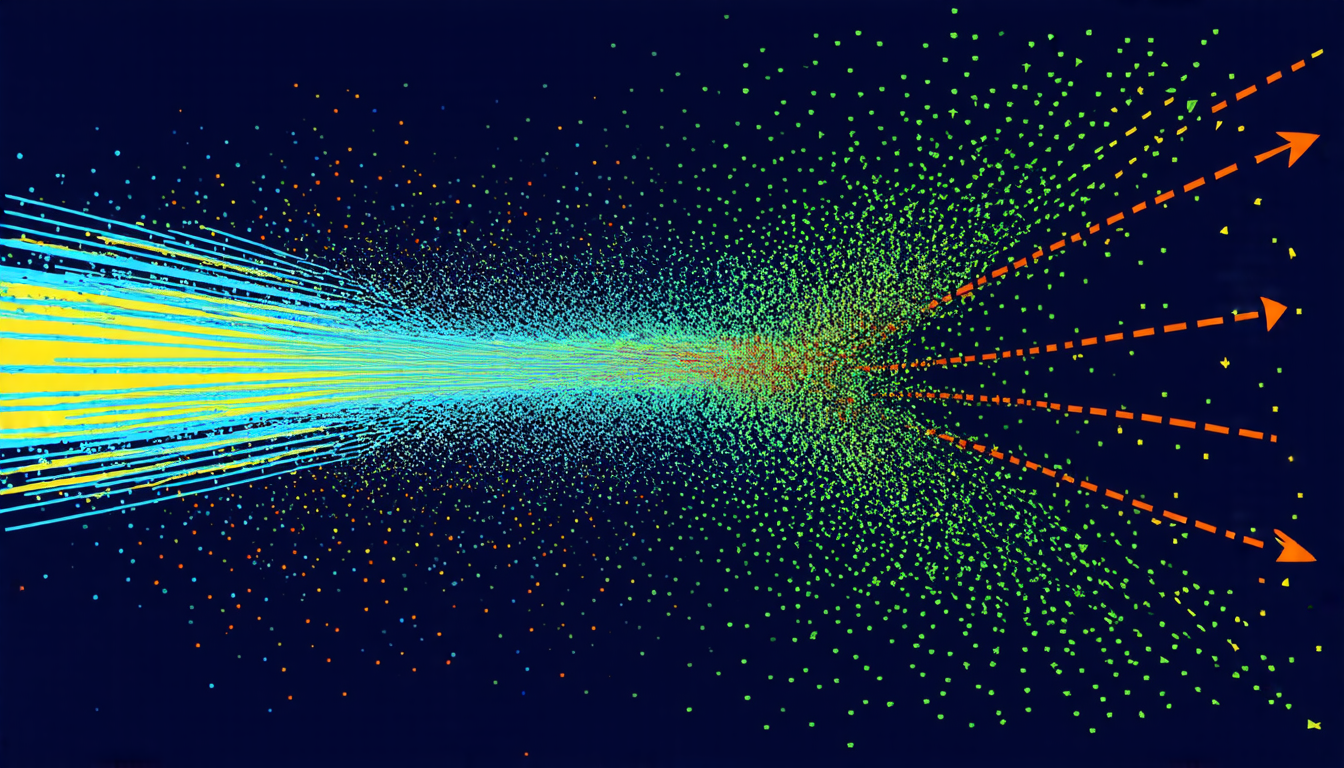
As scientists delve deeper into the mysteries of particle transport, they’re finding new ways to make complex calculations more efficient and accurate. A recent development in Monte Carlo simulations has opened up fresh avenues for researchers, allowing them to tackle some of the most challenging problems in physics.
Monte Carlo methods are a staple of modern scientific computing, used to model everything from radiation therapy to climate simulations. However, these simulations can be notoriously slow and computationally intensive, making it difficult to study complex systems over long periods of time.
The solution lies in weight windows, which are like invisible filters that help guide particles through the simulation. By adjusting these filters, researchers can optimize the calculation and reduce the amount of computational power needed. But traditional methods for setting weight windows have limitations, particularly when dealing with complex problems involving multiple dimensions.
Enter a new approach, developed by a team of scientists using a hybrid method that combines two different time-integration schemes. The result is a more accurate and efficient way to set weight windows, which can then be used to speed up Monte Carlo simulations.
The key innovation lies in the use of the low-order second-moment (LOSM) equations, which provide a simplified model of particle transport. By solving these equations using two different time-integration schemes – backward Euler and Crank-Nicolson – researchers can create a more accurate representation of particle behavior over time.
The team tested their new approach on a suite of benchmarks, including a challenging problem involving an infinite medium with a point source. The results were impressive: the hybrid method was able to accurately capture the wavefront position and reduce computational errors by up to 50%.
But what does this mean for scientists? In short, it opens up new possibilities for studying complex systems that were previously out of reach. With faster and more accurate simulations, researchers can tackle problems like climate modeling, radiation transport in nuclear reactors, and even the behavior of subatomic particles.
The implications are far-reaching, with potential applications in fields as diverse as medicine, energy production, and materials science. As scientists continue to push the boundaries of what’s possible, this new approach is likely to play a key role in shaping our understanding of the world around us.
Cite this article: “Accelerating Particle Transport Simulations with Hybrid Methods”, The Science Archive, 2025.
Particle Transport, Monte Carlo Simulations, Weight Windows, Computational Power, Time-Integration Schemes, Particle Behavior, Wavefront Position, Computational Errors, Climate Modeling, Radiation Transport.





