

Thursday 06 March 2025
A team of scientists has been studying a peculiar phenomenon in space, known as Quasi-Periodic Eruptions (QPEs). These events are characterized by sudden and unpredictable bursts of energy from supermassive black holes at the centers of galaxies. The researchers have made significant progress in understanding the physics behind QPEs and how they affect the surrounding environment.
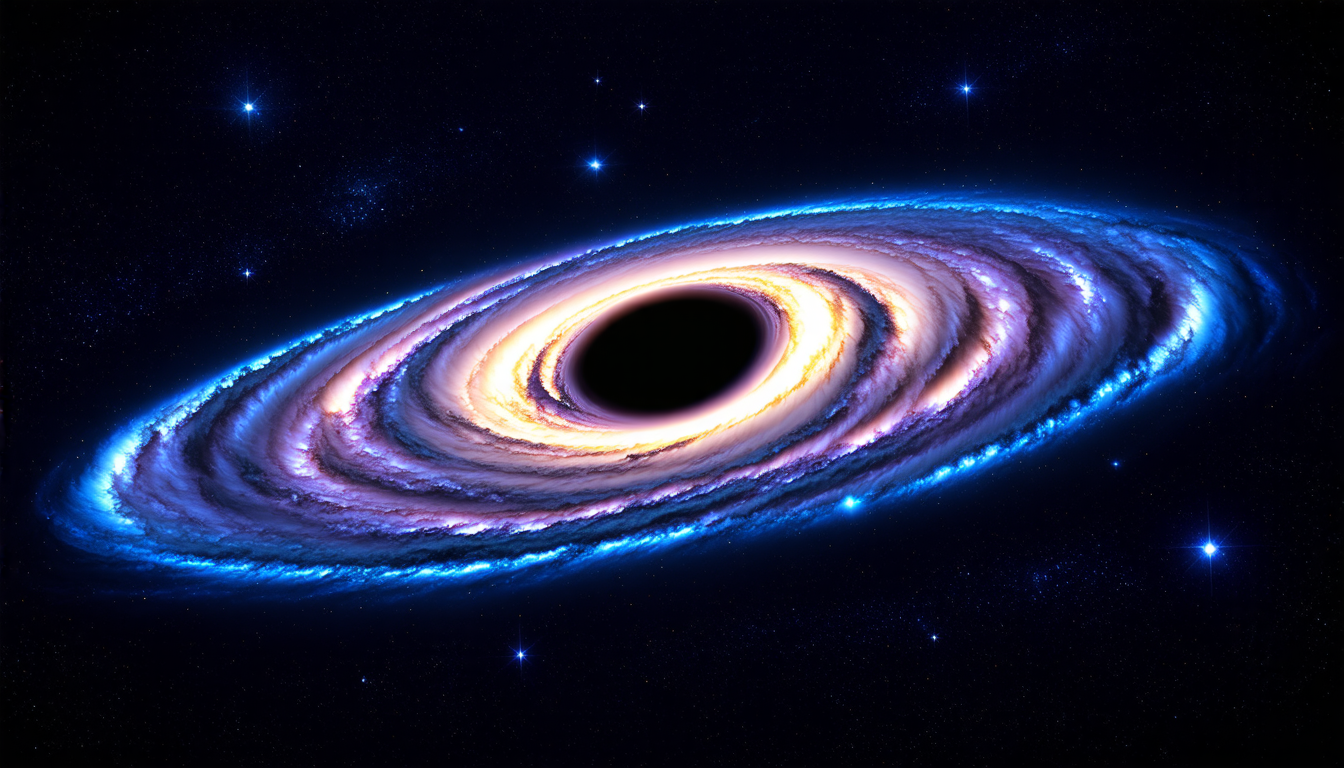
One of the key findings is that QPEs are likely caused by a misaligned spinning disk around the black hole. This alignment affects the way matter flows towards the black hole, causing it to release energy in the form of X-rays and other forms of radiation. The researchers used sophisticated computer simulations to model this process and found that it can lead to the observed patterns of QPEs.
The team also discovered that QPEs are not just random events, but rather they follow a specific pattern. By analyzing data from multiple galaxies, they found that the frequency and intensity of QPEs correlate with the mass of the black hole at the center. This suggests that there is a direct link between the size of the black hole and the likelihood of QPEs occurring.
Another interesting aspect of QPEs is their impact on the surrounding environment. The researchers found that QPEs can trigger powerful winds and jets of energy, which can affect the formation of stars and planets in nearby galaxies. This has significant implications for our understanding of galaxy evolution and the role that supermassive black holes play in shaping the universe.
The study also highlights the importance of continued research into these phenomena. By studying QPEs, scientists can gain a better understanding of the complex interactions between black holes, stars, and gas in galaxies. This knowledge can help us better comprehend the intricate dance of celestial bodies that shapes our universe.
One of the most significant aspects of this study is its potential to shed light on some of the most pressing questions in astrophysics. For example, scientists have long wondered how supermassive black holes at the centers of galaxies manage to grow so massive over billions of years. QPEs may hold the key to unlocking this mystery, as they could be a crucial mechanism for fueling the growth of these behemoths.
The research has far-reaching implications for our understanding of the universe and its many mysteries. By continuing to study QPEs, scientists can unlock new insights into the workings of black holes, galaxies, and the cosmos itself.
Cite this article: “Unlocking the Secrets of Quasi-Periodic Eruptions in Supermassive Black Holes”, The Science Archive, 2025.
Quasi-Periodic Eruptions, Supermassive Black Holes, Galaxy Centers, Energy Bursts, X-Rays, Radiation, Computer Simulations, Mass Correlation, Wind Jets, Astrophysics





