

Thursday 06 March 2025
A team of researchers has made a significant breakthrough in developing a new method for tracking objects in 3D point cloud data captured by LiDAR sensors. The approach, called NextStop, uses a combination of motion estimation and data association to improve the accuracy and robustness of object tracking.
The challenge of object tracking is that it requires identifying and following specific objects across multiple frames of video or sensor data. This can be tricky because objects may move rapidly, change shape or orientation, or even disappear from view. To make matters worse, LiDAR sensors often produce noisy or incomplete data, making it difficult to accurately track objects.
NextStop addresses these challenges by using a Kalman filter-based approach to estimate the motion of objects in 3D space. The Kalman filter is a mathematical algorithm that uses a series of measurements and predictions to estimate the state of an object over time. In this case, the measurements come from the LiDAR sensor, which provides data on the position, orientation, and velocity of objects in the scene.
The researchers also developed a novel way to associate the predicted motion with actual detections from the LiDAR sensor. This is done by calculating a score for each possible match between the predicted motion and the detected object, based on factors such as distance, size, and shape.
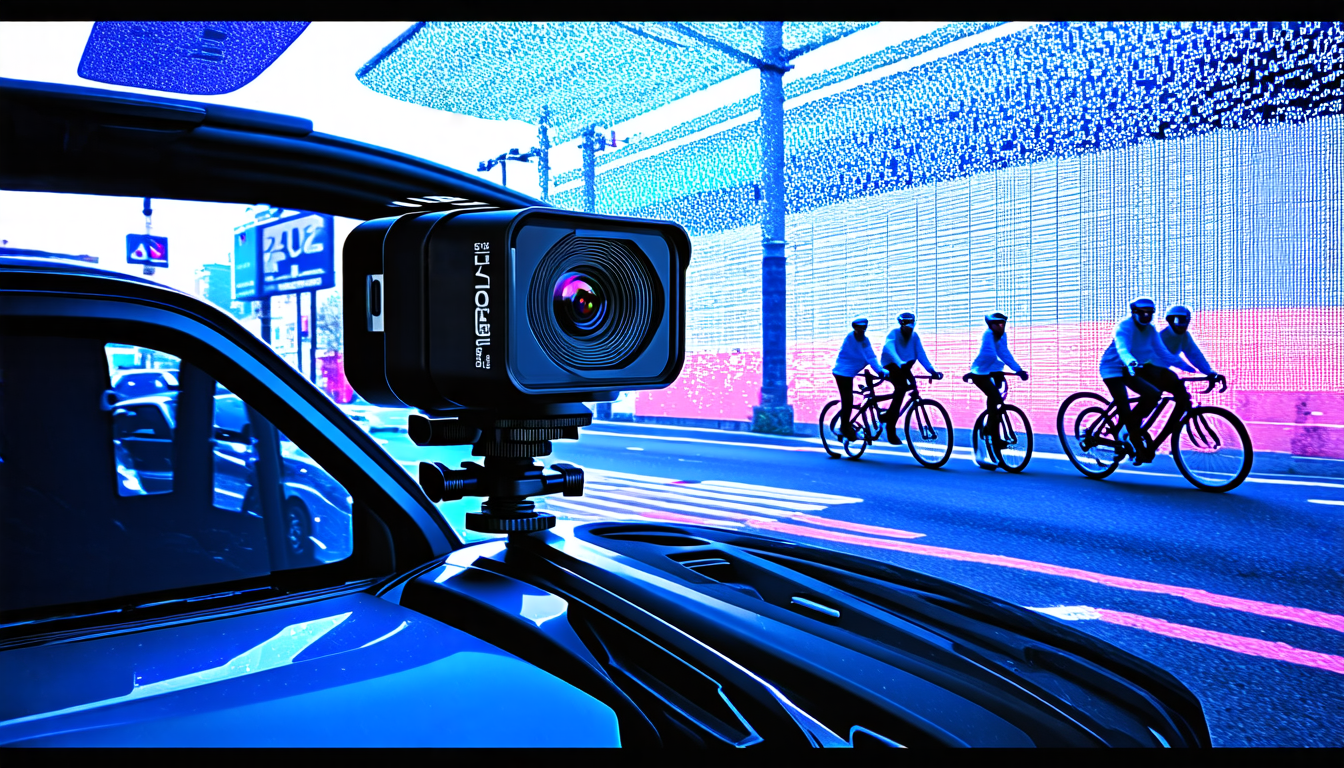
NextStop was tested on the SemanticKITTI dataset, which contains 3D point cloud data captured by a LiDAR sensor mounted on a vehicle. The results show that NextStop outperforms other state-of-the-art methods in terms of tracking accuracy and robustness, especially for small objects like pedestrians and bicycles.
One key advantage of NextStop is its ability to handle occlusion and missing data. When an object moves behind another obstacle or is partially blocked from view by a wall or tree, traditional tracking algorithms can struggle to maintain accurate tracking. However, NextStop’s Kalman filter-based approach allows it to smoothly interpolate the motion of objects even in the presence of noise or incomplete data.
The researchers believe that NextStop has significant potential for applications in autonomous vehicles, robotics, and other fields where accurate object tracking is crucial. For example, autonomous vehicles could use NextStop to track pedestrians and other road users, allowing them to react more quickly and safely to changing traffic conditions.
Overall, the development of NextStop represents an important step forward in the field of computer vision and machine learning.
Cite this article: “NextStop: A Novel Approach for Accurate Object Tracking in 3D Point Cloud Data”, The Science Archive, 2025.
Object Tracking, Lidar Sensors, 3D Point Cloud Data, Motion Estimation, Kalman Filter, Data Association, Computer Vision, Machine Learning, Autonomous Vehicles, Robotics





