

Thursday 06 March 2025
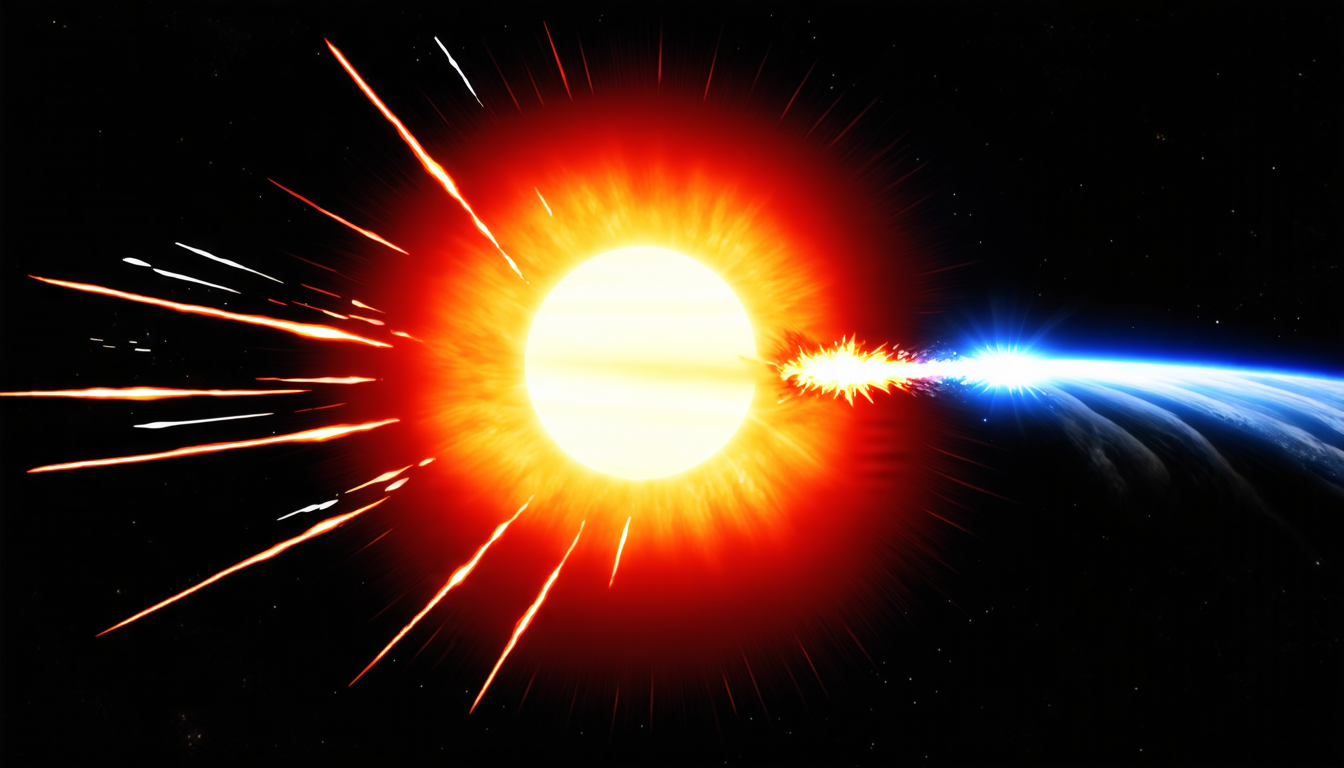
Deep in the solar atmosphere, a spectacular display of energy is unfolding. A coronal EUV jet, powered by magnetic reconnection, shoots out a burst of superheated plasma into the vast expanse of space. This phenomenon has long fascinated scientists, but new research sheds light on the complex dynamics at play.
At its core, the coronal EUV jet is a manifestation of the solar atmosphere’s intrinsic instability. Magnetic fields, which permeate the sun’s surface, are constantly shifting and interacting with each other. When these fields become tangled, they release an enormous amount of energy in the form of plasma, accelerating particles to incredible speeds.
The latest study has focused on a particularly intriguing aspect of coronal EUV jets: their ability to produce multiple episodes of brightening at remote locations. These events, known as remote brightenings (RBs), are thought to be caused by the propagation of energy from the jet’s eruption site. But what exactly drives these RBs?
The researchers used a combination of observations and numerical simulations to investigate this question. By analyzing data from NASA’s Atmospheric Imaging Assembly (AIA) instrument, they identified two distinct peaks in the brightening pattern of an RB event. The first peak occurred just 12 seconds after the jet’s eruption, while the second peak lagged behind by around 108 seconds.
To understand these findings, the team turned to a one-dimensional simulation of the coronal EUV jet and its associated magnetic fields. This allowed them to recreate the complex interactions between plasma flows, shock waves, and thermal conduction in exquisite detail.
The simulations revealed that the second peak of the RB is likely caused by a slow shock wave generated at the jet’s eruption site. This shock wave propagates through the solar atmosphere, heating the surrounding plasma and creating the observed brightening. In contrast, the first peak is thought to be driven by non-thermal electrons accelerated by magnetic reconnection.
These findings have significant implications for our understanding of coronal EUV jets and their impact on the solar atmosphere. By shedding light on the complex dynamics at play, scientists can better predict how these events will evolve and how they might affect space weather.
In the context of space weather, RBs are particularly interesting because they can produce powerful bursts of radiation that can interfere with satellite communications and navigation systems. Understanding the underlying physics of these events is crucial for developing more accurate forecasts and mitigating their effects on our technological infrastructure.
Cite this article: “Unraveling the Dynamics of Coronal EUV Jets: A Key to Predicting Space Weather”, The Science Archive, 2025.
Coronal Euv Jets, Solar Atmosphere, Magnetic Reconnection, Plasma, Space Weather, Radiation, Satellite Communications, Navigation Systems, Forecasting, Magnetic Fields





