
Thursday 06 March 2025
The intricate dance of predator and prey in ecosystems is a delicate balance, one that can be disrupted by even small changes. A new study has shed light on the complex interactions between species in an ecosystem, revealing how seemingly minor alterations to population sizes or hunting rates can have far-reaching consequences.
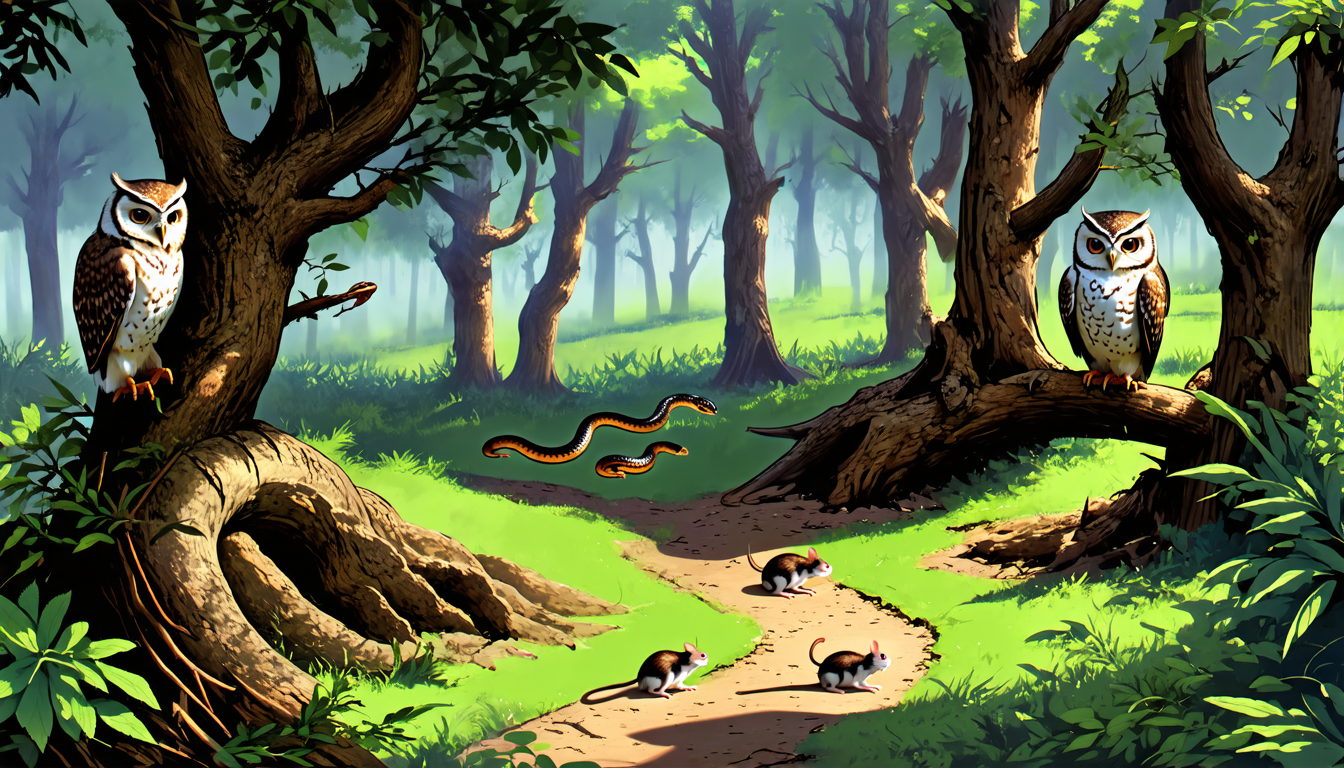
Researchers used a mathematical model to simulate the behavior of three interacting species: owls, snakes, and mice. The model took into account the intricate web of predator-prey relationships, as well as the impact of competition for resources within each species. By analyzing the system’s behavior under different scenarios, the team uncovered some surprising insights.
One key finding was that even small changes in population sizes or hunting rates can lead to dramatic shifts in the ecosystem’s dynamics. For example, a slight increase in owl populations may seem like a minor adjustment, but it could ultimately cause the mouse population to decline precipitously. This is because owls not only prey on mice directly but also indirectly by controlling snake populations, which in turn have an impact on mouse numbers.
The study also highlighted the importance of considering the context in which these interactions take place. In other words, what works well for one ecosystem may not be effective in another. The researchers found that a particular parameter setting – such as a specific balance between predation and competition rates – can lead to stable equilibrium states in some systems but create unstable dynamics in others.
The findings have significant implications for conservation efforts and the management of ecosystems. They suggest that simply controlling one species or adjusting a single population size may not be enough to achieve long-term stability. Instead, policymakers must consider the complex interplay between all species involved and take a holistic approach to managing ecosystems.
Moreover, the study highlights the importance of understanding the underlying dynamics of ecosystem interactions. By using mathematical models to simulate these interactions, researchers can gain valuable insights into how different scenarios might play out in reality. This knowledge can then be used to inform decision-making and develop more effective conservation strategies.
The research is a prime example of the power of interdisciplinary collaboration between mathematicians, biologists, and ecologists. By combining their expertise, scientists can tackle complex problems that may seem daunting at first glance. The study’s results demonstrate the importance of considering the intricate web of relationships within ecosystems and highlight the need for a more nuanced approach to conservation.
In the face of climate change, habitat destruction, and other environmental challenges, it is more crucial than ever to develop a deeper understanding of ecosystem dynamics.
Cite this article: “Web of Complexity: Unraveling Ecosystem Interactions”, The Science Archive, 2025.
Predator-Prey Relationships, Ecosystems, Population Sizes, Hunting Rates, Mathematical Model, Simulation, Conservation Efforts, Ecosystem Management, Climate Change, Habitat Destruction