

Thursday 06 March 2025
Savannas, those vast expanses of grasslands dotted with trees, have long been a source of fascination for scientists and nature lovers alike. These ecosystems are home to a diverse array of species, from towering acacia trees to grazing antelopes, and play a crucial role in the global carbon cycle. But despite their importance, savannas are facing unprecedented threats from climate change, overgrazing, and habitat destruction.
Researchers have long sought to understand the complex interactions that govern these ecosystems, but it’s only recently that they’ve made significant progress in modeling the dynamics of savanna systems. A new study published in a leading scientific journal takes a unique approach to understanding how fires and herbivory shape the stability of these ecosystems.
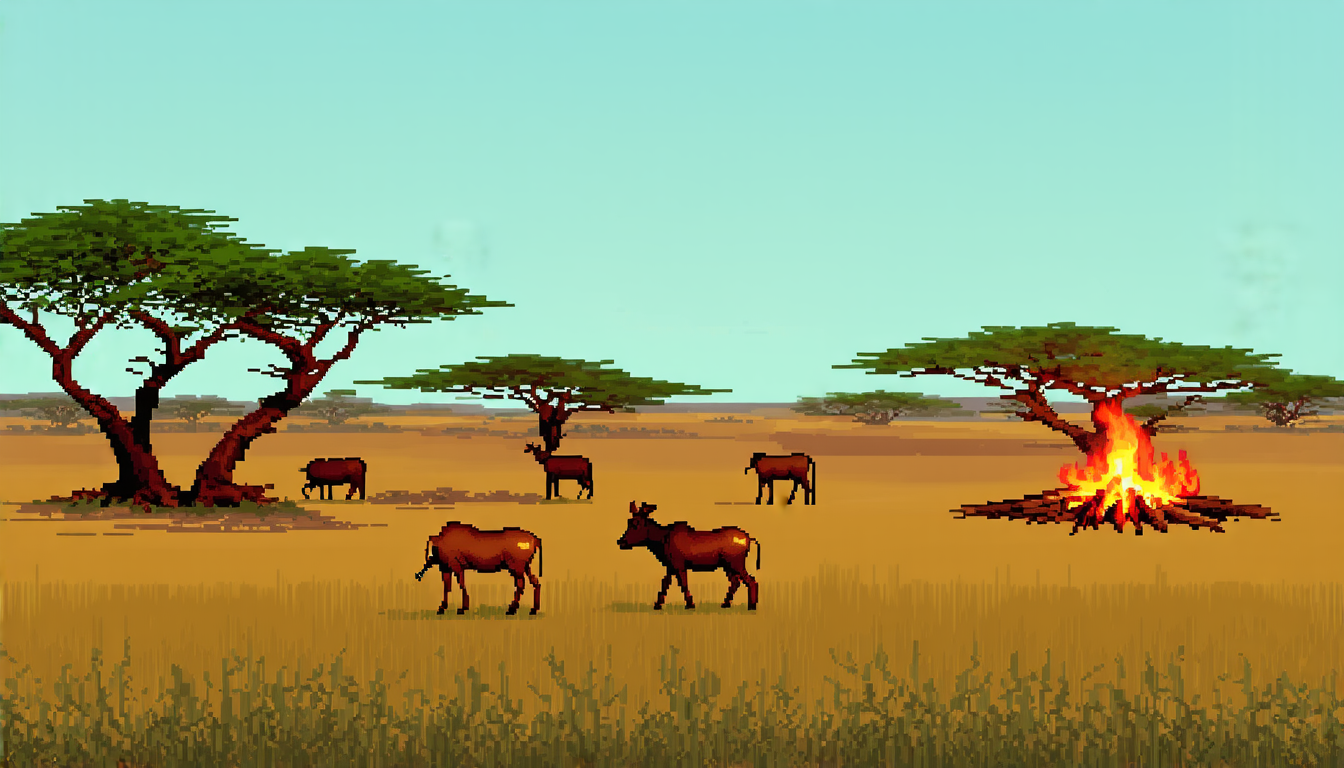
The researchers used a combination of mathematical models and field observations to explore the impact of fire and grazing on the balance between grasses and trees in savannas. They found that when fires are frequent, they can actually promote tree growth by reducing competition from grasses. However, if fires become too rare, grasses can overgrow the area, choking out trees and leading to a loss of biodiversity.
The team also discovered that herbivory – the eating of plants by animals – plays a crucial role in shaping the savanna ecosystem. When herbivores are present, they can help maintain the balance between grasses and trees by controlling the growth of dominant species. But if there’s too little grazing pressure, certain plant species can dominate the landscape, leading to a loss of diversity.
The researchers used computer simulations to test their models against real-world data from savannas across Africa and Australia. They found that their models accurately predicted the outcomes of different scenarios, including changes in fire frequency and herbivory levels.
These findings have important implications for conservation efforts. By understanding how fires and herbivory shape the stability of savanna ecosystems, scientists can develop more effective strategies for managing these environments. For example, controlled burns could be used to promote tree growth and maintain biodiversity, while targeted grazing programs could help control dominant plant species.
The study also highlights the importance of considering multiple factors when making decisions about savanna management. Simply focusing on one aspect, such as fire frequency or herbivory levels, can have unintended consequences for the ecosystem as a whole.
As scientists continue to unravel the complexities of savanna ecosystems, their findings will likely have significant implications for conservation and land-use planning around the world.
Cite this article: “Unlocking the Secrets of Savannas: How Fire and Herbivory Shape Ecosystem Stability”, The Science Archive, 2025.
Savannas, Climate Change, Overgrazing, Habitat Destruction, Mathematical Models, Field Observations, Fire Frequency, Herbivory, Biodiversity, Conservation Efforts, Land-Use Planning





