

Thursday 06 March 2025
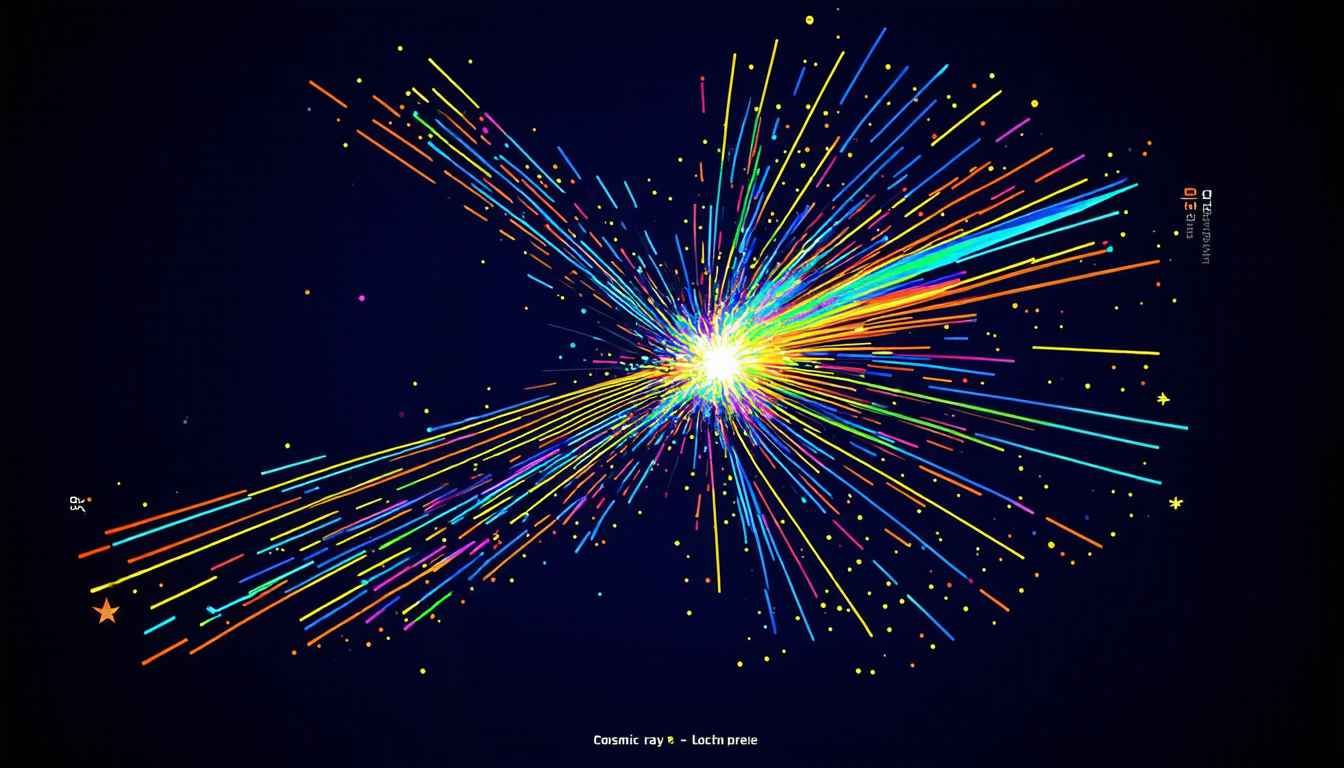
Scientists have long been fascinated by extreme-energy cosmic rays, which are particles that bombard the Earth’s atmosphere at nearly the speed of light. These high-energy particles can originate from distant galaxies, and studying them can provide valuable insights into the universe’s most powerful events.
Recently, a team of researchers has made a significant breakthrough in understanding these cosmic rays. They’ve developed a new method for determining where they come from, allowing scientists to pinpoint their origins with unprecedented precision.
The key to this achievement lies in the way extreme-energy particles interact with the cosmic microwave background radiation that fills the universe. As these particles travel through space, they collide with photons and other particles, causing them to lose energy and change direction. By analyzing the patterns of these interactions, scientists can reconstruct the path these particles took as they traveled from their source to Earth.
The new method uses a mathematical framework called matrix exponential distributions to model these interactions. This approach allows researchers to calculate the likelihood of different origins for each particle, providing a probability distribution that indicates where it likely came from.
To test this method, the team analyzed data from the Amaterasu event, which is an extremely energetic cosmic ray detected by the Telescope Array observatory in 2023. By applying their new approach, they were able to narrow down the possible origins of this particle to within a few megaparsecs – that’s just a tiny fraction of the distance between our galaxy and the nearest large galaxy cluster.
This achievement has significant implications for our understanding of extreme-energy cosmic rays. It shows that scientists may be able to determine where these particles come from, even if they’ve traveled vast distances across the universe. This could provide new insights into the sources of these particles, which are thought to originate from powerful astrophysical events such as supernovae explosions or the collision of galaxies.
The study also highlights the importance of understanding the properties of extreme-energy particles and how they interact with their environment. By developing more sophisticated models of these interactions, scientists can refine their ability to pinpoint the origins of these particles and gain a deeper understanding of the universe’s most powerful events.
In practical terms, this breakthrough could lead to new ways of studying cosmic rays in real-time. Astronomers could use advanced detectors to track the trajectories of these particles as they enter the Earth’s atmosphere, providing valuable information about their origins and properties. This could help scientists better understand the physics of extreme-energy particle interactions and even detect signs of exotic phenomena such as dark matter.
Cite this article: “Cosmic Rays: New Method Uncovers Origins with Unprecedented Precision”, The Science Archive, 2025.
Cosmic Rays, Extreme-Energy Particles, Cosmic Microwave Background Radiation, Matrix Exponential Distributions, Particle Interactions, Astrophysical Events, Supernovae Explosions, Galaxy Collisions, Dark Matter, Telescope Array Observatory.
Reference: Leonel Morejon, “Origin likelihood functions for extreme-energy cosmic rays” (2025).





