

Thursday 06 March 2025
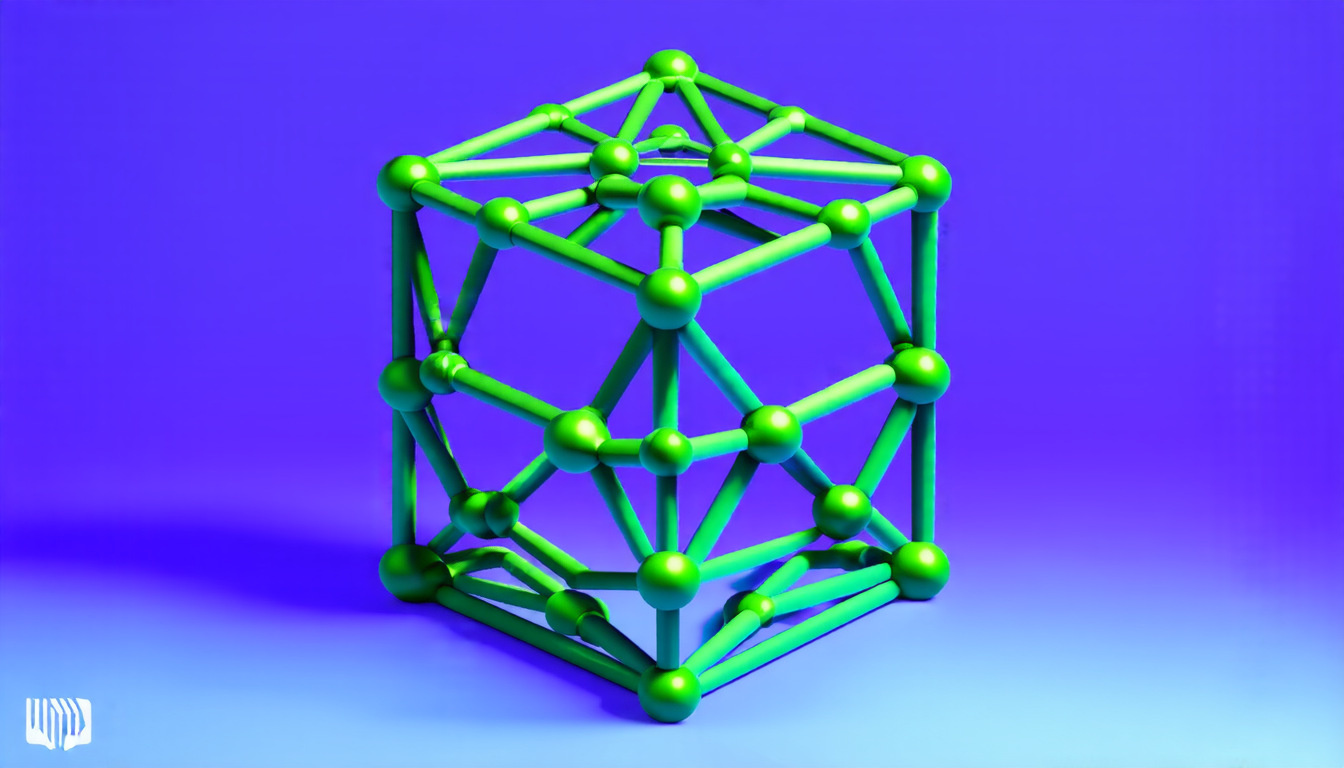
Mathematicians have long been fascinated by the properties of polytopes, three-dimensional shapes formed by a finite number of vertices, edges, and faces. These complex structures have been studied extensively in various fields, including geometry, algebra, and computer science. Recently, researchers have made significant progress in understanding the behavior of polytopes using a combination of mathematical techniques and computational methods.
One of the most intriguing aspects of polytopes is their ability to be decomposed into simpler shapes called simplicial cones. These cones are crucial for solving problems related to counting lattice points within polytopes, which has numerous applications in fields such as computer graphics, cryptography, and optimization. However, finding efficient algorithms for decomposing polytopes into simplicial cones has proven to be a challenging task.
A new study published by researchers from the School of Mathematical Sciences at Capital Normal University has shed light on this problem. By developing an algebraic combinatorial approach, they have created an algorithm called SimpCone that efficiently decomposes polytopes into simplicial cones. This breakthrough has far-reaching implications for various fields where polytopes are used.
The SimpCone algorithm is based on a combination of mathematical techniques and computational methods. It starts by identifying the extreme rays of the polytope, which are points on the boundary that cannot be written as convex combinations of other points. The researchers then use algebraic manipulations to decompose the polytope into simplicial cones, each of which is formed by a subset of the extreme rays.
One of the key advantages of SimpCone is its ability to handle large polytopes with thousands of vertices and faces. Traditional methods for decomposing polytopes are often limited by their computational complexity, making them impractical for large-scale problems. In contrast, SimpCone can efficiently decompose polytopes of any size, making it a valuable tool for researchers in various fields.
The applications of SimpCone are diverse and numerous. For example, in computer graphics, the algorithm can be used to generate efficient rendering algorithms for complex scenes. In cryptography, SimpCone can help cryptographers design more secure encryption schemes by analyzing the properties of polytopes. In optimization, the algorithm can be used to solve large-scale linear programming problems with thousands of constraints.
The researchers behind SimpCone believe that their algorithm has the potential to transform our understanding of polytopes and their applications.
Cite this article: “Efficient Polytope Decomposition Algorithm Unlocks New Applications”, The Science Archive, 2025.
Polytopes, Simplicial Cones, Algebraic Combinatorics, Computer Graphics, Cryptography, Optimization, Linear Programming, Decomposition Algorithms, Geometry, Algebra.
Reference: Guoce Xin, Xinyu Xu, Zihao Zhang, “A combinatorial simplicial cone decomposition” (2025).





