

Thursday 06 March 2025
The latest advancements in artificial intelligence have led to a significant breakthrough in creating realistic simulations of urban environments, enabling robots and autonomous vehicles to navigate complex scenes with ease.
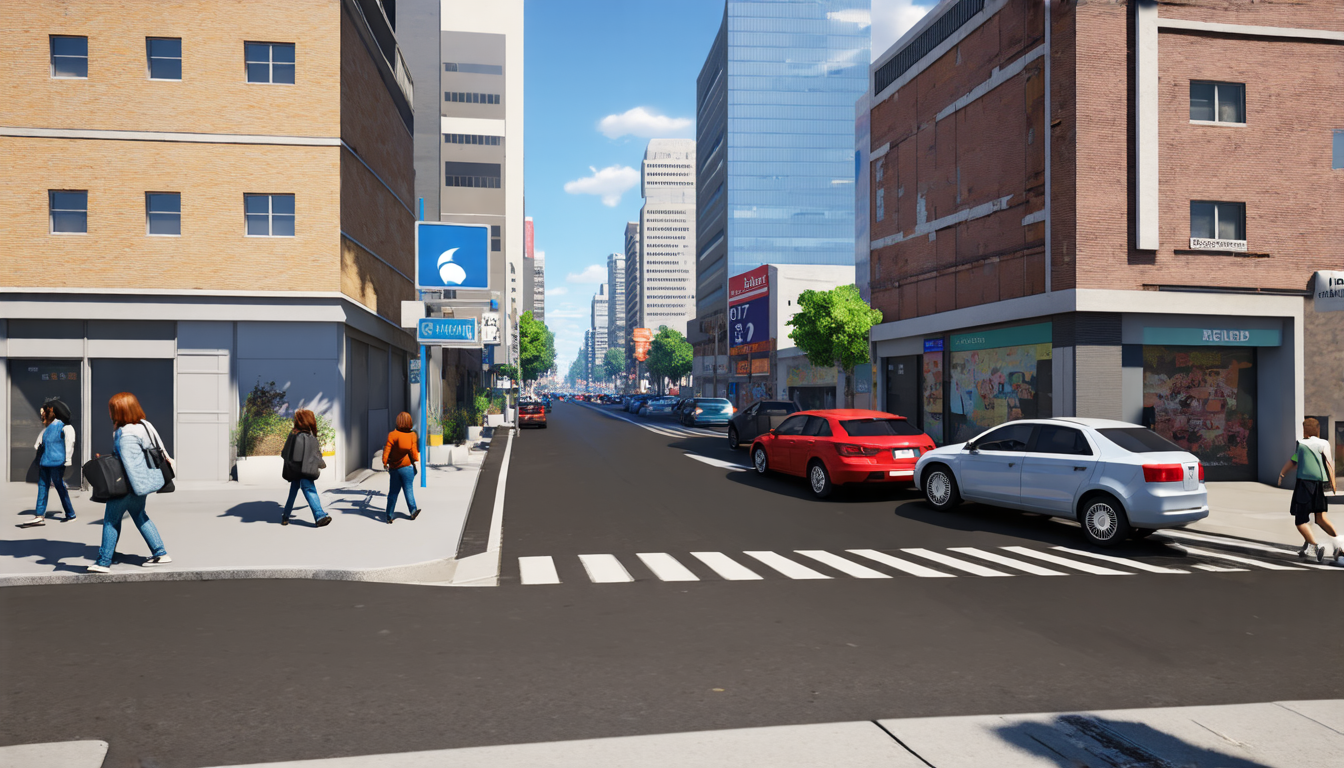
Researchers have developed a novel framework called Vid2Sim, which allows them to convert monocular videos captured by hand-held cameras into photorealistic and interactive 3D simulation environments. This technology has far-reaching implications for the development of intelligent agents that can operate in various urban settings.
To achieve this feat, scientists used a combination of computer vision techniques, including structure-from-motion (SfM) and geometry-consistent reconstruction. They employed an advanced SfM system called GLOMAP to initialize point clouds and camera poses from the video frames. This allowed them to create accurate 3D models of urban scenes with minimal errors.
The next step was to reconstruct the scene geometry using a technique called Gaussian splatting. This involved rendering depth maps, normal maps, and RGB images from each frame and fusing them into a dense point cloud. The resulting mesh was then extracted using voxel carving and ground plane segmentation.
To further refine the simulation environment, researchers implemented screen-space covariance culling to remove rendering artifacts and improve agent observation quality. This technique allows agents to perceive their surroundings more accurately, enabling them to make better decisions.
The Vid2Sim framework has been tested in various urban environments, including streets, alleys, and parking lots. The results show that the simulated scenes are highly realistic, with accurate geometry, texture, and lighting. Agents trained in these simulations demonstrated improved navigation skills, navigating complex routes and avoiding obstacles with ease.
One of the most significant advantages of Vid2Sim is its ability to bridge the sim-to-real gap, enabling agents to seamlessly transition from simulation to real-world deployment. This was achieved by using a single framework for both simulation and real-world testing, eliminating the need for separate models or training protocols.
The potential applications of Vid2Sim are vast, ranging from autonomous vehicles and drones to robots and humanoid agents. The technology has the potential to revolutionize various industries, including logistics, transportation, and construction.
In addition to its practical implications, Vid2Sim also represents a significant milestone in the development of artificial intelligence. It demonstrates the ability of AI systems to learn and adapt from real-world data, creating highly realistic simulations that can be used for training and testing.
Cite this article: “Realistic Urban Simulations with Vid2Sim: Enabling Intelligent Agents to Navigate Complex Scenes”, The Science Archive, 2025.
Artificial Intelligence, Simulation, Urban Environments, Robots, Autonomous Vehicles, Computer Vision, Structure-From-Motion, Geometry-Consistent Reconstruction, Gaussian Splatting, Screen-Space Covariance Culling





