

Thursday 06 March 2025
Networks are all around us, from social media platforms to transportation systems and even the way our brains connect neurons. But understanding how these networks form and function is a complex task. A recent study has shed new light on the structure of random networks, revealing that their modularity – a measure of how well they can be divided into communities – tends to decrease as the network grows.
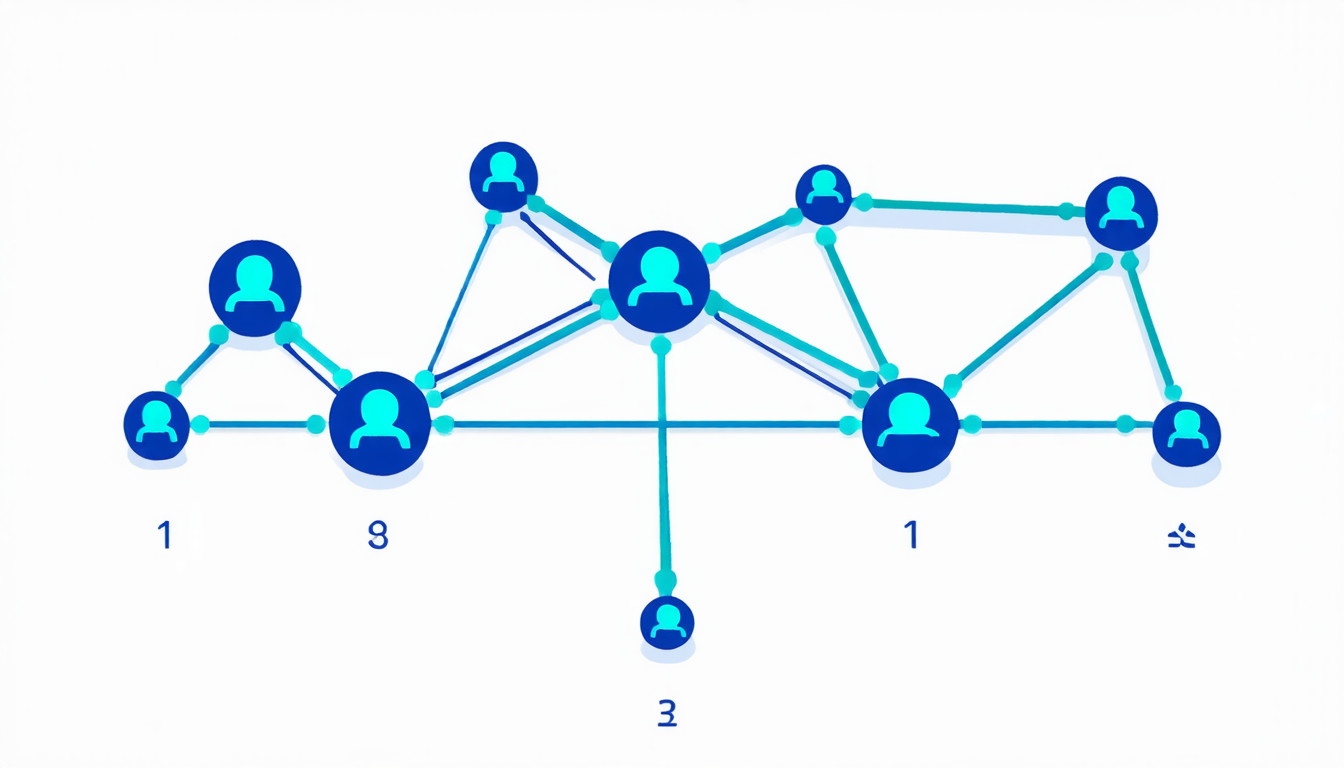
The researchers focused on preferential attachment graphs, a type of network where new nodes attach to existing ones with a probability proportional to their degree. This means that high-degree nodes are more likely to attract new connections, creating a self-reinforcing cycle. The team found that these networks exhibit a peculiar property: as they grow, their modularity increases at first, but then plateaus and eventually starts to decrease.
To understand why this happens, it’s helpful to think of modularity as a measure of how well a network can be divided into clusters or communities. In the early stages of a preferential attachment graph, new nodes tend to attach to high-degree nodes, creating tight-knit groups that are relatively isolated from one another. This leads to high modularity, as the network is easy to partition into distinct communities.
However, as the network continues to grow and more nodes become attached, the structure begins to change. The high-degree nodes start to form long-distance connections with other high-degree nodes, creating a sprawling web of relationships that transcends traditional community boundaries. This process dilutes the modularity of the network, making it harder to identify distinct communities.
The researchers used advanced mathematical techniques to model and analyze these networks, including stochastic processes and concentration inequalities. They found that the decrease in modularity is not just a statistical fluke, but rather a fundamental property of preferential attachment graphs.
These findings have important implications for our understanding of complex systems, from social networks to biological networks. By recognizing that modularity tends to decrease as these networks grow, researchers can refine their models and better predict how they will evolve over time.
The study’s authors also highlight the potential applications of this research in fields such as data analysis and network optimization. For example, by understanding how modularity changes in a network over time, scientists may be able to identify early warning signs of instability or collapse.
Ultimately, the discovery that modularity decreases in preferential attachment graphs is a reminder of the intricate and dynamic nature of complex systems.
Cite this article: “The Modular Structure of Random Networks”, The Science Archive, 2025.
Networks, Modularity, Preferential Attachment Graphs, Random Networks, Graph Theory, Community Detection, Complex Systems, Data Analysis, Network Optimization, Social Networks
Reference: Katarzyna Rybarczyk, Małgorzata Sulkowska, “Modularity of preferential attachment graphs” (2025).





