

Thursday 06 March 2025
In a remarkable breakthrough, scientists have made significant progress in understanding the complex patterns that emerge in networks of interconnected systems. By analyzing the structure and behavior of these networks, researchers can gain valuable insights into how they function and respond to different stimuli.
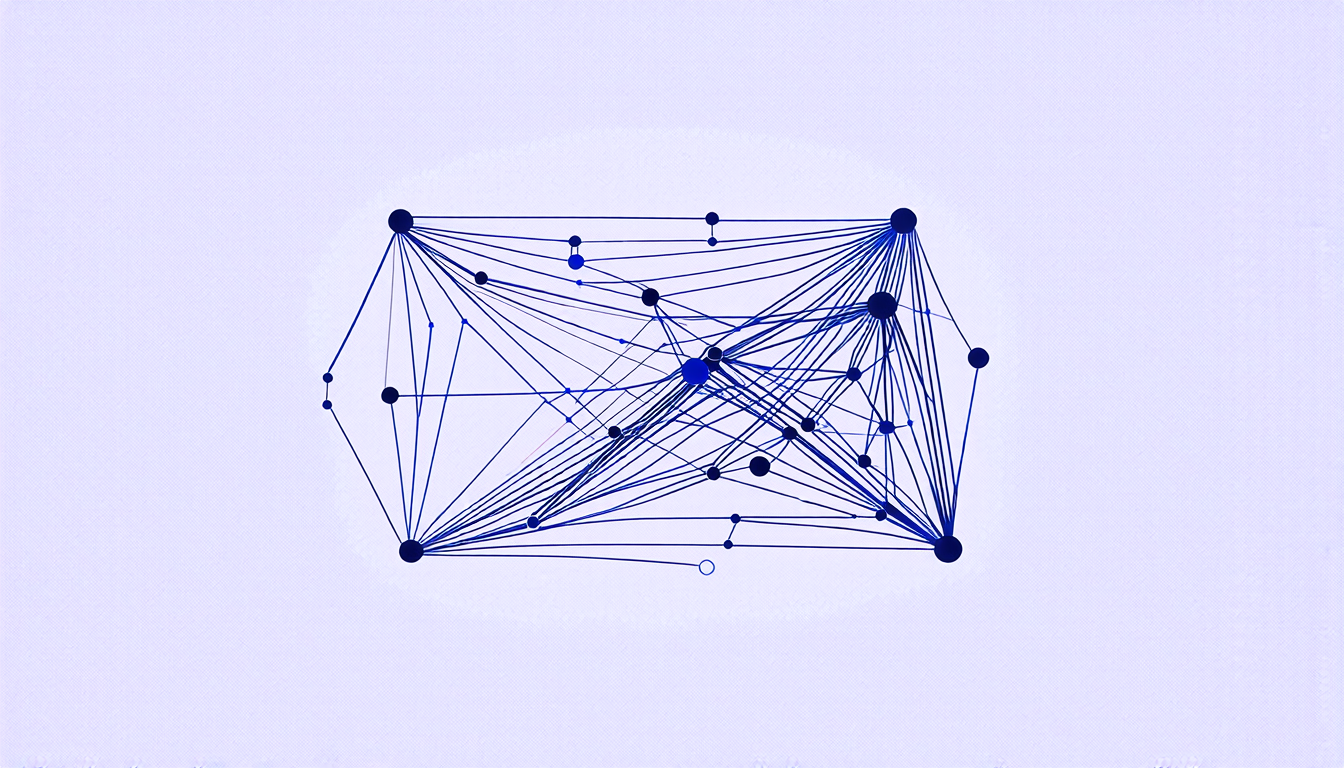
The study, published recently, focuses on a type of network called a directed multigraph. This is a graph where edges have direction and multiple edges between two nodes are allowed. Directed multigraphs are commonly found in real-world systems, such as biological networks, computer networks, and social networks.
One of the key findings of the study is the concept of branching ratios. These ratios describe how quickly information or resources spread through the network. The researchers discovered that the branching ratio of a node can be calculated by analyzing the adjacency matrix of the network’s upstream subgraph.
The adjacency matrix is a mathematical representation of the network, where each entry corresponds to the presence or absence of an edge between two nodes. By examining the eigenvalues and eigenvectors of this matrix, scientists can determine the branching ratio of individual nodes.
The study also explores the concept of asymptotics, which refers to the behavior of a function as its input grows arbitrarily large. In the context of networks, asymptotics is crucial for understanding how information or resources propagate through the system over time.
The researchers found that the asymptotic behavior of a node’s branching ratio depends on the periods of the strongly connected components (SCCs) in the network. An SCC is a subgraph where there is a path from every node to every other node. By analyzing the periods of these SCCs, scientists can predict how quickly information or resources will spread through the network.
The study’s findings have significant implications for fields such as biology, computer science, and social networks. For example, understanding the branching ratios of nodes in biological networks could provide valuable insights into how diseases spread and how treatments might be most effective.
Similarly, in computer networks, understanding the asymptotic behavior of node branching ratios could improve network design and optimization. In social networks, the study’s findings could help predict how information or ideas spread through online communities.
The researchers used a combination of mathematical techniques, including linear algebra and graph theory, to analyze the directed multigraphs. They also employed computational methods to simulate the behavior of these networks and verify their theoretical predictions.
Overall, this research represents an important step forward in understanding complex network systems.
Cite this article: “Deciphering Complex Network Patterns: A Breakthrough in Understanding Directed Multigraphs”, The Science Archive, 2025.
Networks, Directed Multigraphs, Branching Ratios, Adjacency Matrix, Eigenvalues, Eigenvectors, Asymptotics, Strongly Connected Components, Graph Theory, Linear Algebra
Reference: Paolo Boldi, Ian Stewart, “Branching Ratios of Input Trees for Directed Multigraphs” (2025).





