

Thursday 06 March 2025
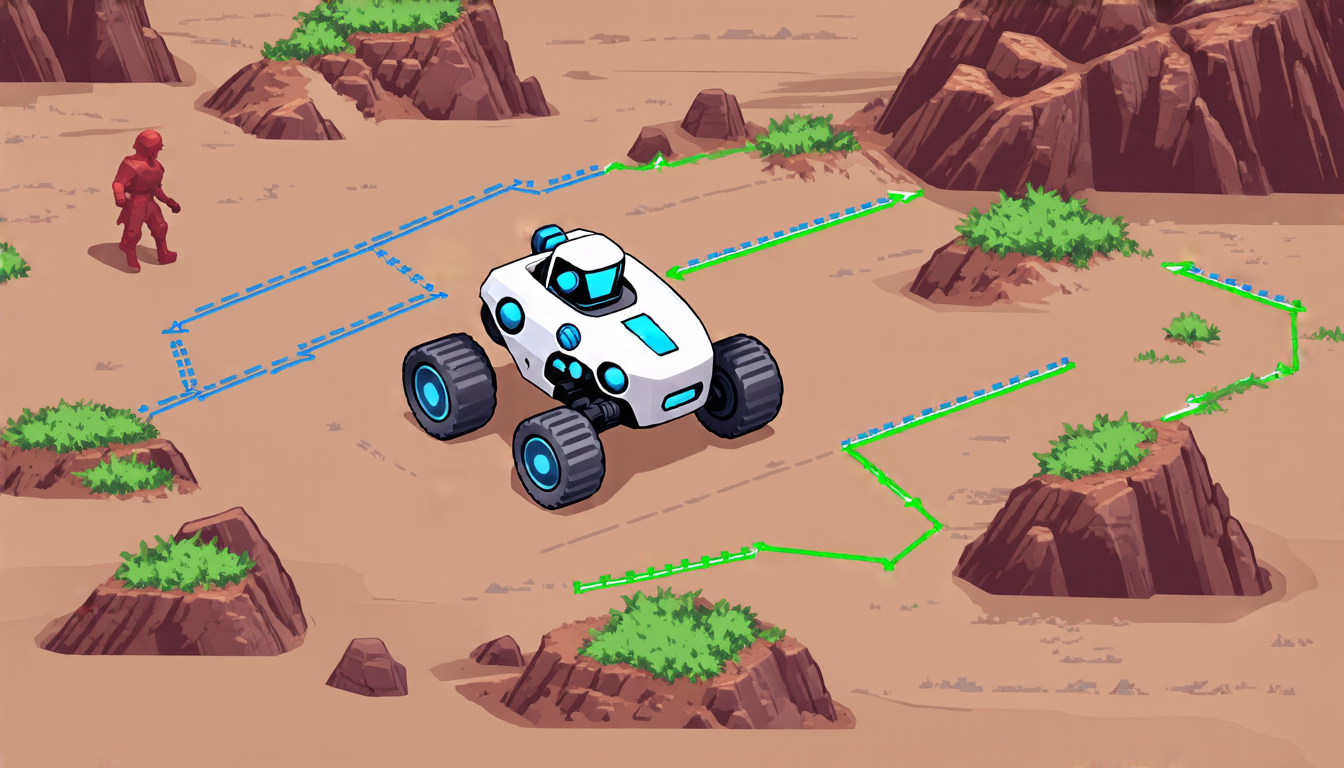
Autonomous robots are becoming increasingly prevalent in our daily lives, from self-driving cars to warehouse robots that can navigate complex terrain. But what about the challenges they face when navigating uneven and unpredictable environments? A recent study has made significant progress in tackling this issue by developing a novel approach to map-making and traversability estimation.
The researchers focused on creating a system that could efficiently generate detailed maps of an environment, even when it’s rough and unstructured. To achieve this, they used a combination of sensors, including lidar (light detection and ranging) and cameras. The lidar sensor provides high-resolution 3D point clouds of the environment, which are then processed using machine learning algorithms to create a detailed map.
But mapping is only half the battle – the robot also needs to be able to determine whether it can safely traverse different areas of the environment. This is where traversability estimation comes in. The researchers developed an algorithm that analyzes the 3D point clouds and estimates the traversability cost of each area, taking into account factors such as terrain roughness, slope, and obstacles.
The key innovation here is the use of a deep neural network to process the 3D point clouds and estimate traversability costs. This allows the system to learn from experience and improve its accuracy over time. The researchers tested their approach on various scenarios, including navigating through forests, across uneven terrain, and around obstacles.
One of the most impressive aspects of this study is its ability to handle complex environments with ease. The system can generate detailed maps and estimate traversability costs in real-time, allowing the robot to make informed decisions about where to go. This could have significant implications for applications such as search and rescue, agriculture, and construction, where robots need to be able to navigate challenging environments.
The researchers also highlight the potential benefits of their approach for reducing the amount of data required to train a traversability estimation model. By using a deep neural network, they were able to train the model using only 1000 samples, compared to thousands or even millions of samples typically required. This could make it more practical to deploy robots in real-world environments where data collection can be time-consuming and resource-intensive.
Overall, this study represents an important step forward in developing autonomous systems that can effectively navigate complex and unpredictable environments. The combination of mapping and traversability estimation provides a powerful tool for robots to make informed decisions about how to move through the world.
Cite this article: “Robots Learn to Navigate Unpredictable Environments with Improved Mapping and Traversability Estimation”, The Science Archive, 2025.
Robotics, Autonomous, Mapping, Traversability, Estimation, Lidar, Cameras, Machine Learning, Neural Networks, Real-Time, Navigation





