

Thursday 06 March 2025
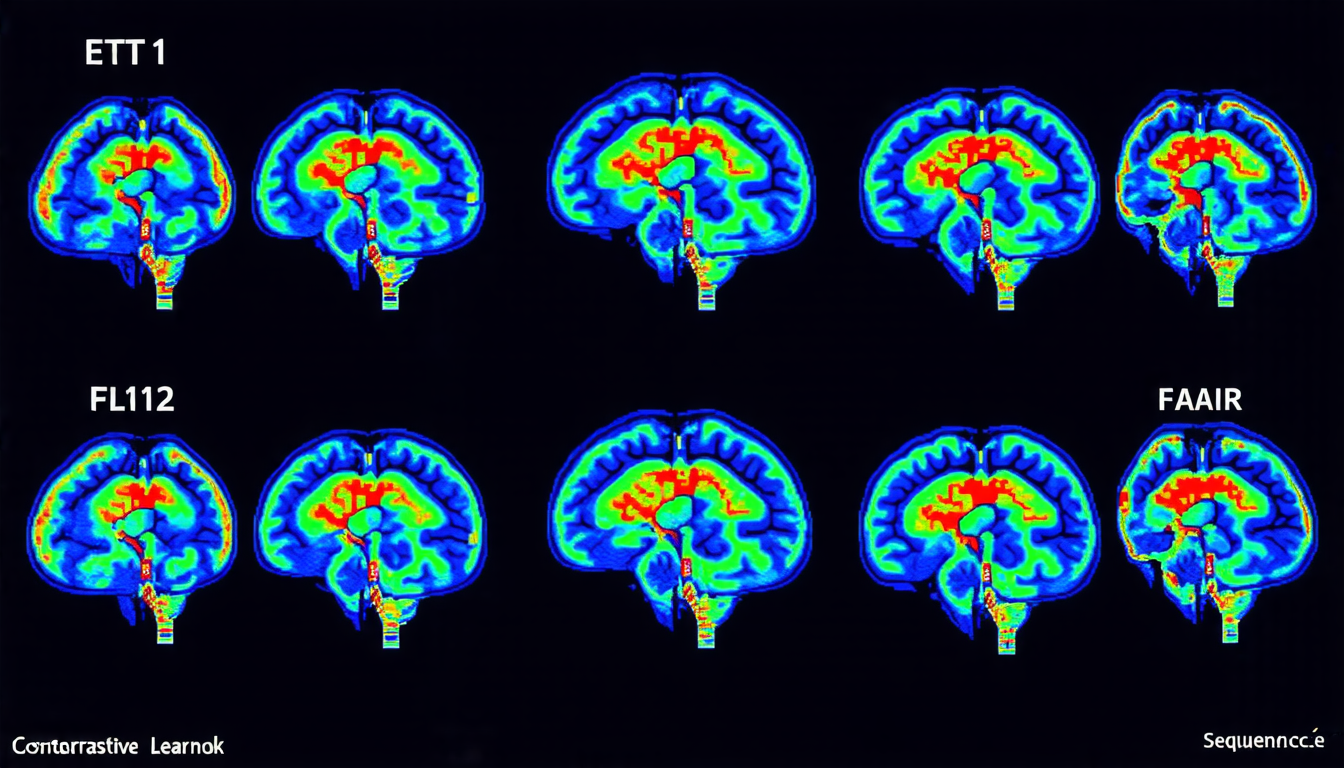
The quest for more accurate MRI sequence classification has been a long-standing challenge in medical imaging research. A team of researchers has made significant strides in this area by developing an unsupervised contrastive learning framework that can identify nine common MRI sequences with high accuracy.
The traditional approach to MRI sequence classification involves using labeled datasets, which are time-consuming and costly to create. However, the lack of standardization in MRI protocols and parameter settings across different institutions and scanners poses significant challenges for automated systems. To address this issue, researchers have turned to unsupervised learning methods that can learn from unlabeled data.
The framework developed by the researchers uses a siamese network architecture, which is trained on unlabeled MRI images using a contrastive loss function. The goal of the training process is to maximize the similarity between augmented versions of the same image while minimizing the similarity between different images. This approach allows the model to learn robust and generalizable representations of MRI sequences without relying on labeled data.
The researchers evaluated their framework on an in-house dataset of brain MRI studies, as well as three external datasets that included a mix of brain and body imaging modalities. The results showed that the unsupervised contrastive learning framework outperformed traditional supervised methods in terms of classification accuracy, especially when fine-tuning was performed using limited labeled data.
One of the key benefits of this approach is its ability to generalize well across different datasets and anatomical regions. This is because the model learns to represent MRI sequences in a way that is invariant to changes in image intensity, resolution, and other factors that can affect classification performance.
The researchers also explored the impact of batch size and image resolution on the framework’s performance. They found that increasing the batch size and image resolution improved classification accuracy, but at the cost of increased computational requirements.
Overall, this study demonstrates the potential of unsupervised contrastive learning for improving MRI sequence classification accuracy. The framework’s ability to learn robust representations from unlabeled data could lead to more efficient and effective development of medical imaging algorithms in the future.
The researchers’ approach has several implications for the field of medical imaging research. First, it highlights the importance of developing unsupervised learning methods that can leverage large amounts of unlabeled data. Second, it suggests that MRI sequence classification may be a promising area for applying contrastive learning techniques. Finally, it underscores the need for further research into optimizing the batch size and image resolution settings for this type of framework.
Cite this article: “Unsupervised Contrastive Learning Framework for MRI Sequence Classification”, The Science Archive, 2025.
Mri Sequence Classification, Unsupervised Learning, Contrastive Learning, Siamese Network, Medical Imaging Research, Image Analysis, Deep Learning, Neural Networks, Computer Vision, Machine Learning





