

Thursday 06 March 2025
Scientists have made a significant breakthrough in our understanding of gravitational interactions between celestial bodies. By studying the motion of three objects orbiting each other, researchers have been able to uncover new insights into the subtle effects that gravity has on these systems.
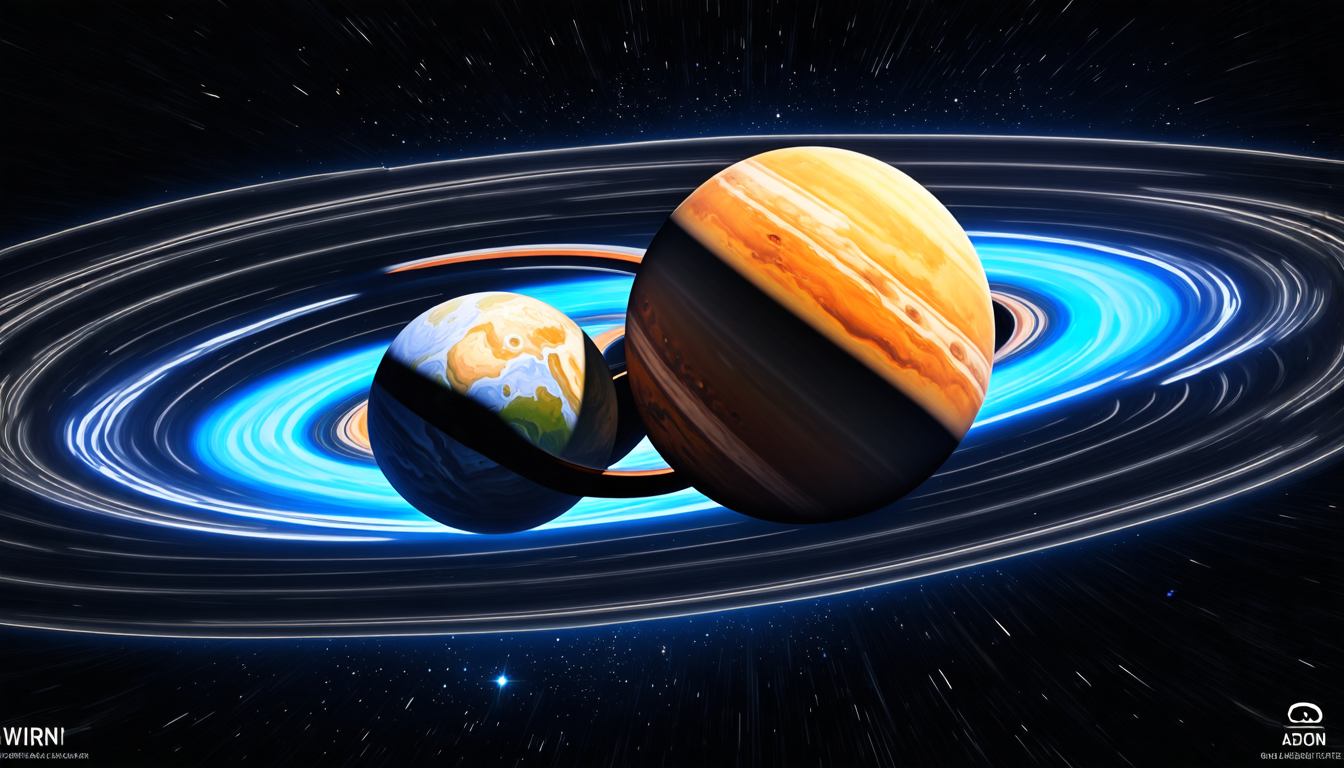
The study focused on a specific type of system known as a hierarchical three-body problem. This occurs when one large object, such as a star or black hole, is orbited by two smaller bodies, like planets or asteroids. In these situations, the gravitational forces between the objects can cause their orbits to become unstable and even lead to the ejection of one or more of the bodies from the system.
To better understand this phenomenon, scientists used advanced computer simulations to model the motion of three celestial bodies orbiting each other. They found that the effects of gravity on these systems are much more complex than previously thought. The simulations showed that the gravitational interactions between the objects can cause their orbits to become distorted and even lead to the formation of chaotic patterns.
One of the key findings was that the presence of an eccentric binary system – where two objects orbit each other at different distances from a central point – can have a significant impact on the motion of the third object. The simulations showed that this can lead to changes in the object’s orbit, including its direction and speed.
The researchers also discovered that the effects of gravity on these systems can be influenced by the mass ratio between the objects. For example, if one object is much more massive than the others, it can dominate the gravitational interactions and cause the other objects to follow a predictable path. However, if the masses are more evenly balanced, the gravitational forces can become more complex and chaotic.
The study has important implications for our understanding of celestial mechanics and the behavior of gravitational systems. It also highlights the importance of considering the subtle effects that gravity has on these systems, which can have significant impacts on their long-term evolution.
The findings of this research could also be applied to a variety of astrophysical scenarios, including the study of binary star systems, exoplanetary orbits, and even the behavior of supermassive black holes at the centers of galaxies. By better understanding the complex gravitational interactions between celestial bodies, scientists can gain valuable insights into the workings of the universe and potentially uncover new phenomena that were previously unknown.
Cite this article: “Unraveling the Complexities of Gravitational Interactions in Celestial Systems”, The Science Archive, 2025.
Gravity, Celestial Mechanics, Hierarchical Three-Body Problem, Gravitational Interactions, Computer Simulations, Orbital Motion, Chaotic Patterns, Eccentric Binary System, Mass Ratio, Astrophysical Scenarios.





