

Thursday 06 March 2025
A team of scientists has made a significant discovery in the field of astrophysics, shedding new light on the mysterious processes that occur in the hearts of galaxies. By studying the formation and evolution of massive stars in the dense disks surrounding supermassive black holes, researchers have gained valuable insights into the creation of heavy elements and the role they play in shaping our universe.
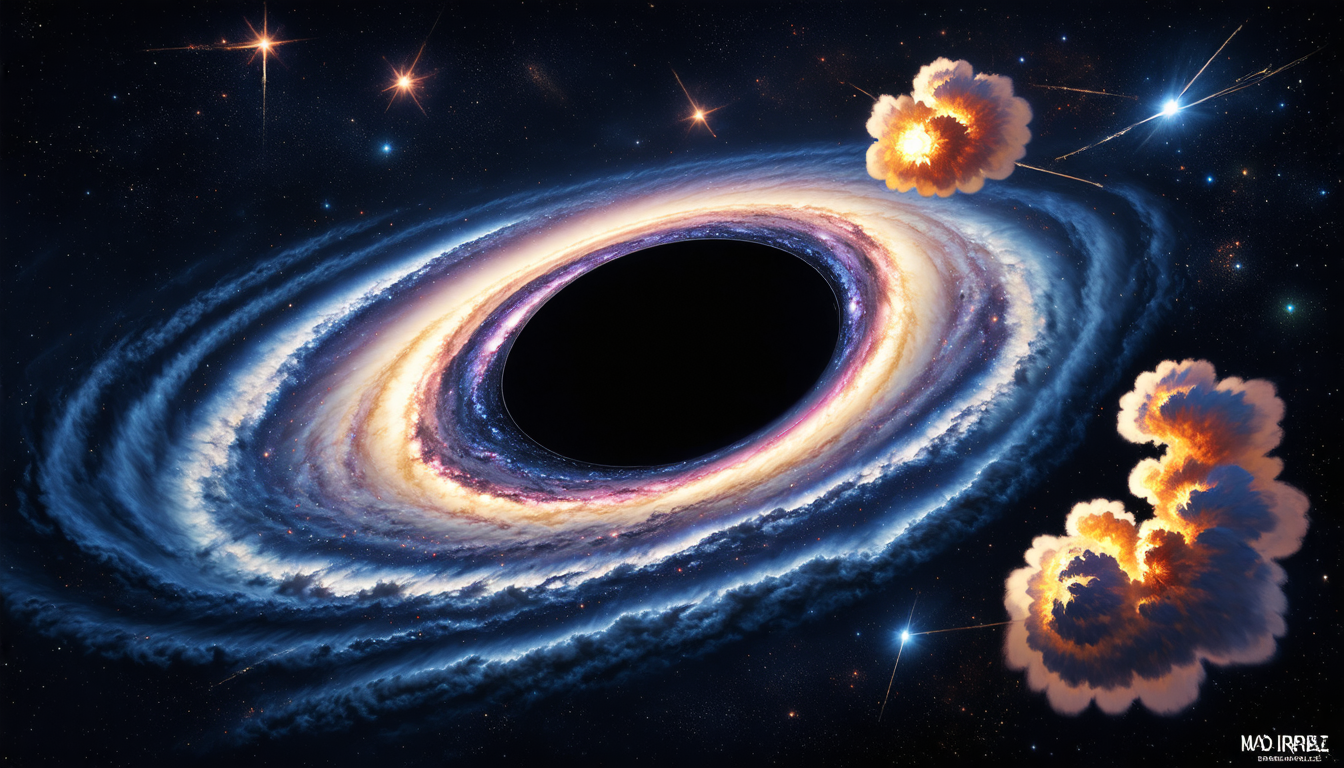
At the center of most galaxies lies a supermassive black hole, an object so dense that not even light can escape its grasp. As matter spirals towards this cosmic behemoth, it heats up and becomes incredibly hot, emitting intense radiation that illuminates the surrounding disk. This disk is thought to be the birthplace of massive stars, which are born from the collapse of giant molecular clouds.
But how do these massive stars form in such a hostile environment? The answer lies in the unique conditions found within the AGN (Active Galactic Nucleus) disk. Here, the intense radiation and strong winds generated by the black hole create a turbulent and dynamic atmosphere that is conducive to star formation.
Using sophisticated computer simulations, researchers have recreated the complex processes that govern the life cycles of these massive stars. They found that as they collapse under their own gravity, the stars undergo a series of violent explosions that expel large amounts of heavy elements into space.
These elements are crucial for the formation of subsequent generations of stars and planets, as well as the development of life itself. By studying the abundance of these elements in distant galaxies, astronomers can gain valuable insights into the history and evolution of our own universe.
One of the most significant findings from this study is the discovery that the heavy elements produced by these massive stars are not evenly distributed throughout the galaxy. Instead, they are concentrated in specific regions, such as around black holes or in areas where star formation is particularly active.
This new understanding has important implications for our understanding of galaxy evolution and the role played by supermassive black holes in shaping their development. It also highlights the importance of continued research into the mysteries of massive stars and the elements they produce.
Ultimately, this study represents a major step forward in our understanding of the intricate dance between stars, galaxies, and the universe as a whole. By continuing to explore the wonders of astrophysics, scientists are one step closer to unraveling the secrets of the cosmos and gaining a deeper appreciation for our place within it.
Cite this article: “Unlocking the Secrets of Galaxy Evolution”, The Science Archive, 2025.
Astrophysics, Galaxies, Supermassive Black Holes, Star Formation, Massive Stars, Heavy Elements, Galaxy Evolution, Agn Disk, Radiation, Simulations





