

Thursday 06 March 2025
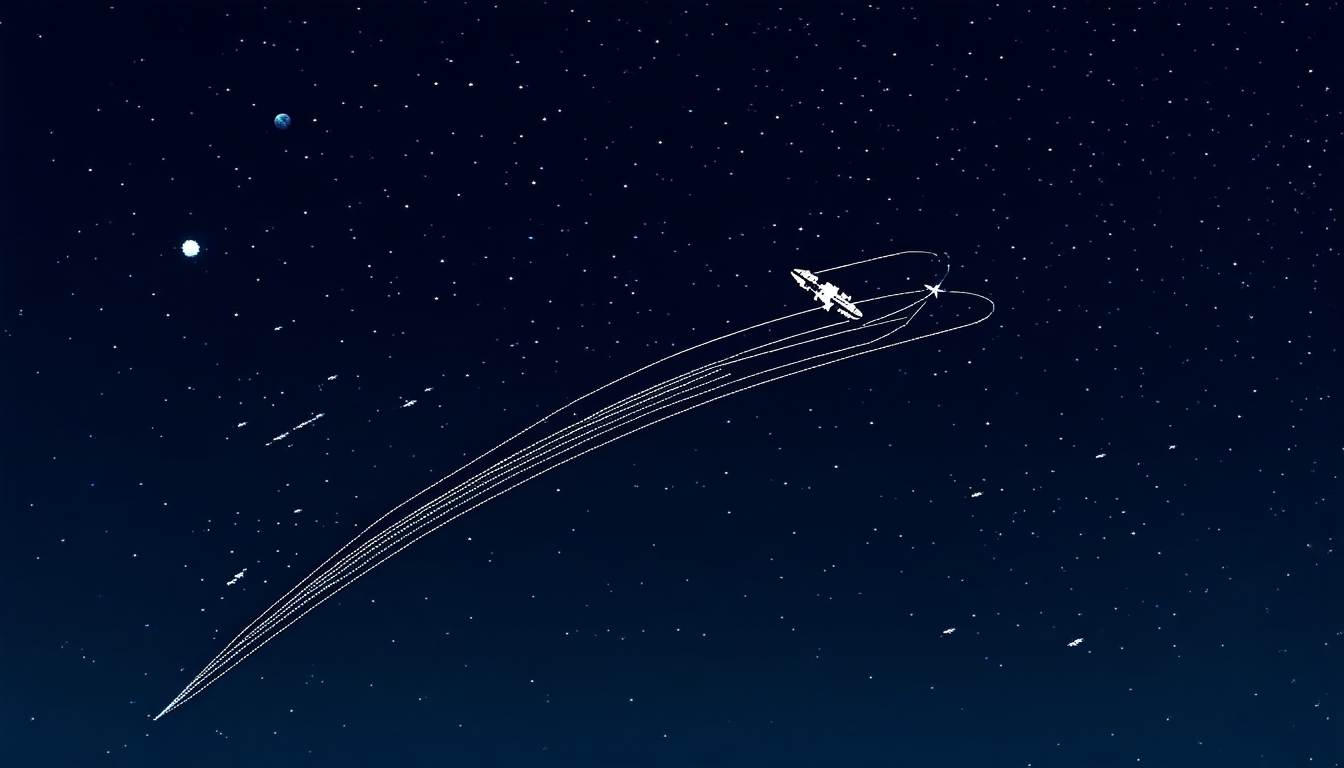
Scientists have made a significant breakthrough in the field of space exploration, developing a new method for optimizing low-thrust spacecraft trajectories. This innovative approach uses generative models to predict how the solution structure varies with respect to different conditions, allowing for faster and more accurate calculations.
Traditionally, trajectory optimization has been a time-consuming and computationally expensive process, requiring significant computational resources and expertise. The new method, however, leverages the power of machine learning to accelerate this process, making it more efficient and accessible to a wider range of researchers and engineers.
The technique involves training a neural network on a dataset of existing trajectories, using information such as the spacecraft’s maximum thrust and initial conditions. This allows the model to learn patterns and relationships between different variables, enabling it to make predictions about how the optimal trajectory will change under different scenarios.
To test the effectiveness of this approach, researchers used it to optimize two different transfer scenarios: one involving a Europa-bound spacecraft and another focused on a halo orbit around Jupiter. In both cases, the results showed that the new method was able to generate high-quality solutions significantly faster than traditional techniques.
One of the key advantages of this approach is its ability to handle complex, non-linear problems with ease. This is particularly important in space exploration, where trajectories often involve multiple gravitational bodies and require careful consideration of factors such as fuel consumption and time of flight.
The development of this new method has far-reaching implications for the field of space exploration, enabling researchers to explore new regions of the solar system more efficiently and effectively. It also opens up new possibilities for autonomous spacecraft control, allowing for more flexible and responsive mission planning in real-time.
In addition to its practical applications, this breakthrough also highlights the potential for machine learning to transform other areas of science and engineering. By leveraging the power of generative models and neural networks, researchers may be able to tackle complex problems that have previously been intractable, leading to new discoveries and innovations across a wide range of fields.
Overall, this breakthrough represents an exciting step forward in the field of space exploration, demonstrating the potential for machine learning to revolutionize our approach to optimizing spacecraft trajectories.
Cite this article: “Accelerating Space Exploration: A New Era of Trajectory Optimization”, The Science Archive, 2025.
Spacecraft, Trajectory Optimization, Generative Models, Neural Networks, Machine Learning, Space Exploration, Low-Thrust Trajectories, Computational Efficiency, Autonomous Control, Solar System





