

Friday 07 March 2025
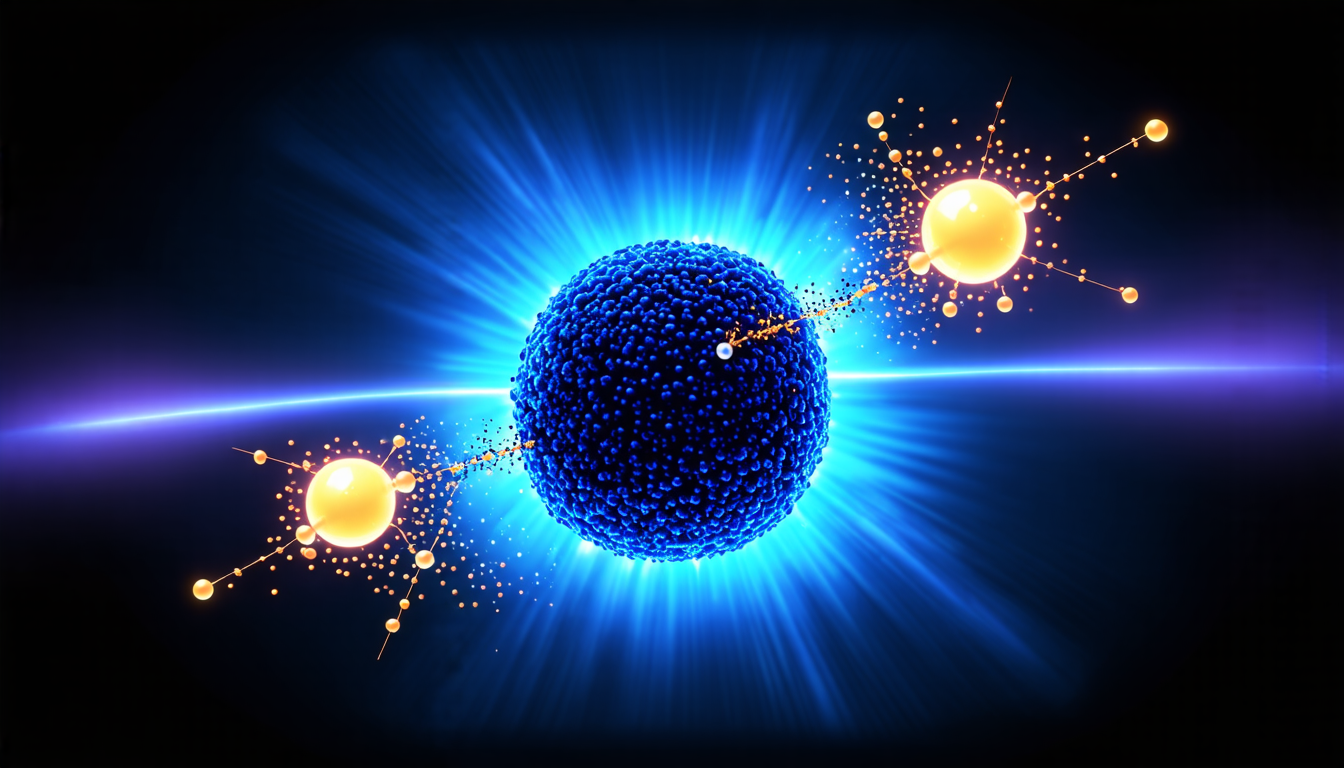
Physicists have long sought to understand the intricacies of nuclear fission, the process by which atomic nuclei split apart releasing a vast amount of energy. While we’ve made significant progress in this area, there’s still much to be learned about the complex dance of protons and neutrons that unfolds during this process.
Recently, researchers from Peking University and the Chinese Academy of Sciences have made a notable breakthrough in their study of fission dynamics. Using advanced computer simulations, they’ve been able to shed new light on how energy is partitioned between the two fragments that emerge from the fission process.
The team used a technique called time-dependent Hartree-Fock-Bogoliubov (TDHFB) to model the behavior of nuclei during fission. This approach allows researchers to simulate the movement of protons and neutrons within the nucleus in real-time, giving them a more detailed understanding of the underlying physics at play.
One key finding was that the energy partition between fragments is influenced by the strength of pairing correlations, which are essentially the interactions between like particles (protons or neutrons) within the nucleus. The researchers found that as these correlations increase, the energy released in the form of neutron emission decreases, while the excitation energies of the fragments themselves remain relatively constant.
This has significant implications for our understanding of fission dynamics and how it relates to the production of rare isotopes. Rare isotopes are crucial for a range of scientific and technological applications, from medical treatments to advanced materials development. However, their creation often relies on complex and expensive experimental setups.
The researchers’ findings suggest that pairing correlations could be used to manipulate the energy partition during fission, potentially allowing for more efficient production of rare isotopes. This has significant potential benefits for scientists working in this area, as it could reduce the need for expensive and time-consuming experiments.
Another important aspect of the study is its implications for our understanding of the scission point, the moment when the nucleus actually splits apart during fission. The researchers found that the energy released at scission is significantly influenced by the shape and deformation of the fragments themselves, which in turn affects the partitioning of energy between them.
This has significant implications for our understanding of the fission process as a whole, and could potentially be used to improve nuclear reactor designs or even develop new applications for fission-based energy production.
Cite this article: “Unraveling the Secrets of Nuclear Fission”, The Science Archive, 2025.
Nuclear Fission, Pairing Correlations, Time-Dependent Hartree-Fock-Bogoliubov, Tdhfb, Energy Partition, Fragment Excitation, Scission Point, Rare Isotopes, Nuclear Reactor Design, Fission Dynamics
Reference: Haoyu Shang, Yu Qiang, Junchen Pei, “Energy partition between splitting fission fragments” (2025).





