

Friday 07 March 2025
As cellular networks continue to evolve, researchers are exploring new ways to optimize performance and capacity. One promising approach is the combination of cell-free massive MIMO (Multiple-Input Multiple-Output) technology with rate-splitting multiple access (RSMA). In a recent study, scientists have developed a novel algorithm that integrates AP selection, precoder design, and power allocation for RSMA-assisted cell-free massive MIMO systems.
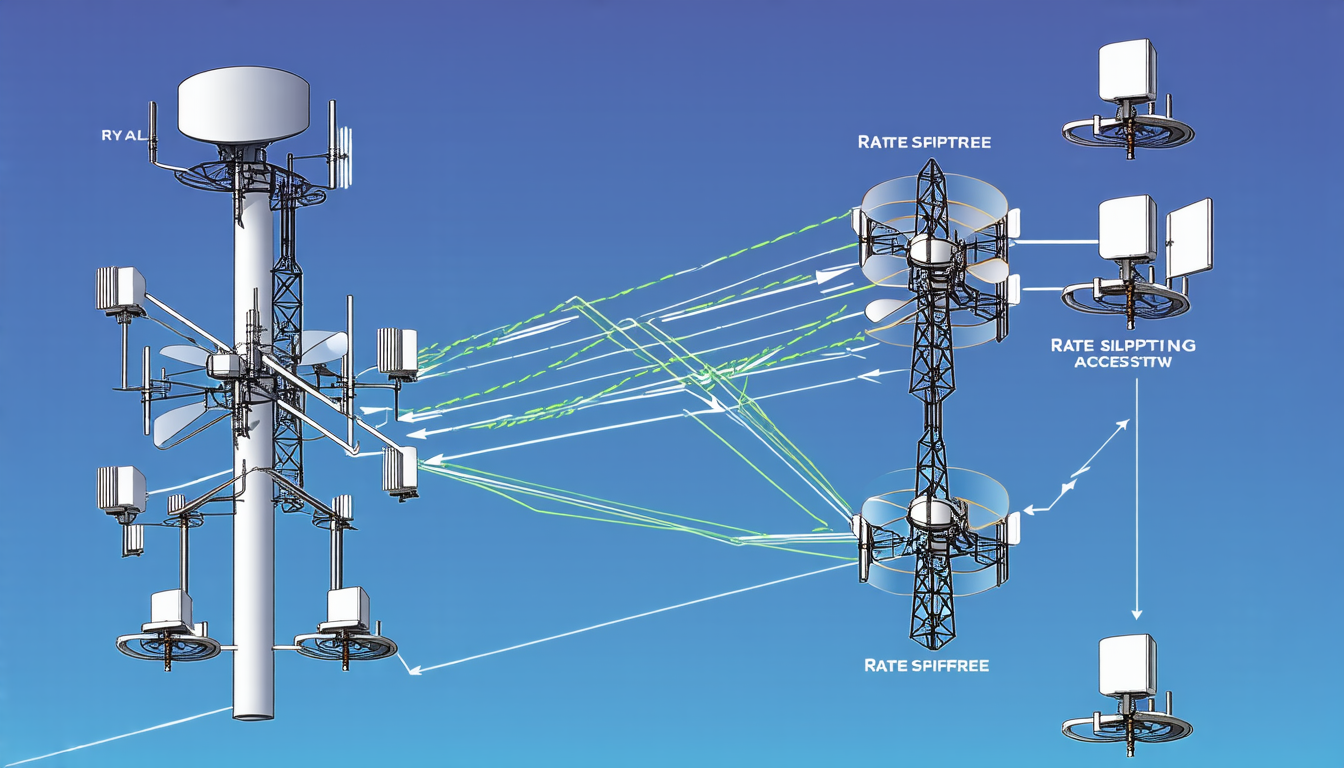
The traditional approach to cellular networks involves a hierarchical structure, where base stations serve specific areas. However, this setup has limitations in terms of capacity and coverage. Cell-free massive MIMO, on the other hand, eliminates the concept of base stations and instead uses a distributed architecture. Each antenna element acts as a transmitter or receiver, creating a massive array of antennas that can serve multiple users simultaneously.
Rate-splitting multiple access is another key technology that enables more efficient use of spectrum. By splitting the data stream into multiple sub-streams and allocating them to different users, RSMA improves spectral efficiency and reduces interference. However, designing an optimal precoder for RSMA-assisted cell-free massive MIMO systems is a complex problem.
The researchers’ algorithm tackles this challenge by employing a three-stage approach. First, they use principal component analysis (PCA) to select the most effective antenna elements for each user. This step ensures that the system focuses on the most important channels and reduces computational complexity.
Next, the algorithm designs precoders using a deep reinforcement learning framework. By training a neural network to optimize the precoder design process, the system learns to adapt to changing channel conditions and user demands. The precoder is then fine-tuned using a second-stage optimization step that takes into account the selected antenna elements.
Finally, the algorithm allocates power to each user based on their specific requirements. This step ensures that each user receives the optimal amount of power needed for reliable communication.
The results of the study demonstrate significant improvements in terms of spectral efficiency and user rates compared to traditional approaches. The algorithm’s ability to adapt to changing conditions and user demands also makes it more robust than previous solutions.
While this research is still in its early stages, it has important implications for the development of next-generation cellular networks. As the demand for mobile data continues to grow, novel technologies like cell-free massive MIMO and RSMA will play a crucial role in meeting that demand. By integrating these technologies with advanced algorithms and machine learning techniques, researchers can develop more efficient, reliable, and scalable communication systems.
Cite this article: “Optimizing Cell-Free Massive MIMO Systems with Rate-Splitting Multiple Access Using Machine Learning”, The Science Archive, 2025.
Cell-Free Massive Mimo, Rate-Splitting Multiple Access, Rsma, Precoder Design, Power Allocation, Antenna Selection, Principal Component Analysis, Deep Reinforcement Learning, Neural Networks, Spectral Efficiency





