

Friday 07 March 2025
Scientists have made a significant breakthrough in understanding the properties of planar graphs, which are diagrams that can be drawn on a flat surface without any lines crossing each other. These graphs have numerous applications in computer science and mathematics, including network design and data visualization.
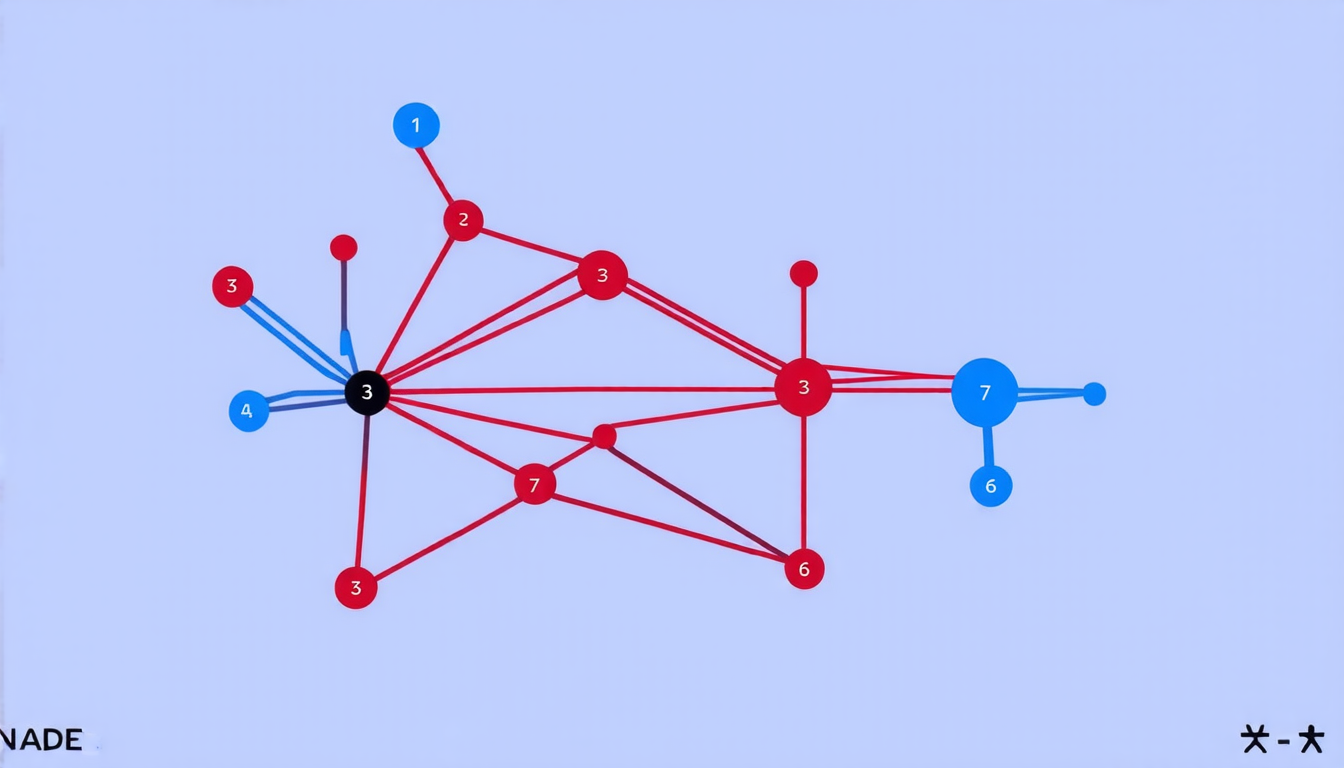
Researchers have long been fascinated by the question of whether it’s possible to color these graphs using just two colors while avoiding certain patterns or cycles. The answer has eluded them until now. A recent study has shown that planar graphs without cycles of length 3, 4, and 6 are actually 2-colorable.
To put this in perspective, think of a graph as a network of connections between different nodes or vertices. In the case of planar graphs, these nodes can be thought of as cities connected by roads on a map. The goal is to color each city with one of two colors, say red and blue, such that no adjacent cities have the same color.
The key challenge lies in avoiding certain patterns or cycles, which are sequences of nodes that form a loop. In this case, the researchers focused on cycles of length 3, 4, and 6, which are particularly important because they can create problems when coloring the graph.
By using a technique called discharging, the scientists were able to show that planar graphs without these specific cycles can be colored with just two colors. This may seem like a simple task, but it’s actually quite complex and requires a deep understanding of mathematical concepts such as graph theory and combinatorics.
The implications of this discovery are far-reaching. For example, it could lead to more efficient algorithms for network design and data visualization, which rely on planar graphs to represent complex systems. Additionally, the study opens up new avenues for research in graph theory and its applications.
One of the most exciting aspects of this breakthrough is that it challenges our current understanding of planar graphs. For years, researchers have believed that certain properties were inherent to these diagrams, but this discovery shows that there may be more flexibility than previously thought.
As scientists continue to explore the properties of planar graphs, they may uncover even more surprising results. The study of graph theory is a rich and dynamic field, and this breakthrough is just one example of how new insights can emerge from careful analysis and innovative thinking.
Cite this article: “Unlocking the Secrets of Planar Graphs”, The Science Archive, 2025.
Planar Graphs, Graph Theory, Combinatorics, Network Design, Data Visualization, 2-Colorability, Discharging, Cycles, Graph Coloring, Mathematics





