

Friday 07 March 2025
The pursuit of understanding the fundamental laws of physics has led researchers to explore the intricacies of gravity and its interactions with other forces. A recent study published in a scientific journal delves into the mysteries of gravitational scattering, shedding light on the behavior of particles as they approach each other.
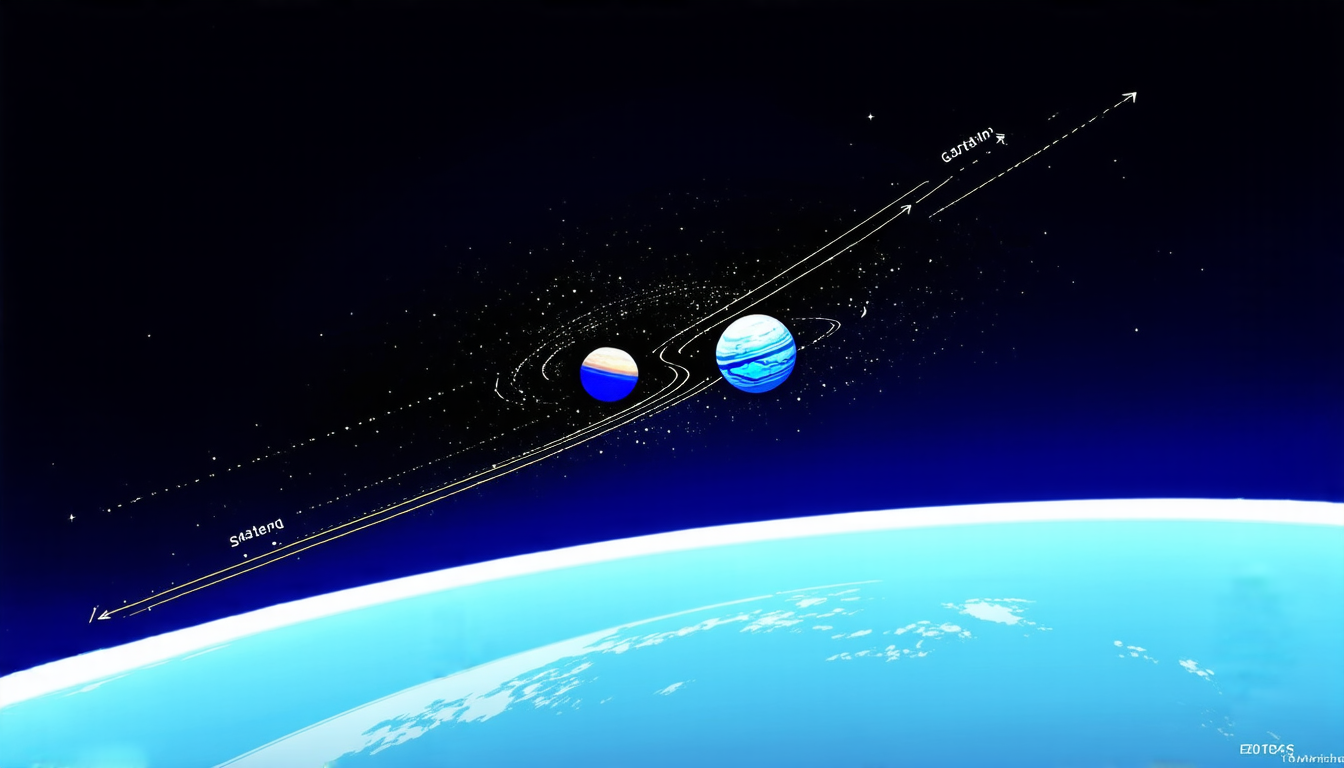
Gravitational scattering refers to the process by which two or more objects interact through gravity, resulting in their trajectories being altered. This phenomenon is crucial for understanding various astrophysical and cosmological phenomena, such as the formation of black holes and the evolution of galaxies. However, the complexity of gravitational interactions has made it challenging to accurately model and predict the outcomes of such encounters.
The study in question focuses on the behavior of particles at null infinity, a mathematical concept that represents the boundary between the observable universe and the infinite expanse beyond. Researchers have long struggled to develop a consistent framework for describing the physics of this region, as traditional methods fail to account for the unique properties of gravity near the event horizon.
To address these challenges, the authors employed a novel approach based on the concept of superrotations. These are hypothetical transformations that describe the symmetry of spacetime and play a crucial role in understanding the behavior of particles at null infinity. By incorporating superrotations into their model, researchers were able to develop a more accurate and comprehensive framework for describing gravitational scattering.
The results of this study have significant implications for our understanding of gravity and its interactions with other forces. The authors demonstrate that the inclusion of superrotations leads to a more precise prediction of particle trajectories during gravitational scattering, which can be used to refine models of astrophysical events such as black hole mergers. Moreover, the framework developed in this study provides a foundation for exploring new areas of research, including the investigation of quantum gravity and the behavior of particles at the event horizon.
The significance of this work lies not only in its theoretical implications but also in its potential practical applications. For instance, the development of more accurate models of gravitational scattering could lead to improved simulations of astrophysical events, allowing scientists to better understand the origins of cosmic phenomena such as gamma-ray bursts and supernovae. Furthermore, the study’s findings may have implications for the design of future gravitational wave detectors, which rely on precise predictions of particle interactions to detect these elusive signals.
In essence, this research represents a major step forward in our understanding of gravity and its role in shaping the universe.
Cite this article: “Unlocking the Secrets of Gravitational Scattering: A Breakthrough in Understanding Gravitys Role in Shaping the Universe”, The Science Archive, 2025.
Gravitational Scattering, Null Infinity, Superrotations, Black Holes, Galaxy Evolution, Astrophysical Phenomena, Gravitational Waves, Quantum Gravity, Event Horizon, Particle Trajectories.
Reference: Shivam Upadhyay, “On symmetries of gravitational on-shell boundary action at null infinity” (2025).





